
Volkswagen Coolant Leak Repair at DART Auto
A customer drove their 2013 Tiguan into our shop last month with a faint sweet smell in the cabin and a coolant warning light that flickered on cold mornings. By the time they arrived, the expansion tank had dropped below minimum twice in three weeks. That's the pattern we see constantly with VW coolant systems – small leaks that seem manageable suddenly become urgent when a plastic flange cracks or a water pump seal gives out completely. Volkswagen cooling systems rely heavily on plastic components that become brittle over time, and the MQB and PQ35 platforms are particularly notorious for coolant flange failures on the cylinder head and thermostat housing. Generic shops often replace the obvious leaking part without pressure-testing the entire system or checking for secondary failure points, which means the car returns in six months with a different leak.
Proper Volkswagen coolant leak repair requires more than swapping a hose. The factory coolant specification – G12, G12+, G13 depending on model year – matters because mixing coolant types causes corrosion and sensor fouling. Our technicians use VCDS and factory scan tools to monitor live coolant temperature data, bleed air from the system correctly, and verify that the auxiliary electric coolant pump cycles properly on turbocharged engines. We follow VW torque specs for aluminum housings to prevent thread damage and use OEM or equivalent gaskets that match the thermal expansion rates of the engine block.
When you bring your Volkswagen to DART Auto for coolant leak repair, you can expect:
- Complete pressure testing of the cooling system to identify all leak points, not just the most visible one
- Inspection of common failure components – coolant flanges, thermostat housings, expansion tanks, and water pump seals
- Proper coolant fill and bleeding procedures using factory methods to prevent air pockets and overheating
- Post-repair verification with scan tool monitoring to confirm stable operating temperatures and proper sensor readings
Common Coolant Leak Repair Issues on Volkswagen Vehicles
A customer brought in a 2013 Jetta TDI last month with a puddle under the car every morning. The culprit? A cracked plastic coolant flange – a failure so predictable on EA288 diesels that experienced techs check it during every inspection. Volkswagen coolant leaks rarely announce themselves with drama; they start as slow seeps that owners dismiss until the low-coolant light flashes or the temperature needle climbs into the red during a commute.
- Plastic coolant flanges (2009–2019 models, especially EA888 and EA288 engines): VW used plastic thermostat housings and coolant flanges across the MQB platform and earlier PQ35/PQ46 chassis. Heat cycling causes the plastic to become brittle, leading to hairline cracks around bolt holes or outlet ports. The EA888 Gen3 (2012–present) is notorious for rear coolant flange failures that require intake manifold removal to access.
- Water pump failures (B5/B6 Passat 1.8T, Mk4/Mk5 Golf/Jetta 2.0L): The plastic impeller separates from the metal shaft, or the pump housing cracks at the mounting flange. On timing-belt-driven pumps (like the 2.0L AEG/AVH), a leaking pump can contaminate the timing belt and cause catastrophic engine damage if the belt slips.
- Expansion tank cracks (all models, 2005–2015 especially): The pressurized reservoir develops stress cracks along seams or mounting tabs. Mk5 and Mk6 platforms see this frequently after 80,000 miles. The tank sits near the engine bay's hot side, accelerating degradation.
- Heater core pinhole leaks (B5.5 Passat, Mk4 platform): Corroded heater cores drip coolant onto the passenger-side carpet. Owners often mistake the sweet smell and wet floor for a clogged sunroof drain until the windshield fogs persistently.
- Radiator end-tank separation (2011–2018 models with plastic end tanks): The crimped joint between aluminum core and plastic tanks fails under pressure. This is common on Tiguan, Passat, and CC models that tow or operate in stop-and-go traffic with the A/C running.
- EGR cooler leaks (TDI models, 2009–2015): Exhaust gas recirculation coolers develop internal coolant leaks that contaminate the intake system with coolant vapor. This causes white smoke, rough idle, and misfires before external coolant loss becomes obvious.
Why Choose DART Auto for Volkswagen Coolant Leak Repair
A customer arrived last month with a 2014 Passat TDI, complaining of a sweet smell and a puddle under the car every morning. The dealership quoted her over $1,400 for a thermostat housing and water pump. We diagnosed it in under an hour: a cracked expansion tank – a known weak point on EA288 diesels – and a loose hose clamp at the EGR cooler. Total repair was less than half the dealer estimate, and we caught an unrelated coolant temperature sensor drift that would have triggered limp mode within weeks.
That story captures what sets DART Auto apart for Volkswagen coolant leak work:
- Platform-specific diagnostics: We use VCDS and factory-level scan tools to pressure-test the system, read live coolant temps at multiple sensors, and cross-reference TSBs for your chassis code – whether it's an EA888 Gen3 with a leaky coolant flange on 2015+ models or a VR6 with the infamous thermostat housing crack.
- Master technicians with dealer training: Our salaried techs average over a decade of European experience and aren't incentivized to upsell – they diagnose the actual failure, not the most profitable one.
- Complete system verification: After the repair, we pressure-test again, road-test to operating temperature, and verify coolant flow with live data to confirm the fix holds under real-world conditions.
We've been Denver's European specialists since 2000, and every repair is backed by a 3-year/36,000-mile warranty on parts and labor.
Symptoms – How to Know You Need This Service
Volkswagen coolant leaks often announce themselves gradually, then escalate quickly. You may notice:
- Sweet smell in the cabin or under the hood – ethylene glycol has a distinct sugary odor that's especially noticeable after the engine has been running
- Coolant warning light or low coolant message on the instrument cluster – VW systems are sensitive and will alert you early, often before you see visible leaks
- Visible puddles or drips under the car – usually bright green, pink, or orange depending on coolant type; often appears near the front of the engine bay or below the water pump
- White or light-colored residue on engine components – dried coolant leaves crusty deposits around hoses, flanges, and the expansion tank cap
- Engine temperature climbing higher than normal – even a small leak can introduce air into the system and cause erratic temperature swings
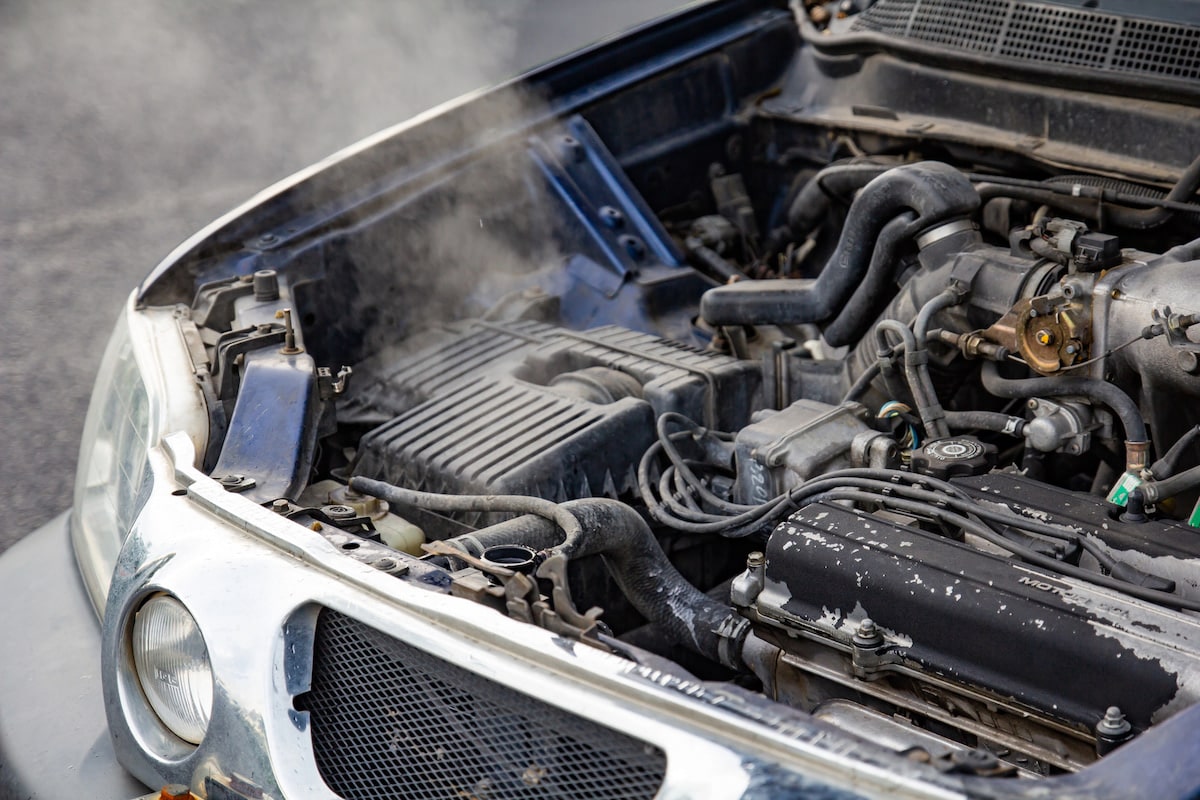
- Steam or vapor from under the hood – this means coolant is hitting hot exhaust components; if you see this, pull over safely and shut off the engine immediately
- Heater blowing cold air intermittently – air pockets from leaks prevent hot coolant from reaching the heater core
- Expansion tank level dropping repeatedly – if you're adding coolant more than once every few months, you have a leak that needs diagnosis
If your temperature gauge climbs into the red zone or you see steam, stop driving immediately to avoid head gasket damage or warped cylinder heads. For other symptoms, schedule an inspection soon – small leaks become expensive repairs when ignored.
Which Volkswagen Models We See for Coolant Leak Repair
We diagnose and repair coolant leaks across the full Volkswagen lineup, with particularly frequent visits from vehicles on the MQB, PQ35, and PQ46 platforms where plastic coolant components age poorly. The work varies significantly depending on engine family – EA888 turbocharged engines have different failure points than naturally aspirated EA113 or TDI engines.
Models we commonly service for coolant leak repair include:
- Golf / GTI / Golf R – Mk5 through Mk8 (2006–present), especially 2008–2014 Mk6 with EA888 Gen2 engines prone to coolant flange and thermostat housing leaks
- Jetta – Mk5 and Mk6 (2005–2018), including TDI variants where EGR cooler leaks are common
- Passat – B6, B7, and B8 generations (2006–present), both 2.0T and VR6 engines; NMS (North American) Passat from 2012–2019
- Tiguan – first-generation (2009–2017) and second-generation MQB (2018–present); first-gen models frequently develop water pump and coolant flange leaks after 80,000 miles
- Atlas – 2018–present, VR6 and 2.0T variants; expansion tank caps and hose connections are common failure points
- CC – 2009–2017, shares platform and cooling system issues with B6/B7 Passat
- Beetle – 2012–2019 (A5 platform), 2.0T and TDI engines
- Eos – 2007–2016, 2.0T engines with thermostat housing and water pump seal issues
- Touareg – second and third generation (2011–present), including V6 TDI and VR6 engines; auxiliary coolant pumps fail frequently on turbocharged models
We service both manual and DSG-equipped vehicles. Coolant leak repair procedures are largely similar across transmissions, though DSG models require careful attention to transmission cooler lines. If you drive an older Mk4 or earlier air-cooled model, call us first – we focus our tooling and training on 2005-and-newer water-cooled platforms where we see the highest volume.
Causes & Risks – What Happens if Ignored
Volkswagen's shift to lightweight plastic cooling components reduced manufacturing costs but introduced predictable failure modes tied to heat cycling and age. Denver's temperature swings – freezing overnight, then climbing into the 80s by afternoon – accelerate thermal fatigue in these parts. Mix in high-mileage stop-and-go driving, deferred coolant changes that leave acidic fluid eating at aluminum and plastic, and you have a recipe for leaks that start small but cascade quickly.
Ignoring a slow coolant leak for even two weeks can turn a $400 flange replacement into a $3,500 head gasket job. Here's the escalation path:
- Weeks 1–2: Small drips cause coolant level to drop below the sensor threshold. The engine runs slightly hotter than normal, but the gauge stays in range. Owners top off the reservoir and assume the problem is solved.
- Weeks 3–4: Air pockets form in the cooling system. The heater blows cold at idle. The temperature gauge swings erratically because the sensor reads air instead of coolant. Cylinder head temperatures climb unevenly, warping the aluminum.
- Month 2: Head gasket begins to fail at the hottest cylinder (usually #4 on inline-four engines). Combustion gases pressurize the cooling system, blowing coolant out of the expansion tank cap. White exhaust smoke appears. Mixing coolant and oil turns the dipstick milky.
- Month 3+: Severe overheating warps the cylinder head beyond machining limits. The engine needs a replacement head, new gaskets, resurfaced block, and often a new turbocharger (if exhaust temps spiked high enough to damage the turbine bearings). Total repair cost exceeds the value of many older Volkswagens.
On turbocharged models, a failing water pump that leaks coolant into the timing belt cover can soak the belt, causing it to slip and shear valves into pistons – an interference-engine nightmare that totals the powertrain.
Safety Impact – Why Coolant Leak Repair Matters
A catastrophic coolant loss while driving doesn't just strand you – it creates immediate hazards. When a radiator end tank blows apart on the highway, the engine loses all coolant in seconds. The temperature skyrockets, and within two miles the aluminum cylinder head begins to warp. Power steering (electric on most modern VWs, but hydraulic on older models) can fail if the serpentine belt starts slipping from coolant spray. Suddenly you're fighting a heavy steering wheel in traffic with an engine that's seizing.
Specific safety risks by failure mode:
- Stop driving immediately: Temperature gauge in the red zone, steam pouring from under the hood, loss of power accompanied by knocking sounds, sweet coolant smell inside the cabin with wet carpet (heater core leak filling the footwell and fogging windows).
- Schedule within 48 hours: Visible coolant puddles under the car, low-coolant warning light illuminated, heater blowing cold at idle, slight temperature gauge fluctuations during highway driving.
- Address within two weeks: Coolant level dropping slowly with no visible external leak (may indicate EGR cooler or head gasket weep), faint sweet smell near the engine bay after driving, minor coolant residue on hoses or flanges.
Insurance adjusters scrutinize maintenance records after accidents. If an overheated engine caused a loss-of-control incident and service records show ignored coolant warnings, liability questions arise.
How Volkswagen Coolant Leak Repair Actually Works
Volkswagen cooling systems are pressurized to roughly 20 psi, raising the boiling point of the coolant to around 265°F. This allows the engine to run hotter for efficiency and emissions compliance. The expansion tank acts as both a reservoir and a pressure regulator; its cap contains a spring-loaded valve that vents excess pressure above the setpoint. Coolant circulates through the engine block, cylinder head, turbocharger (if equipped), heater core, and radiator in a continuous loop driven by an electric or belt-driven water pump.
What makes Volkswagen repairs distinct:
- Air-bleeding procedure: VW systems trap air easily. After any cooling system repair, techs must follow a specific bleeding sequence – often running the engine at 2,000 RPM with the heater on full blast while repeatedly squeezing the upper radiator hose to purge air pockets. Skipping this causes overheating and comebacks.
- G12/G13 coolant specification: VW requires specific silicate-free coolant formulations (pink or purple G12++ or G13). Mixing green universal coolant causes precipitation that clogs heater cores and radiators. We stock OEM-spec coolant and flush the system completely during repairs.
- Torque-to-yield fasteners: Many coolant flanges and thermostat housings use single-use bolts that stretch during installation. Reusing them leads to leaks. We replace all fasteners per VW repair procedures.
- Plastic component replacement philosophy: If one plastic flange has failed, others of the same age are near failure. Experienced techs recommend replacing the entire thermostat housing assembly, not just the leaking o-ring, to avoid a comeback three months later when the next weak point cracks.
Repairing a rear coolant flange on an EA888 Gen3 requires removing the intake manifold, disconnecting fuel lines, and accessing the back of the cylinder head in a cramped space. This isn't a quick roadside fix – it's precision work that demands factory repair information, proper
How We Diagnose Coolant Leak Repair Issues on Volkswagen
Last month, a customer brought in a 2014 Tiguan with a persistent sweet smell and a coolant warning light that flickered on during highway drives. She'd topped off the reservoir twice in three weeks but couldn't see any puddles. That's the challenge with Volkswagen coolant leaks – they often hide behind plastic covers or evaporate off hot exhaust components before leaving evidence on the ground.
Our diagnostic process follows a structured path that combines factory-level scan tools with hands-on inspection:
- VCDS or VAS scan: We connect factory-grade diagnostic equipment to pull stored fault codes and live data from the engine control module, checking for coolant temperature anomalies, thermostat performance outside normal parameters, and any history of overheating events that might point to pressure loss.
- Pressure test the system: With the engine cold, we pressurize the cooling system to 20-22 psi and watch for pressure drop over ten minutes. This reveals leaks that only occur under operating pressure, not just gravity drips.
- UV dye injection and inspection: We add fluorescent dye to the coolant and run the engine through heat cycles, then use a UV light to trace even microscopic seepage paths. Common culprits on EA888 Gen3 engines include the water pump weep hole, thermostat housing O-rings, and the plastic coolant flange that cracks on 2012-2018 Passat and GTI models.
- Visual inspection of hoses and connections: We check every hose end, especially the lower radiator hose connection that sees heat cycling stress, and inspect the expansion tank for stress cracks near the mounting tabs – a known weak point on MQB-platform vehicles.
- Combustion leak test: If we suspect head gasket involvement, we use a block tester to check for exhaust gases in the coolant, particularly on 2.0T engines that have seen overheating or have high mileage.
Once we've pinpointed the source, we document our findings with photos and translate the diagnosis into a clear repair plan with a written estimate that explains exactly what failed, why it matters, and what we'll do to fix it.
Coolant Leak Repair on Volkswagen: Repair vs. Replacement
The repair-versus-replacement decision depends on what's actually leaking and how far the damage has progressed.
True repair situations are rare but do exist. If we catch a weeping thermostat housing early, sometimes cleaning the mating surfaces and installing new O-rings with proper torque (10 Nm on most housings, following factory spec) solves the problem. Hose clamps can be repositioned or upgraded to constant-tension clamps that compensate for thermal expansion. These repairs work when the underlying components haven't degraded.
Partial replacement makes sense in most leak scenarios:
- Replacing the plastic coolant flange on EA888 engines while keeping the existing hoses and radiator
- Installing a new water pump when the weep hole shows seepage but the thermostat and hoses are still good
- Swapping out a cracked expansion tank (common on 2010-2014 Jetta and Golf) without touching the rest of the system
- Replacing corroded heater core hoses at the firewall connections while the core itself remains sound
Full system replacement becomes necessary when multiple components have reached end-of-life simultaneously – often seen on vehicles past 120,000 miles where hoses have hardened, the radiator shows internal corrosion, and the water pump bearings are noisy. At that point, replacing everything as an assembly prevents comebacks and gives you years of reliable service.
We walk you through what we found during diagnosis, explain the service life remaining in adjacent components, and present options at different price points. Our technicians are salaried, not flat-rate, so there's no incentive to oversell. We recommend what we'd do on our own vehicles.
How to Make Your Volkswagen Coolant Leak Repair Last Longer
After we've fixed the leak, a few habits will help you get maximum life from the new components.
Driving habits that matter:
- Allow 60-90 seconds of idle time before driving in freezing weather – cold starts stress plastic components that contract overnight
- Avoid lugging the engine below 1,500 rpm under load, which creates combustion pressure spikes that stress head gasket sealing surfaces
- Let the engine reach operating temperature before sustained high-speed driving; the thermostat needs to open fully to establish proper flow
- In stop-and-go traffic during summer heat, keep an eye on the temperature gauge and turn on the heater if it climbs above normal – it buys time before pulling over
Owner maintenance you can handle safely:
- Check coolant level in the expansion tank weekly during the first month after repair, then monthly thereafter – catch any new seepage early
- Look for new stains on your parking spot and sniff for sweet coolant smell when opening the hood
- Watch for steam from the hood or coolant warning lights, and shut down immediately if the temperature gauge spikes
Volkswagen-specific care: Use only G12evo (pink) or G13 (purple) coolant approved to VW TL 774-J or TL 774-L specifications. Generic "universal" coolant lacks the corrosion inhibitors that protect aluminum components in VAG cooling systems. Follow the 60,000-mile coolant change interval religiously – old coolant becomes acidic and eats through aluminum housings from the inside. Keep your software updated at service intervals; revised thermostat control maps in ECU updates have fixed premature wear issues on some model years.
Leave pressure testing, thermostat replacement, and anything involving the cylinder head to the shop – these require specialized tools and torque specifications that vary by engine code. Attempting coolant flange removal without the proper crowfoot wrench and angle gauge can strip aluminum threads that cost hundreds to repair.
What to Expect When You Bring Your Volkswagen In
We know coolant leaks can feel unpredictable – one day it's a small drip, the next you're watching the temperature gauge climb. Here's exactly how we handle your visit, start to finish:
- Drop-off and intake: Schedule an appointment or use our early drop-off if you need to leave the car before we open. Remove valuables; we'll secure your keys and document your concern in detail.
- Pressure test and visual inspection: We pressurize the cooling system with the engine cold, then inspect hoses, flanges, the expansion tank, water pump weep hole, and heater core connections. On turbocharged models, we check the turbo coolant lines and EGR cooler – both common leak sources on TSI/TDI engines.
- Written estimate and communication: You'll receive a detailed estimate with photos of the failed part and an explanation of what happens if you delay the repair. We never start work without your approval.
- Repair and post-repair verification: Once approved, we replace the faulty component using OEM or premium aftermarket parts, bleed the system per factory procedure, and road-test to full operating temperature while monitoring coolant temps with live data.
- Pickup walkthrough: At pickup, we'll show you the old part, explain what failed, and review the warranty. If you notice anything unusual in the days after – temperature fluctuation, residual smell – call us immediately; we'll recheck at no charge.
Loaner vehicles and shuttle service are available on a first-come basis for longer repairs. After-hours pickup can be arranged if your schedule requires it.
Our Volkswagen Services
- Air Conditioning AC Repair
- Battery Repair Replacement
- Brake Repair & Brake Fluid Change
- Check Engine Light Diagnostics
- Clutch Repair & Replacement
- Cooling System Repair
- Drive Shaft Repair
- Engine Repair
- Exhaust & Catalytic Converter Repair
- Head Gasket Repair & Replacement
- Oil Change
- Oil Leak Repair
- Scheduled Service Maintenance
- Steering Repair
- Suspension Repair
- Cambelt Timing Belt Replacement
- Transmission Repair
- Tune Up
- Wheel Alignment