
Ferrari Coolant Leak Repair at DART Auto
Ferrari cooling systems operate under precise thermal management parameters that generic shops routinely overlook. The F136, F140, and F154 powerplants rely on dual-zone cooling circuits with electronically controlled thermostats and flow-regulated pumps that communicate constantly with the Bosch ME7 or Marelli ECU. When coolant leaks develop, many shops treat it like any other car – swap a hose, top off the fluid, send you on your way. That approach fails spectacularly on Ferrari platforms where air pockets trigger limp mode, incorrect bleed procedures warp cylinder heads, and using non-OEM coolant chemistries corrode aluminum components within months.
We see common failure points on 2004–2009 F430 platforms where the lower radiator hose connection to the thermostat housing cracks from heat cycling, and 2009–2014 California models where the coolant expansion tank develops stress fractures near the mounting tabs. The 458 Italia and Speciale (2010–2015) frequently present with water pump weep hole seepage from bearing seal degradation around 25,000 miles. Proper repair demands factory bleed procedures using Leonardo diagnostic software to command pump activation sequences and monitor individual sensor readings during refill – equipment and knowledge dealerships have and most independents don't.
When you bring your Ferrari to DART Auto for coolant leak repair, expect:
- Pressure testing of the entire cooling circuit to isolate the exact leak source, not just the visible puddle
- Leonardo or SD2/SD3 diagnostic scans to verify thermostat operation, pump duty cycles, and sensor accuracy before and after repair
- OEM-spec Agip Antifreeze or Shell Premium coolant with proper inhibitor packages for aluminum Ferrari blocks
- Factory vacuum-fill and bleed procedures with ECU-commanded pump cycling to eliminate air pockets that cause overheating and head gasket failure
Common Coolant Leak Repair Issues on Ferrari Vehicles
Ferrari coolant systems operate under extreme thermal stress, and platform-specific design choices mean certain leak points appear with predictable regularity. Spotting these early – before catastrophic overheating – separates a straightforward repair from a five-figure engine rebuild.
- F430 (2005–2009) and 360 Modena (1999–2005) header tank cracking: The plastic expansion tanks on these models develop stress fractures at mounting points and seams, especially after heat cycles above 220°F. The tank sits near the rear firewall, making visual inspection difficult until coolant stains appear on the undertray.
- 458 Italia and 488 GTB radiator end-tank seepage: High-pressure aluminum-to-plastic crimp joints on the side radiators weaken over time. Early symptoms include a sweet smell from the side vents and minor coolant loss between services. Left unchecked, the crimp fails completely, dumping coolant onto hot exhaust components.
- California and Portofino water pump weep-hole leaks: The front-mounted water pump uses a ceramic seal that wears from cavitation and impeller imbalance. A small drip from the weep hole is the design's early-warning system, but many owners ignore it until the bearing seizes and shreds the serpentine belt.
- 599 GTB and F12 Berlinetta thermostat housing O-ring degradation: The aluminum thermostat housing uses stacked O-rings that harden from repeated thermal cycling. Coolant seeps past the rings, pooling on the lower engine valley and evaporating on hot surfaces, often mistaken for an oil leak until the system loses pressure.
- 812 Superfast and SF90 Stradale quick-disconnect fittings: Newer models use push-to-connect coolant couplings with internal locking tabs. Vibration and thermal expansion cause the tabs to fatigue, resulting in slow leaks that only appear when the system is hot and pressurized – invisible during cold inspections.
- All V8 and V12 models – cylinder head gasket micro-leaks: Ferrari's flat-plane V8s and 65-degree V12s generate extreme combustion pressures. Head gaskets can weep coolant externally at the deck surface or internally into the oil passages, causing milky oil and steam from the exhaust before visible external leaks appear.
Why Choose DART Auto for Ferrari Coolant Leak Repair
Ferrari coolant systems demand precision. The F430 and 360 Modena platforms are notorious for radiator end-tank failures – the plastic tanks crack along the crimp seams, often before 30,000 miles. The 458 Italia and California models suffer from expansion tank leaks where the sensor grommet hardens and splits. Generic shops treat these as simple hose-and-clamp jobs, but Ferrari's pressurized systems require bleed procedures that prevent airlocks in the flat-plane V8 cylinder heads. Miss a bleed step and you'll overheat the engine within miles.
DART's master technicians use Leonardo diagnostic software – the same platform Ferrari dealerships rely on – to verify thermostat operation, monitor coolant temperature sensors across all banks, and confirm the bleed cycle completes properly. We stock OEM Behr radiators and Genuine Ferrari expansion tanks because aftermarket alternatives fail within a year on these high-heat applications. Our salaried compensation model means no technician rushes through the multi-stage bleed procedure to chase the next flat-rate ticket.
- Platform-specific leak diagnosis: Pressure testing with Ferrari-specific adapters that seal properly on quick-disconnect fittings
- TSB familiarity: We track Ferrari's service bulletins on coolant hose routing changes and updated clamp torque specs for 2010–2015 California models
- Post-repair verification: Road test with live data monitoring to confirm operating temperatures stay within 185–205°F under load
- 3-year/36,000-mile warranty: Parts and labor coverage that reflects our confidence in OEM components and proper installation
Symptoms – How to Know You Need This Service
Ferrari coolant leaks often announce themselves subtly before becoming catastrophic. You may notice:
- Sweet smell in the cabin or near the engine bay – ethylene glycol has a distinct maple syrup odor that intensifies when the engine reaches operating temperature
- Coolant puddles under the car after parking – bright green, orange, or pink fluid pooling beneath the engine or front trunk area, often more visible on cold mornings
- Low coolant warning on the instrument cluster – the yellow reservoir icon illuminates when fluid drops below the minimum sensor, sometimes intermittently during hard cornering before becoming constant
- Temperature gauge climbing higher than normal – needle moving past the usual midpoint position, especially during spirited driving or in traffic
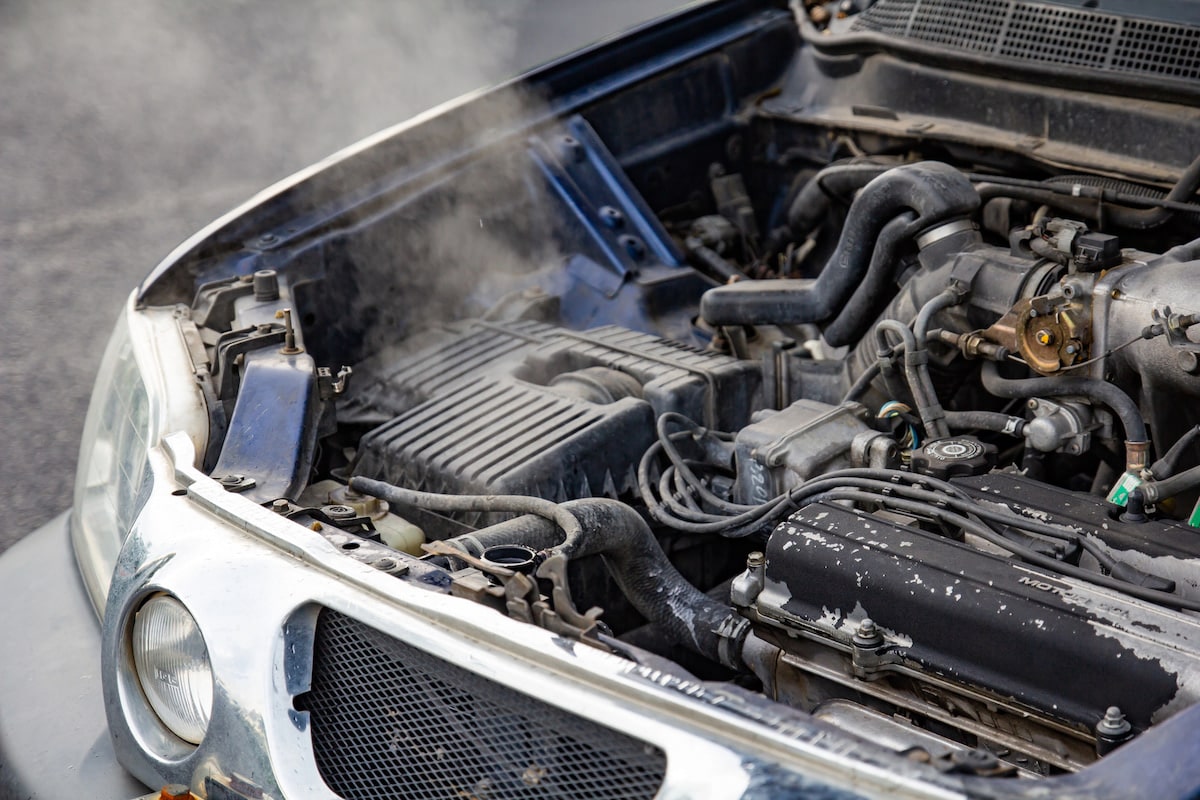
- White steam from the engine bay – visible vapor escaping near the firewall or wheel wells when coolant contacts hot exhaust components
- Reduced heater performance – cabin heat output drops noticeably because air pockets in the system prevent proper heat exchanger flow
- Visible coolant residue on hoses or components – crusty white or green deposits around connections, the expansion tank, or water pump housing
- Engine misfires or rough idle after sitting – coolant seeping into cylinders overnight causes stumbling on cold starts
If the temperature gauge enters the red zone or you see steam billowing from vents, stop driving immediately and arrange flatbed transport. Continuing to operate a Ferrari with severe coolant loss warps heads and destroys engines in minutes.
Which Ferrari Models We See for Coolant Leak Repair
We regularly service coolant system repairs across modern Ferrari platforms, with particular familiarity in the following models and their common failure modes:
- 360 Modena and Spider (1999–2005, F131 chassis) – radiator end tank splitting, thermostat housing gasket weepage, expansion tank cap failures on both manual and F1 gated transmissions
- F430 and Scuderia (2004–2009, F136 V8) – lower radiator hose connection cracks, water pump seal deterioration, coolant reservoir mounting tab fractures affecting both Berlinetta and Spider variants
- California and California T (2008–2017, F149/F154 V8) – expansion tank stress cracks, thermostat housing leaks, radiator support bracket corrosion on both hardtop convertible generations
- 458 Italia, Spider, and Speciale (2010–2015, F136 V8) – water pump weep hole seepage, radiator side tank separation, coolant pipe O-ring failures common across all body styles
- 488 GTB and Spider (2015–2019, F154 twin-turbo V8) – intercooler coolant circuit leaks, turbocharger coolant feed line failures, expansion tank cap pressure loss
- F12 Berlinetta and TDF (2012–2017, F140 V12) – front radiator hose degradation, thermostat actuator coolant seepage, auxiliary coolant pump failures
- GTC4Lusso (2016–2020, F140 V12) – all-wheel-drive front differential cooler line leaks, expansion tank mounting failures unique to the shooting brake platform
Earlier models including the 550 Maranello, 575M, and 612 Scaglietti occasionally come through our shop, though parts availability and diagnostic software compatibility require advance consultation for pre-2004 platforms.
Causes & Risks – What Happens if Ignored
Coolant leaks on Ferrari vehicles stem from the brand's performance-first engineering: high compression ratios, lightweight materials, and cooling systems pushed to their thermal limits. The plastic components Ferrari specifies are chosen for weight savings, but they age poorly in Denver's temperature swings and UV exposure. Aluminum-to-plastic joints experience differential expansion rates, weakening crimp seals and O-ring grooves. Track use accelerates the process – sustained high RPM and brake heat soak the engine bay, cycling coolant temperatures between 180°F and 240°F within minutes.
What begins as a few drops under the car escalates quickly. Here's the typical progression when a Ferrari coolant leak goes unaddressed:
- Weeks 1–3: Minor coolant loss requires topping off between drives. The engine runs slightly hotter than normal, especially in traffic. No warning lights yet, but the gauge creeps toward the upper range.
- Weeks 4–8: The leak grows as pressure cycling enlarges cracks or loosens fittings. The cooling system can no longer maintain stable temperatures under load. The ECU begins pulling timing to prevent detonation, robbing power and responsiveness.
- Weeks 9–12: Coolant level drops below the pump inlet, introducing air into the system. Localized hot spots form in the cylinder heads. The temperature warning illuminates intermittently, then stays on. Continued driving risks warping the heads or cracking the block.
- Beyond 12 weeks: Catastrophic overheating warps aluminum heads, blows head gaskets, or cracks cylinder liners. What started as a $600 hose or $1,200 radiator repair becomes a $15,000–$35,000 engine-out rebuild. Resale value plummets when service records show overheating events.
The cost dimension is straightforward – every week of delay multiplies the repair scope. The safety dimension is equally serious: a sudden coolant loss at highway speed can seize the engine, eliminating power steering and brake assist while the car is still moving.
Safety Impact – Why Coolant Leak Repair Matters
Ferrari coolant leaks create immediate safety hazards beyond the engine damage. When coolant sprays onto hot exhaust manifolds or turbochargers, it vaporizes into dense white smoke that obscures the driver's vision and panics surrounding traffic. The sweet-smelling vapor entering the cabin through the HVAC system can cause dizziness and impaired reaction time. More critically, a sudden loss of coolant at operating temperature can seize the engine mid-corner or during a highway merge, instantly cutting power steering assist and leaving the driver wrestling an unresponsive wheel.
Specific failure modes that escalate risk:
- Stop driving immediately: Temperature gauge in the red zone, steam from hood vents, loss of power with warning lights, sweet smell inside the cabin with reduced visibility, grinding or knocking sounds from the engine bay.
- Schedule service within 48 hours: Coolant puddles under the car after overnight parking, fluctuating temperature gauge during normal driving, intermittent low-coolant warning, visible stains on undertray or wheel wells.
- Monitor closely and book within two weeks: Slow coolant loss requiring top-off every 500 miles, slight coolant smell when the engine is hot, minor seepage visible during cold inspection.
Insurance and liability concerns come into play when a known coolant leak causes an accident. If service records show repeated low-coolant warnings that were ignored, and the resulting engine seizure contributes to a collision, both insurance claims and legal liability become complicated. Ferrari's onboard diagnostics log every overheat event with timestamps – data that surfaces during post-accident investigations.
How Ferrari Coolant Leak Repair Actually Works
Ferrari cooling systems use a pressurized, closed-loop design with a front-mounted radiator (or dual side radiators on mid-engine models), an electric water pump, and an electronically controlled thermostat. Unlike simpler vehicles where coolant flows passively, Ferrari's system actively modulates flow based on engine load, oil temperature, and intake air temperature. The ECU commands pump speed and thermostat position to maintain precise coolant temps – typically 190–205°F at cruise, spiking to 220°F under hard acceleration. This active management requires OEM diagnostic software to verify proper operation after any cooling system work.
Ferrari-specific design choices that affect repair procedures:
- Aluminum block and head construction: Torque specifications for coolant fittings and thermostat housings are critical. Over-torquing strips threads in soft aluminum; under-torquing allows leaks. Ferrari specifies torque-to-yield bolts in many locations, requiring replacement rather than reuse.
- Bleed screw locations and sequence: Ferrari V8 and V12 engines have multiple bleed points – often five or more – that must be opened in a specific sequence while filling. Missing a bleed screw traps air pockets that cause localized overheating and false temperature readings.
- Proprietary coolant formulation: Ferrari specifies a long-life coolant with specific corrosion inhibitors for aluminum and magnesium alloys. Mixing generic coolant creates galvanic corrosion that eats through radiator tubes and pump housings within months.
- Electronic pump calibration: After replacing the water pump or bleeding the system, the ECU must relearn pump flow rates using factory diagnostic tools. Without this step, the pump may cavitate or fail to deliver adequate flow at high RPM.
- Pressure testing requirements: Ferrari cooling systems operate at 18–22 PSI. Proper diagnosis requires pressure-testing the cold system, heat-cycling the engine, then pressure-testing again. Many leaks only appear when components expand under heat.
The combination of exotic materials, active electronic control, and extreme operating conditions means Ferrari coolant repairs demand factory-level tooling and training.
How We Diagnose Coolant Leak Repair Issues on Ferrari
Ferrari coolant systems run at elevated pressures and temperatures compared to everyday vehicles, and the F430/458/488 platforms share a common weak point: coolant header tanks crack from heat cycling, while older 360 Modena and 550 Maranello models suffer from corroded aluminum fittings where dissimilar metals meet. Generic shops miss these nuances; we start every coolant leak diagnosis with Ferrari-specific knowledge baked in.
- Pressure test the system cold and hot. We use a dedicated pressure tester calibrated to Ferrari's higher operating range (typically 1.4–1.8 bar). Many leaks only appear when the engine reaches operating temperature, so we cycle the car through heat to expose intermittent failures.
- Scan with Leonardo or equivalent Ferrari diagnostic platform. The ECU and body control modules log coolant temperature anomalies, low-level warnings, and thermostat fault codes that point us toward specific circuit failures before we even open the hood.
- Inspect the entire coolant path visually. We trace every hose, clamp, and junction from the radiators (left and right on mid-engine cars) back to the expansion tank, checking for weeping at the water pump gasket, cracked quick-disconnect fittings, and staining around the cylinder head outlets.
- Dye test when the leak is elusive. UV-reactive dye circulated through the system reveals hairline cracks in plastic components and seepage at gasket interfaces that pressure alone won't expose.
- Document findings with photos and fluid analysis. If we see oil contamination in the coolant or vice versa, we flag the head gasket or oil cooler as the culprit and outline next steps.
Once the diagnostic is complete, you receive a detailed quote that separates the failed component from any recommended preventive work. No guessing, no upselling parts that still have life left.
Coolant Leak Repair on Ferrari: Repair vs. Replacement
Deciding between repair and replacement hinges on the component's condition and the cost-benefit of keeping the original part in service. Here's how we approach each scenario:
When Repair Makes Sense
- Loose or corroded hose clamps. Factory spring clamps on 360/430-era cars lose tension over time. Replacing the clamp and cleaning the mating surface solves the leak without touching the hose itself.
- Repairable fittings and unions. Aluminum coolant pipes on the 456 GT and 550 Maranello can be re-sealed if the flange face is still flat and the O-ring groove is undamaged. We machine the surface true, install a new OEM seal, and torque to spec.
- Thermostat housing gaskets. If the housing casting is intact and the bolt holes aren't stripped, a new gasket and proper torque sequence restore the seal without the expense of a new housing.
When Partial or Full Replacement Is the Right Call
- Cracked expansion tanks. Plastic header tanks on F430, 458, and California models develop stress cracks that cannot be reliably repaired. We replace the tank with an OEM or upgraded aluminum unit.
- Corroded radiator end tanks. If the core is still good but the plastic end tank has failed, some radiators allow tank replacement. More often, the labor to swap tanks approaches the cost of a complete radiator, so we replace the assembly.
- Water pump seal failure. When the mechanical seal weeps, the entire pump comes out. On timing-belt-driven pumps (360, 430), we replace the pump and belt together to avoid returning for the same labor twice.
We walk you through the trade-offs and show you the failed part so you understand why replacement is the safer, more cost-effective path forward.
How to Make Your Ferrari Coolant Leak Repair Last Longer
Once the leak is fixed, a few deliberate habits keep your coolant system healthy for the long haul. Ferrari engines generate serious heat, and the cooling system components age faster when subjected to thermal shock and neglect.
Driving Habits That Protect the System
- Warm up before spirited driving. Let the engine reach operating temperature (around 180–200°F) before demanding full power. Cold starts followed by immediate high RPM cycling stress hoses, clamps, and gaskets.
- Cool down after track or canyon runs. Idle for a minute or two after hard driving to let coolant temps stabilize and prevent heat soak that can warp plastic components.
- Avoid prolonged idling in hot weather. Mid-engine Ferraris rely on airflow; sitting in traffic on a 95°F day with the A/C on max can push coolant temps higher than a spirited drive at speed.
Maintenance You Can Monitor
- Check coolant level monthly. The expansion tank has min/max marks. If the level drops between services, bring the car in before a small leak becomes a roadside failure.
- Watch for temperature gauge anomalies. If the needle climbs higher than normal or fluctuates, the thermostat or a blockage may be developing.
- Listen for gurgling or hissing. Air in the system or a pinhole leak often announces itself with sound before you see fluid on the ground.
Leave the Hard Stuff to the Pros
Ferrari cooling systems require specific bleeding procedures and the correct OEM coolant mixture (typically a 50/50 blend of Agip or Shell formulation). DIY top-offs with the wrong fluid or improper bleeding introduce air pockets that cause overheating and new leaks. We handle all coolant service with factory procedures, the right tools, and the fluids your Ferrari was engineered to use.
What to Expect When You Bring Your Ferrari In
Schedule your appointment online or by phone – we'll ask about symptoms you've noticed (steam from vents, low coolant warning lights, puddles under the car). When you arrive, remove valuables from the cabin and glove box; our team will handle the rest. If you need transportation, we offer loaner vehicles and local shuttle service within the Denver metro area.
- Initial inspection and pressure test: We lift the car, remove underbody panels, and pressure-test the cooling system to 18–20 psi while inspecting every hose junction, radiator seam, and water pump weep hole. The Leonardo scan tool checks for stored codes related to coolant temperature deviations.
- Written estimate with photos: You'll receive a detailed breakdown naming the failed components – radiator end tank, thermostat housing gasket, expansion tank cap – with photos showing the leak source. We explain why each repair matters and what happens if you delay it.
- Repair execution: Once approved, we source OEM parts from trusted Ferrari suppliers, replace the failed components using factory torque specs, and perform the complete coolant bleed sequence per Ferrari service procedures. Sealant cure times are respected – no shortcuts.
- Post-repair verification: We road-test the car through multiple heat cycles, monitoring live coolant temps and confirming the cooling fans cycle properly. A final pressure test ensures zero leaks before we clean the engine bay and prepare your Ferrari for pickup.
At pickup, we walk you through the completed work, show you the old parts, and explain the warranty coverage. If anything feels off in the first week – temperature gauge behavior, coolant smell – call us immediately. We'll re-inspect at no charge to confirm everything is operating as designed. After-hours pickup can be arranged if your schedule requires it; just let us know when you book the appointment.
Our Ferrari Services
- Air Conditioning AC Repair
- Battery Repair Replacement
- Brake Repair & Brake Fluid Change
- Check Engine Light Diagnostics
- Clutch Repair & Replacement
- Cooling System Repair
- Drive Shaft Repair
- Engine Repair
- Exhaust & Catalytic Converter Repair
- Head Gasket Repair & Replacement
- Oil Change
- Oil Leak Repair
- Scheduled Service Maintenance
- Steering Repair
- Suspension Repair
- Cambelt Timing Belt Replacement
- Transmission Repair
- Tune Up
- Wheel Alignment