
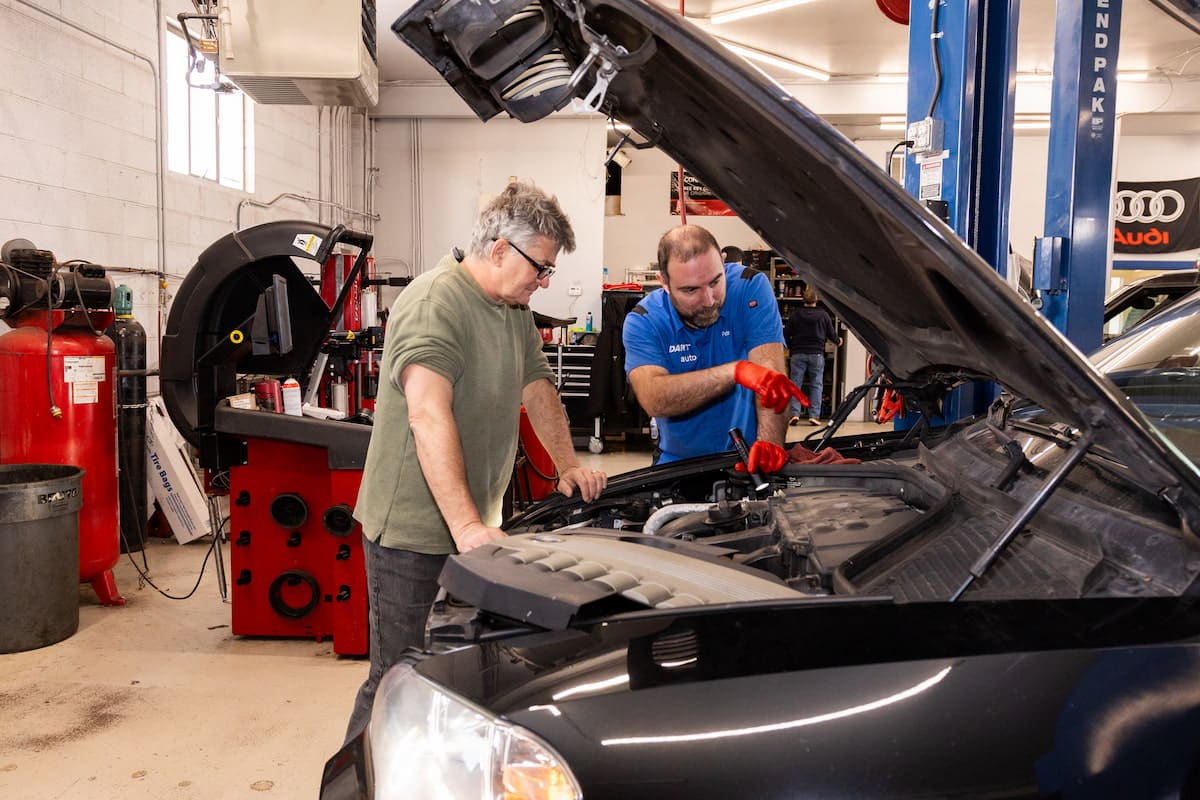
Volkswagen Scheduled Service Maintenance at DART Auto
Your Volkswagen dashboard just reminded you that service is due, and you're weighing whether to book with the dealer or find a specialist who understands these cars. Volkswagen scheduled maintenance isn't just about changing oil and rotating tires – it's about following a precise sequence of inspections, fluid services, and component checks that VW engineers designed for your specific platform and engine code. Miss a DSG service interval on your EA888-powered GTI, skip the Haldex fluid change on your Tiguan, or ignore the carbon cleaning that TSI engines need, and you're setting up expensive repairs down the road.
DART Auto has specialized in European vehicles since 2000, and our master technicians know the difference between a routine 40,000-mile service on a 2015 Golf TDI (EA288) and the same interval on a 2018 Atlas with the VR6. We follow factory service schedules to the letter, use VCDS and VAS diagnostic tools to verify system health, and apply the correct VW 502.00 or 504.00 oil specs your engine requires. Our salaried technicians take the time to inspect brake fluid condition, scan for stored fault codes, and check the health of components that fail predictably on specific platforms – timing chain tensioners on early TSI engines, water pump leaks on EA888 Gen 3, PCV valve failures across the MQB lineup.
When you bring your Volkswagen to DART for scheduled maintenance, you can expect:
- Factory-spec fluid changes using VW-approved oils, coolants, and transmission fluids matched to your engine and gearbox
- Complete multi-point inspection covering common Volkswagen failure points – coil packs, cam followers, intake carbon buildup, and cooling system integrity
- VCDS diagnostic scan to pull adaptation values, check for pending codes, and verify that all control modules are communicating correctly
- Transparent explanation of what's due now, what's approaching, and what can wait – no upselling, just honest guidance backed by our 3-year/36,000-mile warranty
Common Scheduled Service Maintenance Issues on Volkswagen Vehicles
If your Volkswagen is due for scheduled maintenance, you're already thinking ahead – and that's exactly the right mindset. Modern Volkswagens are built with precision engineering that rewards consistent care. The drivers who come to us at DART Auto typically aren't dealing with catastrophic failures; they're the ones who understand that small investments now prevent expensive surprises later. Here's what we see most often when Volkswagen owners stay on top of their intervals:
- DSG transmission service on 2009–2018 models (DQ250/DQ381): Volkswagen's dual-clutch automatic requires fluid and filter changes every 40,000 miles. Skip it, and you'll feel hesitation, jerky shifts, or mechatronic unit failure. The DQ250 six-speed and DQ381 seven-speed both use specific VW-approved fluid – generic ATF will damage clutch packs and cause adaptive learning problems.
- Carbon buildup on EA888 Gen 2 and Gen 3 TSI engines (2008–present): Direct-injection 2.0T engines accumulate carbon on intake valves because fuel never washes them clean. By 60,000–80,000 miles, you'll notice rough idle, misfires, and reduced power. Walnut-blasting the valves restores performance and prevents long-term valve damage.
- Timing belt replacement on older TDI and VR6 engines: 2.0 TDI (2009–2015) and 3.6 VR6 engines use interference-design timing belts due every 120,000 miles. Miss the interval, and a snapped belt bends valves and destroys pistons – a $6,000+ engine rebuild versus a $1,200 preventive service.
- Haldex all-wheel-drive service on 4Motion models (2002–present): The rear differential and Haldex coupling require fresh fluid and filter every 30,000–40,000 miles. Neglect leads to binding, overheating, and total Haldex pump failure, leaving you with front-wheel drive only.
- Water pump and thermostat housing leaks on EA888 Gen 3 (2015–present): The plastic thermostat housing and integrated water pump are known weak points. Coolant leaks appear around 80,000–100,000 miles. Catching them during scheduled service prevents overheating and head gasket damage.
- Brake fluid hygroscopic degradation: Volkswagen specifies DOT 4 low-viscosity brake fluid changes every two years. Old fluid absorbs moisture, lowers the boiling point, and corrodes ABS modules – a $1,800 repair that a $150 flush would have prevented.
Why Choose DART Auto for Volkswagen Scheduled Service Maintenance
Your Volkswagen's maintenance schedule isn't just a list of oil changes. VW platforms – from the MQB chassis under your Golf or Tiguan to the MLB Evo in your Atlas – demand specific fluid specs, software calibrations, and interval-based inspections that generic quick-lube shops simply skip. DART Auto has invested in factory-level diagnostic tools, including VCDS and OEM scan software, so we catch the small things before they become expensive: DSG mechatronic adaptations that drift out of spec, carbon buildup on TSI direct-injection engines (especially EA888 Gen 3 in 2015+ models), and timing-chain stretch patterns common on early 2.0T platforms.
Our salaried master technicians follow Volkswagen's published service procedures to the letter, cross-referencing Technical Service Bulletins and software updates released after your car left the factory. Because we're not paid flat-rate, there's zero incentive to rush your service or upsell parts you don't need. We perform the full multi-point inspection VW prescribes – suspension bushings, brake fluid moisture content, coolant pH, DSG clutch pack wear – and document findings with photos and notes so you understand what's happening under your car. Every service is backed by our 3-year/36,000-mile warranty on parts and labor, a commitment no dealership in Denver matches at our price point.
Symptoms – How to Know You Need This Service
Volkswagen vehicles are communicative when maintenance is overdue. You may notice:
- Service reminder light or message in the instrument cluster – VW's onboard service interval system tracks mileage, engine hours, and operating conditions to calculate when service is due
- Rougher idle or hesitation on cold starts – often a sign that carbon buildup on intake valves (common on TSI/TFSI direct-injection engines) is affecting airflow and combustion
- Delayed or harsh shifts from your DSG transmission – DSG fluid and mechatronic service intervals are strict; overdue service leads to clutch slip and shift quality degradation
- Oil level warnings or consumption between changes – EA888 Gen 1 and Gen 2 engines are known for oil consumption; if you're adding a quart every 1,000 miles, it's time for inspection and possibly PCV valve replacement during service
- Reduced fuel economy or sluggish throttle response – clogged air filters, dirty MAF sensors, or overdue spark plug replacement all degrade performance on turbocharged Volkswagen engines
- Squealing or grinding from brakes – brake fluid absorbs moisture over time; VW specifies replacement every two years to prevent internal corrosion and maintain ABS/ESP function
- Coolant level dropping or sweet smell from vents – early warning of water pump or thermostat housing leaks, which should be caught during scheduled inspections before they strand you
If you see a flashing check engine light, loss of power, or temperature warnings, stop driving immediately and arrange a tow. For routine service reminders and gradual performance changes, schedule your appointment soon to prevent minor maintenance from becoming major repairs.
Which Volkswagen Models We See for Scheduled Service Maintenance
DART Auto services the full range of Volkswagen platforms from the early 2000s forward. We regularly perform scheduled maintenance on:
- Golf / GTI / Golf R – Mk4 (1999–2006), Mk5 (2006–2009), Mk6 (2010–2014), Mk7/7.5 (2015–2021), Mk8 (2022+), covering 1.8T, 2.0T FSI, EA888 Gen 1/2/3, and EA888 evo engines
- Jetta / GLI – Mk4 through Mk7, including TDI variants (ALH, BEW, CBEA, CJAA engines) and all gasoline turbo four-cylinders
- Passat – B5/B5.5 (1998–2005), B6 (2006–2010), B7 (2012–2015), B8 (2016–2019), including 1.8T, 2.0T, VR6, and TDI powertrains
- CC – 2009–2017, both 2.0T and VR6, with attention to timing chain tensioner updates and DSG service intervals
- Tiguan – first-generation (2009–2017) and second-generation MQB (2018+), including Haldex all-wheel-drive fluid service on 4Motion models
- Atlas / Atlas Cross Sport – 2018+ with VR6 or 2.0T engines, following VW's extended service intervals for MQB-based SUVs
- Touareg – 2004–2017, including TDI V6, VR6, and air suspension models requiring specialized diagnostic access
- Beetle / Beetle Convertible – 1998–2019, all engine variants including the 1.8T, 2.0T, and TDI
- Eos – 2007–2016, with particular attention to retractable hardtop mechanism lubrication and DSG service
We also service Volkswagen Routan minivans (2009–2014) and earlier air-cooled or water-cooled classics on a case-by-case basis. If your model isn't listed, call us – we've likely worked on it and can confirm our capability and parts access before you book.
Causes & Risks – What Happens if Ignored
Scheduled maintenance intervals exist because Volkswagen engineers know exactly when wear accelerates and when fluids break down under normal driving. Denver's stop-and-go traffic, elevation changes, and temperature swings push transmissions, turbos, and cooling systems harder than highway cruising. Short trips never fully warm the oil, allowing moisture and fuel dilution to accumulate. Cold starts at altitude demand more from your battery and ignition system. These aren't excuses – they're the real-world conditions your Volkswagen faces every day, and the factory schedule accounts for them.
When you defer scheduled service, the damage compounds in predictable ways:
- Skipped DSG service: Dirty fluid loses friction properties within 10,000 miles past the interval. Clutch packs slip, the mechatronic unit overheats, and you'll need a $4,000–$6,000 transmission replacement instead of a $450 service.
- Delayed carbon cleaning: Misfires from clogged valves trigger catalytic converter damage. What starts as a $400 walnut-blast becomes a $2,200 cat replacement plus valve work.
- Overdue timing belt: A failed belt on an interference engine means bent valves, damaged pistons, and possible crankshaft scoring. You're looking at $5,000–$8,000 in machine work and parts, or a used engine swap.
- Ignored Haldex service: The coupling seizes, damaging the rear differential and driveshaft. A $350 service becomes a $3,500 AWD system overhaul.
- Old brake fluid: Moisture-contaminated fluid corrodes the ABS pump and wheel speed sensors. Brake performance degrades, and you're facing a $1,500–$2,000 ABS module replacement.
The pattern is always the same: a modest scheduled service prevents a major repair. The longer you wait past the interval, the steeper the cost curve becomes.
Safety Impact – Why Scheduled Service Maintenance Matters
Volkswagen's safety systems – ABS, ESC, traction control, and brake assist – all depend on the components you maintain during scheduled service. When brake fluid degrades, your stopping distances increase and ABS modulation becomes erratic. When a timing belt snaps, you lose all power steering and brake boost while coasting to a stop in traffic. A seized Haldex coupling can cause sudden understeer in snow, exactly when you need AWD most. These aren't theoretical risks; they're the real-world consequences we see when maintenance gets deferred too long.
Here's how to think about urgency:
- Stop driving now: Coolant leaks with overheating warnings, brake pedal going to the floor, or transmission stuck in gear. These require immediate towing.
- Schedule within the week: Misfires, rough shifting, or ABS warning lights. You can drive carefully, but don't wait for your next oil change.
- Schedule at the next interval: Upcoming timing belt service, carbon cleaning, or Haldex fluid change. Plan ahead so you're not scrambling when the failure happens.
Insurance and liability also matter. If a known maintenance item – like an overdue timing belt – causes an accident, your insurer can argue negligence. Keeping records of completed scheduled service protects you legally and financially.
How Volkswagen Scheduled Service Maintenance Actually Works
Volkswagen builds complexity into their systems that rewards proper maintenance and punishes shortcuts. Take the DSG transmission: it's essentially two manual gearboxes with computer-controlled clutches, managed by a mechatronic unit that adapts shift points based on fluid condition, temperature, and wear. The transmission doesn't just need clean fluid – it needs the exact VW-spec G 052 182 or G 055 005 fluid, because the clutch friction coefficients and hydraulic pressures are calibrated to those formulas. After a fluid change, the mechatronic unit must relearn its adaptive values using VCDS or VAS diagnostic software. A generic shop that drains and fills without the reset procedure leaves the transmission shifting on outdated parameters.
Other Volkswagen-specific maintenance details:
- Electronic parking brake service mode: Replacing rear brake pads on 2015+ models requires entering service mode via OBD-II to retract the electronic calipers. Without the right scan tool, you can't compress the pistons.
- Oil-change interval reset and inspection schedules: Volkswagen's variable service intervals adjust based on driving conditions. Resetting the reminder without updating the car's service history in the ECU causes the next interval to calculate incorrectly.
- Haldex pump priming procedure: After a Haldex service, the system must be primed and bled using the factory scan tool. Skip this step, and you'll have air in the hydraulic circuit and delayed AWD engagement.
- Torque-to-yield fasteners: Many Volkswagen components use single-use bolts that stretch during installation. Reusing them – even if they look fine – risks bolt failure and oil leaks.
This is why dealer-level diagnostic capability matters. DART Auto invests in the same VCDS and ODIS tooling that Volkswagen dealerships use, plus the training to understand what each module is telling us. We follow factory repair procedures, use OEM-spec fluids and parts, and perform the electronic resets that make the repair complete. Scheduled maintenance isn't just about changing fluids – it's about maintaining the software, adapting the
How We Diagnose Scheduled Service Maintenance Issues on Volkswagen
Your Volkswagen's dashboard reminder is glowing, or you've noticed subtle changes in how the car drives. Our diagnostic process begins the moment you describe what brought you in, because scheduled maintenance isn't one-size-fits-all – it's tailored to your specific model year, engine platform, and driving conditions.
- VAS diagnostic scan and fault code retrieval. We connect factory-level diagnostic equipment (VCDS or VAS tools) to read current and stored fault codes across all control modules. This reveals pending issues in the engine, transmission, ABS, airbag, and comfort systems that generic scanners miss. On MQB-platform vehicles (2015-newer Golf, Jetta, Tiguan), we also check adaptation values and software version levels to ensure your car's programming matches current factory specifications.
- Visual inspection of wear items and fluid condition. We perform a complete underhood and underbody inspection, checking brake pad thickness, rotor condition, suspension bushings, CV boot integrity, and exhaust hangers. On EA888 Gen3 engines (2015-newer 1.8T and 2.0T), we inspect the intake manifold for carbon buildup and check PCV system function – a common source of rough idle and oil consumption on these platforms.
- Fluid sampling and analysis. We pull the dipstick and inspect transmission fluid color and smell (burnt fluid indicates clutch wear in DSG gearboxes). Oil condition tells us about combustion health and whether the previous interval was appropriate for your driving style.
- Road test to validate concerns. We drive your Volkswagen through a range of conditions – cold start, highway cruise, hard acceleration, and braking – listening for timing chain rattle on startup (common on early EA888 Gen2 engines), feeling for transmission shift quality, and noting any steering or suspension anomalies.
- Comprehensive written estimate. We translate diagnostic findings into a prioritized service plan, separating what's due now per Volkswagen's maintenance schedule from what can wait, and explaining why each item matters for your specific model and mileage.
Scheduled Service Maintenance on Volkswagen: Repair vs. Replacement
Scheduled maintenance on a Volkswagen often sits at the intersection of prevention and correction. Here's how we decide what makes sense for your car and budget:
When Servicing the Existing Component Works
- DSG transmission service at 40,000-mile intervals. The dual-clutch gearbox doesn't need replacement – it needs fresh fluid and a new filter. This flush-and-fill service resets clutch adaptation and extends transmission life by hundreds of thousands of miles.
- Brake fluid flush every two years. The hydraulic system is sound; we're simply replacing hygroscopic fluid that has absorbed moisture and lowered its boiling point. This prevents internal corrosion and maintains full braking performance.
- Intake manifold carbon cleaning on TSI engines. Direct-injection engines build carbon deposits on intake valves because fuel never washes over them. Walnut-blasting the valves restores airflow and throttle response without replacing any hard parts.
When Partial Replacement Makes Sense
- Replacing worn brake pads and resurfacing rotors. If rotor thickness is still above minimum spec and the surface is true, we can machine them smooth and install new pads – no need for new rotors yet.
- Replacing the PCV valve and diaphragm on EA888 engines. The crankcase ventilation system clogs over time, causing oil leaks and rough idle. A new valve assembly solves it without tearing into the engine.
When Full Replacement Is the Right Call
- Timing belt and water pump on 2.5L five-cylinder engines (2005-2014 Jetta, Rabbit, Beetle). At 100,000 miles, the belt is due. Because the water pump is driven by the timing belt and requires the same labor to access, replacing both together prevents a second teardown if the pump fails at 110,000 miles.
- Ignition coils and spark plugs as a set on TSI engines. If one coil has failed and the others have 80,000+ miles, replacing all four prevents recurring misfires and multiple diagnostic visits.
We walk you through the cost-benefit of each option and let you decide. Our technicians are salaried, so there's no incentive to upsell – just honest guidance on what your Volkswagen needs now and what can wait.
How to Make Your Volkswagen Scheduled Service Maintenance Last Longer
Scheduled maintenance intervals exist because parts wear predictably, but how you drive and care for your Volkswagen directly affects whether you hit those intervals early or late.
Driving Habits That Extend Component Life
- Allow proper warm-up before hard acceleration. TSI and TDI engines use tight tolerances and turbochargers. Let oil circulate and reach operating temperature before boosting – this prevents premature bearing wear and carbon buildup from incomplete combustion.
- Use engine braking on descents. Downshift the DSG or manual gearbox when descending grades rather than riding the brakes. This reduces brake pad wear and prevents fluid boil on mountain drives.
- Avoid short trips when possible. Frequent cold starts without reaching full operating temperature cause oil contamination, moisture buildup in the exhaust, and accelerated wear on emission components like the catalytic converter and oxygen sensors.
- Minimize aggressive launches in DSG-equipped cars. Launch control is engineered into the system, but repeated hard launches accelerate clutch wear. Save it for special occasions rather than every stoplight.
Maintenance Habits You Can Do Yourself
- Check oil level monthly, especially on EA888 engines. Some oil consumption is normal on turbocharged direct-injection engines. Keeping the level between the min and max marks prevents bearing damage and timing chain stretch.
- Inspect tire pressure and tread depth regularly. Proper inflation reduces rolling resistance and uneven wear. Rotate tires every 5,000–7,500 miles to maximize tread life.
- Listen for changes in engine or transmission behavior. New noises, delayed shifts, or rough idle are early warnings. Addressing them promptly prevents small issues from becoming expensive failures.
Brand-Specific Care That Matters
- Use VW-spec fluids and filters. Volkswagen's long-life oil (502.00/504.00 spec) and DSG fluid (G 052 182 or G 055 025) are engineered for the tight tolerances and extended intervals these cars demand. Substituting generic fluids shortens component life.
- Keep software up to date. Volkswagen releases software updates that refine transmission shift logic, improve fuel economy, and address drivability concerns. We flash the latest calibrations during scheduled service to keep your car performing as intended.
- Follow the maintenance schedule in your owner's manual, not the dashboard reminder alone. The variable service interval system adjusts for driving conditions, but it doesn't account for severe-duty use like frequent towing or dusty environments. Consult the manual's severe-duty schedule if you drive in those conditions.
Leave safety-critical work – brake system bleeding, timing belt replacement, suspension work – to the shop. Our diagnostic equipment and torque specifications ensure the job is done right. You handle the monitoring; we'll handle the wrenching.
What to Expect When You Bring Your Volkswagen In
We've streamlined the scheduled maintenance experience so you know exactly what's happening at every step. Here's how your visit unfolds:
- Appointment and drop-off: When you schedule, we ask for your VIN, current mileage, and service history so we can pre-load the correct VW maintenance schedule and order any platform-specific parts. Drop off your Volkswagen at your scheduled time; if you need a loaner vehicle or our shuttle service to downtown Denver, let us know when you book.
- Initial inspection and estimate: Before we touch a wrench, a technician performs a comprehensive visual and scan-tool inspection. We pull fault codes, check for open recalls or TSB updates, and photograph anything that needs attention beyond the scheduled service. You'll receive a written estimate with line-item explanations – we'll call to walk you through findings and answer questions before proceeding.
- Service execution: We follow VW's prescribed intervals: oil and filter with VW 502.00/504.00 spec, DSG service at 40k miles with G 055 025 A2 fluid, spark plugs and air filter as specified for your engine code. Every fluid drain and torque spec matches factory procedure. If we find something during the service – a leaking cam adjuster seal on an EA888, for example – we document it and call before adding work.
- Post-service verification: After completing the service, we road-test your Volkswagen and re-scan for fault codes. We reset service reminders in the instrument cluster and verify all systems are operating within VW parameters. At pickup, we walk you through what we did, show you the old parts if requested, and explain the next service interval. If anything feels off in the days after pickup, call us – we'll get you back in immediately to verify the work.
Keep your personal items and registration with you; we'll handle the rest. After-hours key drop and pickup are available if your schedule demands it – just let us know at booking.
Our Volkswagen Services
- Air Conditioning AC Repair
- Battery Repair Replacement
- Brake Repair & Brake Fluid Change
- Check Engine Light Diagnostics
- Clutch Repair & Replacement
- Coolant Leak Repair
- Cooling System Repair
- Drive Shaft Repair
- Engine Repair
- Exhaust & Catalytic Converter Repair
- Head Gasket Repair & Replacement
- Oil Change
- Oil Leak Repair
- Steering Repair
- Suspension Repair
- Cambelt Timing Belt Replacement
- Transmission Repair
- Tune Up
- Wheel Alignment