
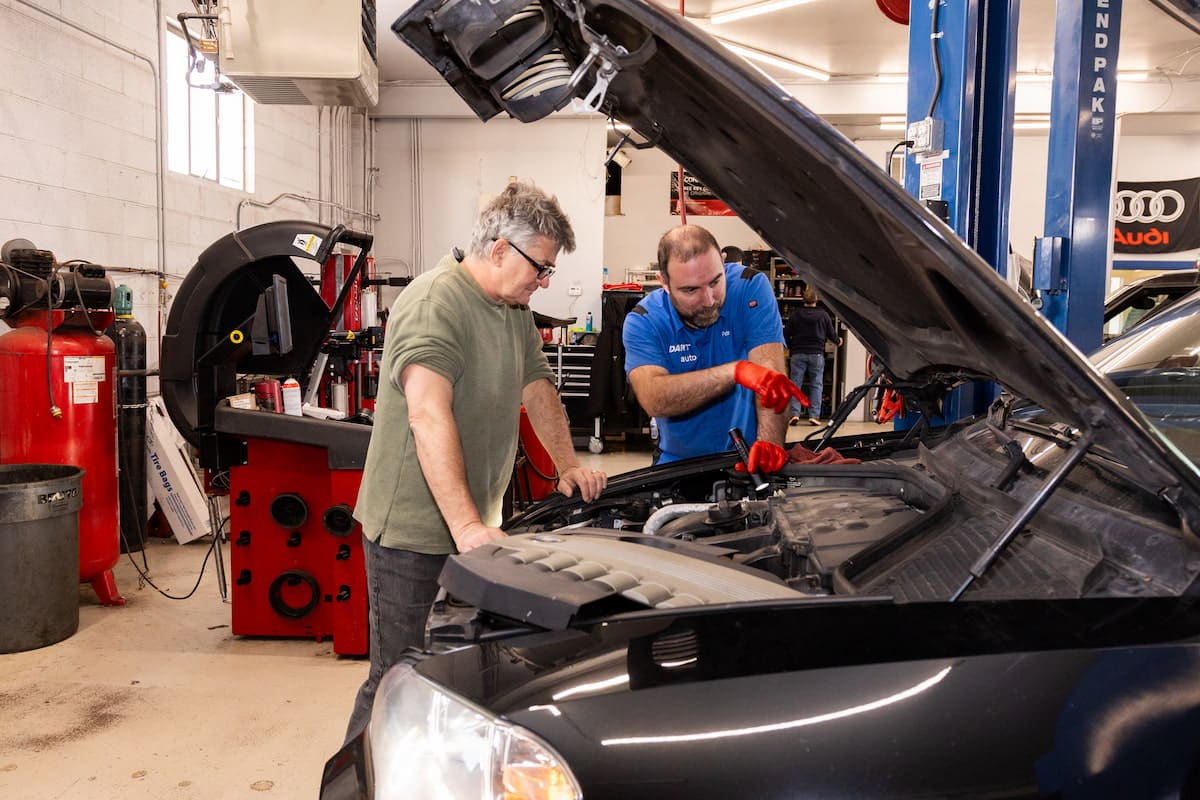
Rolls-Royce Scheduled Service Maintenance at DART Auto
Your Rolls-Royce represents the pinnacle of automotive engineering, and maintaining it requires more than generic oil changes and tire rotations. Scheduled service maintenance on a Rolls-Royce involves intricate procedures that most shops lack the tooling, training, and experience to execute properly. Since 2000, DART Auto has specialized in European luxury vehicles, and we approach every Rolls-Royce service interval with the factory-level precision these machines demand.
Rolls-Royce scheduled maintenance differs fundamentally from mass-market vehicles. The 6.75-liter twin-turbo V12 found in Phantom and Ghost models requires specific synthetic oil formulations and precise fill procedures. The air suspension systems on these platforms demand software recalibration after fluid changes, something generic shops often overlook. Phantom VII and Ghost Series I models also require periodic updates to the onboard diagnostic modules – skipping these can trigger false fault codes and degrade performance. Our master technicians use factory diagnostic protocols and OEM-specification fluids to ensure every service interval maintains the exacting standards Rolls-Royce engineering demands.
When you bring your Rolls-Royce to DART Auto for scheduled service, you can expect:
- Complete multi-point inspection using factory service schedules and diagnostic software
- OEM-specification fluids, filters, and components sourced from trusted European suppliers
- Software updates and module recalibrations performed with dealer-level diagnostic equipment
- Transparent documentation of all work performed, with explanations of upcoming service intervals and any emerging issues we identify
Common Scheduled Service Maintenance Issues on Rolls-Royce Vehicles
Rolls-Royce owners in Denver bring their vehicles to us when scheduled service intervals arrive, and we've seen the same patterns emerge across generations. These aren't just oil changes – they're comprehensive inspections that catch problems before they strand you or cost thousands more down the road.
- Air suspension system deterioration on Phantom (2003–2017): The self-leveling air suspension relies on air struts, compressors, and height sensors that degrade predictably. By 60,000 miles, compressor seals harden and struts develop slow leaks. Regular inspections catch early compressor cycling and allow us to replace struts before the system dumps completely and leaves the car sitting on the bump stops.
- V12 spark plug and ignition coil wear (all models): The 6.75L and 6.6L twin-turbo V12 engines use twelve individual coil packs. Coil failure is progressive – one misfiring cylinder stresses the remaining coils and catalytic converters. Scheduled replacement at 40,000–50,000 miles prevents rough idle, loss of power, and expensive catalyst damage.
- Brake fluid hygroscopic degradation: Rolls-Royce specifies DOT 4 fluid replacement every two years regardless of mileage. The advanced ABS and stability control systems are sensitive to moisture contamination. We've pulled fluid with 3–4% water content from cars that skipped intervals – enough to cause internal corrosion in the hydraulic control unit and spongy pedal feel.
- Transmission fluid and filter service on ZF 8HP: The eight-speed automatic in Ghost and Wraith models (2010+) uses lifetime-fill fluid according to BMW/ZF, but real-world experience shows degradation by 60,000 miles. Delayed shifts, shudder during lockup, and adaptation faults all respond to fluid and filter replacement using the correct ZF LifeguardFluid 8.
- Engine oil consumption monitoring on turbocharged models: The N74 twin-turbo V12 can consume a quart between intervals under spirited driving. We track consumption trends during each service and inspect PCV valve operation and turbo seals before minor consumption becomes a rebuild-level problem.
- Battery registration and coding after replacement: Rolls-Royce vehicles require battery registration through the vehicle's control modules when replaced. Skipping this step causes the alternator to overcharge or undercharge, shortening both battery and alternator life. We handle registration with factory-level diagnostic tools at every service where battery health is marginal.
Why Choose DART Auto for Rolls-Royce Scheduled Service Maintenance
When your Rolls-Royce service interval arrives, you need a shop that understands the platform-specific requirements BMW Group engineering built into these vehicles. DART Auto maintains the factory diagnostic tooling – including ISTA/D and ISTA/P – to access Rolls-Royce-specific service menus, read live data streams, and execute the software resets and adaptations the factory schedule demands. Our technicians follow OEM procedures for items like the ZF 8HP automatic transmission fluid exchange (which requires specific fill temperatures and scan-tool monitoring), brake fluid flushing on vehicles with Dynamic Ride hydraulic anti-roll systems, and the correct torque sequences for aluminum suspension components.
We track Technical Service Bulletins and software updates that affect scheduled maintenance. Early Phantom VII models (2003–2008) had revised engine-oil specifications and updated crankcase ventilation procedures; later Ghost Series I cars (2010–2014) saw updates to the N74 V12 valve-stem seal service intervals. Because we're salaried rather than flat-rate, our technicians take the time to verify these platform changes in your VIN history before starting work. You get dealer-level capability without the dealer price tag, backed by a 3-year/36,000-mile warranty on parts and labor. We've served Denver since 2000, and hundreds of online reviews reflect our commitment to fixing it right the first time.
Symptoms – How to Know You Need This Service
Rolls-Royce scheduled service maintenance follows precise mileage and time intervals, but certain symptoms signal you've delayed service too long or that an issue has developed between intervals:
- Service indicator illuminated on the instrument cluster – Rolls-Royce vehicles calculate service intervals based on driving conditions and will alert you when maintenance is due
- Reduced throttle response or hesitation during acceleration – often indicates overdue engine oil service or clogged air filters on the twin-turbo V12
- Air suspension warning lights or "Suspension Inactive" messages – can result from low hydraulic fluid levels that should be checked during scheduled service
- Rough idle or minor vibration at stop lights – may point to spark plugs nearing the end of their service life (typically 20,000–30,000 miles on Phantom VII and Ghost models)
- Increased brake dust accumulation or soft brake pedal feel – signals brake fluid hygiene has degraded and moisture contamination requires a flush
- Transmission shifting delays or harsh engagement – often caused by aging transmission fluid, which Rolls-Royce specifies for replacement every 40,000–50,000 miles
- Climate control performance decline – can stem from cabin air filters that should be replaced at every service interval
If you see suspension warnings or experience sudden power loss, schedule service immediately rather than continuing to drive.
Which Rolls-Royce Models We See for Scheduled Service Maintenance
DART Auto provides factory-level scheduled service maintenance for all modern Rolls-Royce platforms. We regularly service:
- Phantom (2003–2017, Phantom VII) – including standard wheelbase, extended wheelbase, Drophead Coupé, and Coupé variants with the 6.75L V12
- Phantom (2018–present, Phantom VIII) – updated architecture with revised service intervals and software requirements
- Ghost (2010–2020, Series I) – based on the BMW F01 7-Series platform but requiring Rolls-Royce-specific fluids and diagnostic protocols
- Ghost (2021–present, Series II) – all-new aluminum spaceframe architecture with distinct service procedures
- Wraith (2014–2021) – the 6.6L twin-turbo V12 shares some service intervals with Ghost but requires model-specific calibration updates
- Dawn (2016–2021) – convertible variant with additional hydraulic soft-top maintenance requirements during scheduled service
- Cullinan (2019–present) – Rolls-Royce's SUV platform with all-wheel-drive system requiring transfer case fluid service at specific intervals
We maintain complete factory service schedules and diagnostic capability for all these platforms. Our technicians receive ongoing training on Rolls-Royce-specific procedures, ensuring your vehicle receives the precise maintenance it requires at every interval.
Causes & Risks – What Happens if Ignored
Scheduled service intervals exist because Rolls-Royce engineers know exactly how fluids degrade, how seals age, and how wear particles accumulate in a closed system. Denver's temperature swings – from sub-zero mornings to 90-degree afternoons – accelerate seal hardening and fluid breakdown. Short trips around Cherry Creek or the Tech Center don't bring oil and coolant to full operating temperature, allowing moisture and combustion byproducts to accumulate. Altitude affects turbocharger seals and crankcase ventilation differently than sea-level operation.
When owners defer scheduled maintenance, small issues cascade into expensive failures:
- Skipped air suspension inspections: A slow leak in one strut forces the compressor to run continuously, burning out the $1,800 compressor and draining the battery overnight. What starts as a $900 strut replacement becomes a $3,500 repair with towing.
- Delayed transmission service: Degraded fluid loses its friction-modifier properties, causing clutch slip inside the transmission. Slip generates heat and metal particles, which clog the valve body and mechatronic unit. A $600 fluid service avoided becomes a $12,000 transmission replacement.
- Ignored spark plug replacement: Misfires dump unburned fuel into the exhaust, overheating and destroying the catalytic converters. Replacing twelve spark plugs and coils costs $1,200–$1,800; replacing cats adds another $6,000–$8,000.
- Contaminated brake fluid: Moisture in the system corrodes the ABS hydraulic unit from the inside. Pedal feel deteriorates, ABS function becomes erratic, and eventually the entire unit fails. A $180 fluid flush becomes a $4,500 ABS module replacement.
- Overdue engine oil service: Sludge builds in the valley of the V12, clogging the variable valve timing solenoids and oil galleries. Timing faults trigger limp mode, and in severe cases, cam phaser failure requires cylinder head removal.
Safety Impact – Why Scheduled Service Maintenance Matters
A Rolls-Royce is a 5,500-pound luxury sedan with 450–600 horsepower and advanced driver-assistance systems that rely on precise sensor calibration and hydraulic response. When scheduled maintenance lapses, the safety margin disappears faster than owners expect.
- Brake system degradation: Contaminated fluid reduces boiling point, causing vapor lock and complete brake fade during hard stops from highway speed. ABS and stability control depend on instant hydraulic pressure – moisture contamination adds milliseconds of delay that can mean the difference between stopping and not stopping.
- Air suspension failure: A collapsed air strut drops one corner of the car, changing suspension geometry and steering response mid-corner. We've seen cars towed in after sudden height loss on I-25 – the ride-height sensors go into fault mode and the vehicle becomes nearly undriveable.
- Ignition system misfires: A misfiring cylinder under load creates hesitation during merging or passing. The engine stumbles exactly when you need power, creating dangerous situations in traffic. Multiple misfires can trigger limp mode, cutting power to 30% with no warning.
- Tire wear from skipped rotations: Uneven tire wear reduces contact patch and increases stopping distance, especially in rain or snow. Rolls-Royce uses staggered wheel sizes on many models – rotation patterns must follow OEM specs or handling becomes unpredictable.
Stop driving immediately if: the brake pedal feels spongy or sinks to the floor, the car drops to one corner and won't rise, or the engine misfires consistently under load. Schedule service within the week if: you notice delayed shifts, increased oil consumption, or warning lights for tire pressure, brake wear, or service intervals.
How Rolls-Royce Scheduled Service Maintenance Actually Works
Rolls-Royce scheduled maintenance isn't just checking boxes on a list – it's a systematic inspection of interdependent systems that communicate through multiple control modules. The car tracks oil quality through algorithms monitoring temperature, load, and time. It monitors brake pad wear through sensors embedded in the pads themselves. Every fluid has a replacement interval based on chemical breakdown, not just mileage. Our approach follows factory procedures with diagnostic tools that read fault memory, adaptation values, and sensor data the same way a Rolls-Royce dealer does.
What makes Rolls-Royce service different from other brands:
- Component coding and registration: Batteries, control modules, and even brake pads must be registered to the vehicle's network after replacement. The car adjusts charging profiles, brake pressure algorithms, and warning thresholds based on what's installed. Generic scan tools can't perform these functions – we use factory-level diagnostics.
- Fluid specifications and fill procedures: The ZF transmission requires a specific fill procedure with the fluid at 40°C, measured through live data while the car is running. Brake fluid must meet low-viscosity specs for the high-speed ABS pump. Coolant is a long-life formulation that can't be mixed with conventional types.
- Air suspension calibration: After replacing struts or servicing the system, ride height must be calibrated at all four corners with the car on a level surface. The system stores these values and uses them to adjust damping and leveling response. Skipping calibration causes uneven ride height and premature wear.
- Torque-to-yield fasteners: Many engine and suspension components use single-use bolts that stretch during installation. Reusing them risks failure. We stock OEM fasteners and follow torque sequences exactly as specified – no shortcuts.
We perform scheduled maintenance the
How We Diagnose Scheduled Service Maintenance Issues on Rolls-Royce
When your Rolls-Royce arrives for scheduled service, we start by acknowledging that these vehicles demand precision – and we deliver exactly that through a methodical diagnostic process that respects the engineering behind every Ghost, Phantom, Wraith, and Dawn.
- Initial consultation and service history review. We pull up your vehicle's complete maintenance record and cross-reference the factory schedule for your specific model year and platform. Rolls-Royce vehicles built on the BMW 7-Series platform (2003–2009 Phantom) or the later bespoke aluminum spaceframe (2010+ Ghost, Wraith) have distinct service intervals and known wear points that guide our inspection priorities.
- Full system scan with factory-level diagnostics. We connect our diagnostic equipment – including BMW ISTA/D and ISTA/P tooling that interfaces with Rolls-Royce control modules – to read fault codes, adaptation values, and live data streams from the engine, transmission, air suspension, and active safety systems. This reveals pending issues like early-stage carbon buildup on the N74 V12, transmission adaptation drift, or air-strut calibration errors before they become failures.
- Physical inspection and fluid analysis. We lift the vehicle and inspect brake pad thickness, rotor condition, suspension bushings, coolant hoses (the thermostat housings on 2010–2016 Ghost models are known failure points), and undercarriage corrosion. We sample fluids for color, consistency, and contamination – transmission fluid condition tells us whether the ZF 8-speed needs a flush or filter service.
- Road test and functional verification. We drive the car through varied conditions to confirm shift quality, brake feel, steering response, and suspension damping. Any vibration, hesitation, or noise gets documented and traced back to root cause.
At the end of this process, you receive a detailed inspection report with photos, prioritized recommendations, and a transparent quote. We explain what needs attention now, what can wait, and why – so you can make informed decisions about your Rolls-Royce's care.
Scheduled Service Maintenance on Rolls-Royce: Repair vs. Replacement
Scheduled service on a Rolls-Royce isn't always a simple parts swap. We assess whether a repair, partial replacement, or complete replacement makes sense based on the component's condition and your vehicle's long-term health.
When Repair Is the Right Call
- Brake service. If rotors are within minimum thickness spec and pads haven't worn into the backing plates, we resurface the rotors and install new pads – no need to replace rotors prematurely.
- Throttle body and intake cleaning. Carbon buildup on the N74 V12 intake valves (common on 2010–2014 Ghost and Wraith) responds well to walnut-blasting or chemical cleaning without removing the entire intake manifold unless deposits are severe.
- Fluid exchanges. Transmission, coolant, and brake fluid flushes restore performance without replacing expensive hard parts, provided the system hasn't been neglected past the point of internal damage.
When Partial or Full Replacement Makes Sense
- Suspension components. Air struts on the self-leveling system can develop leaks; we replace the failed strut rather than rebuild, because the labor cost to rebuild approaches the price of a new OEM unit and reliability matters more on a Rolls-Royce.
- Ignition and fuel system parts. Coil packs and spark plugs are wear items on the V12 – we replace all twelve coils and plugs together to prevent return visits for misfires on the cylinders we didn't touch.
- Coolant system overhaul. If the thermostat housing is leaking, we replace hoses, expansion tank, and water pump during the same service window to avoid cascading failures weeks later.
We walk you through the logic behind each recommendation, show you the worn parts, and respect your timeline and budget. You'll never feel pressured into the most expensive option – just the right one.
How to Make Your Rolls-Royce Scheduled Service Maintenance Last Longer
Rolls-Royce ownership rewards thoughtful habits. Small adjustments to how you drive and maintain your vehicle can extend service intervals and prevent expensive repairs down the road.
Driving Habits That Protect Your Investment
- Allow proper warm-up. The N74 V12 runs tight tolerances; let the engine idle for 30–60 seconds before driving, and avoid full throttle until coolant reaches operating temperature. This reduces wear on piston rings and valve seals.
- Brake gently and progressively. The massive weight of a Phantom or Ghost puts tremendous stress on brakes. Smooth, early braking reduces pad glazing and rotor warping, extending service life by thousands of miles.
- Drive the car regularly. Rolls-Royce vehicles suffer when parked for weeks – batteries drain, brake rotors corrode, and seals dry out. A 20-minute drive every week keeps fluids circulating and systems exercised.
Maintenance You Can Monitor
- Check fluid levels monthly. Pop the hood and verify engine oil, coolant, brake fluid, and washer fluid levels. Low coolant can indicate a slow leak; low brake fluid may signal worn pads.
- Listen for changes. New noises – squeaks, rattles, grinding – are early warnings. Address them before a minor issue cascades into a major repair.
- Watch the dash. Rolls-Royce's onboard diagnostics will alert you to issues early. Don't ignore warning lights; they're your first line of defense.
Professional Care That Matters
- Use OEM or premium fluids. The ZF 8-speed transmission and air suspension require specific fluid specs. Cheap alternatives accelerate wear and void warranties.
- Follow factory service intervals. Rolls-Royce publishes maintenance schedules for a reason – oil changes every 10,000 miles, brake fluid every two years, spark plugs and air filters at prescribed intervals. Skipping services costs more in the long run.
- Keep software updated. Transmission adaptations, engine maps, and safety system calibrations improve with updates. We flash the latest software during scheduled service to keep your car performing as the engineers intended.
Leave complex work – brake bleeding, suspension calibration, software updates – to professionals with the right tools and training. DIY attempts on safety-critical systems can create dangerous conditions and expensive comebacks. We're here to handle the technical work so you can enjoy the drive.
What to Expect When You Bring Your Rolls-Royce In
Scheduled maintenance at DART Auto follows a structured process so nothing gets overlooked:
- Appointment and drop-off: We'll confirm your service interval and any owner-reported concerns. Bring your vehicle's service booklet if you have it – we cross-reference the factory schedule against your mileage and previous work. Loaner vehicles and shuttle service are available; just ask when you book. Remove valuables and personal items from the cabin.
- Complete inspection: Before we perform the scheduled items, we run a full visual and scan-tool inspection. We document fluid condition, brake pad thickness, suspension bushings, and any stored fault codes. This catches emerging issues before they become expensive failures.
- Written estimate and authorization: You'll receive a detailed estimate covering the factory-scheduled services and any additional recommendations we found during inspection. We explain what each item does, the consequences of deferring it, and the parts we'll use – OEM or premium aftermarket from trusted suppliers.
- Service execution: Our master technicians – each with at least 10 years of experience and dealer training – perform the work using factory repair information, specialty tools, and the correct fluid specifications. We follow torque values, software reset procedures, and post-service adaptations the platform requires.
- Post-repair verification and pickup: Every Rolls-Royce gets a road test and a final scan-tool check to confirm no new fault codes. At pickup, we walk you through what we did, show you any parts we replaced, and answer questions. If something feels off in the days after service, call us – we'll get you back in and make it right.
Our Rolls-Royce Services
- Air Conditioning AC Repair
- Battery Repair Replacement
- Brake Repair & Brake Fluid Change
- Check Engine Light Diagnostics
- Clutch Repair & Replacement
- Coolant Leak Repair
- Cooling System Repair
- Drive Shaft Repair
- Engine Repair
- Exhaust & Catalytic Converter Repair
- Head Gasket Repair & Replacement
- Oil Change
- Oil Leak Repair
- Steering Repair
- Suspension Repair
- Cambelt Timing Belt Replacement
- Transmission Repair
- Tune Up
- Wheel Alignment