
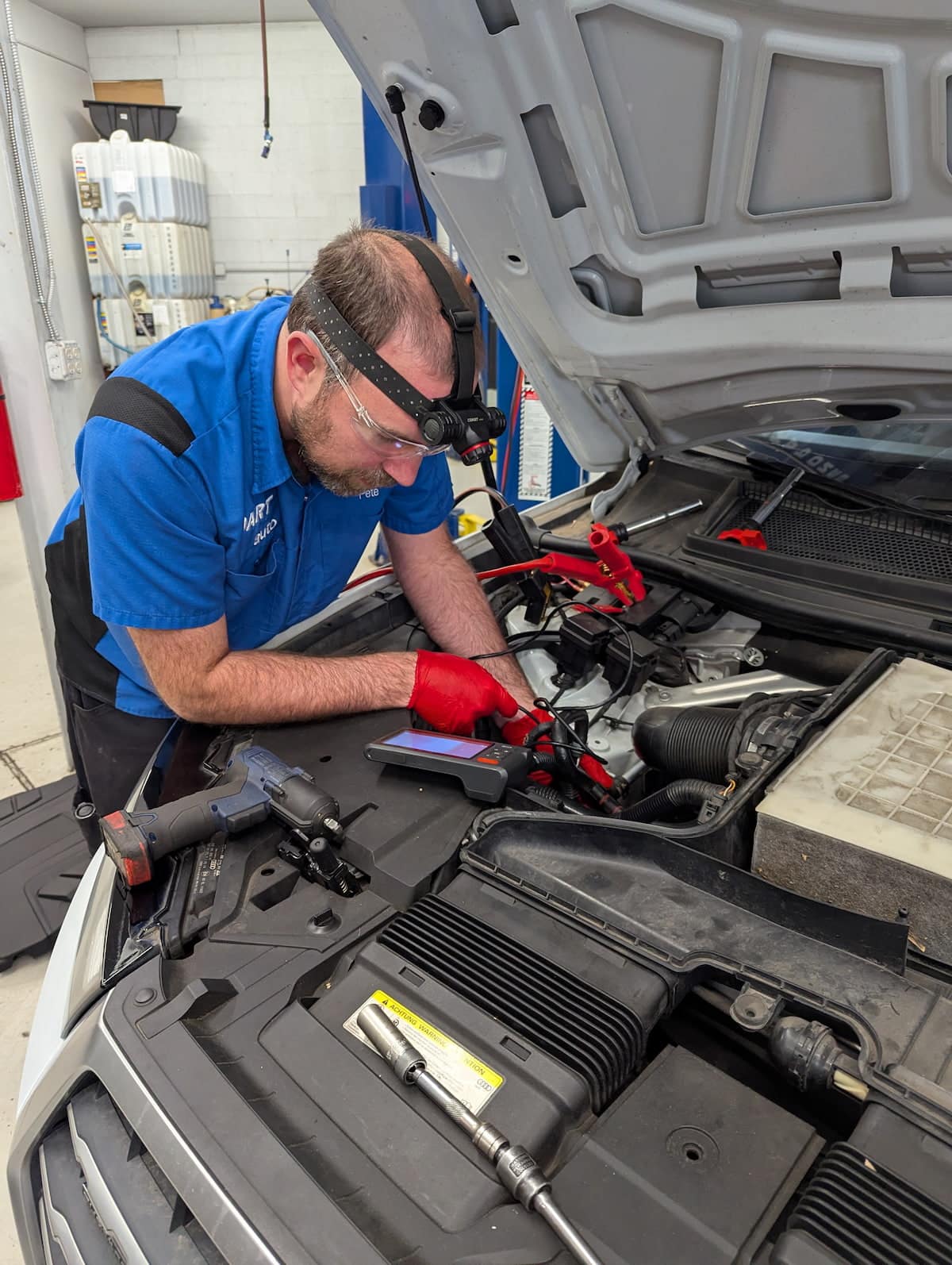
Rolls-Royce Tune Up at DART Auto
The BMW N74 V12 that powers Phantom, Ghost, and Wraith models demands precision maintenance that most shops simply cannot deliver. These 6.6- and 6.75-liter twin-turbo engines use individual coil-on-plug ignition for each cylinder, variable valve timing on both camshafts, and intricate fuel injection mapping calibrated to tolerances measured in milliseconds. A proper tune up on a Rolls-Royce involves more than swapping spark plugs – it requires factory diagnostic software to verify ignition timing advance curves, monitor knock sensor response across all twelve cylinders, and confirm that both turbochargers spool symmetrically under load. The N73 naturally aspirated V12 in earlier Phantom models shares similar complexity, with dual VANOS systems and individual throttle bodies that must remain synchronized after any ignition service.
DART Auto has invested in the BMW ISTA diagnostic platform and Rolls-Royce-specific service procedures that dealerships use. Our technicians understand that misfires on bank 1 cylinders 1-6 often trace to coil pack degradation exacerbated by heat from the right-side turbocharger, while bank 2 issues frequently stem from carbon fouling on intake valves starved of direct fuel wash. We follow OEM torque specifications for spark plug installation – critical on aluminum heads where overtightening causes thread damage and undertightening invites heat transfer problems and pre-ignition. After component replacement, we perform full system adaptation and clear long-term fuel trims to give the engine a clean learning baseline.
When you bring your Rolls-Royce to DART Auto for tune up service, expect:
- Complete ignition system inspection with coil pack resistance testing and spark plug gap verification against factory specs
- Fuel injection system evaluation including injector spray pattern analysis and fuel pressure testing at idle and under load
- Throttle body synchronization and idle speed relearn using factory-level diagnostic tools
- Post-service road test with live data monitoring to confirm smooth power delivery across the entire RPM range
Common Tune Up Issues on Rolls-Royce Vehicles
Rolls-Royce vehicles demand meticulous attention to ignition and fuel delivery systems, and several platform-specific patterns emerge across the marque's modern lineup. The 6.75-liter V12 and later BMW-derived N73/N74 V12 engines share common failure modes that affect smooth operation and performance.
- Coil pack degradation on 2003–2016 Phantom (N73/N74 V12): Individual coil-on-plug assemblies fail progressively, often starting with cylinders 7 and 8 on the right bank. Heat cycling in the valley between cylinder banks accelerates insulation breakdown, leading to misfires under load. Factory diagnostic protocol calls for checking secondary ignition patterns with an oscilloscope, not just pulling misfire codes.
- Spark plug fouling on Ghost/Wraith/Dawn (N74TU): Direct-injection carbon buildup on intake valves migrates into the combustion chamber, fouling plugs prematurely. Model years 2010–2014 see this most frequently. OEM service interval calls for plugs every 37,500 miles, but real-world conditions often demand inspection at 25,000 miles.
- Fuel injector imbalance on Silver Seraph (BMW M73 V12): The transition-era Seraph uses Bosch multi-port injectors prone to varnish buildup from short-trip driving. Uneven spray patterns cause rough idle and stumbling on acceleration. Flow-testing each injector is the only reliable diagnostic.
- Mass airflow sensor drift on all BMW-era platforms: Hot-film MAF sensors on post-2003 Rolls-Royce models develop contamination from oil vapor and dust, skewing fuel trims. Symptoms mimic ignition faults but require different diagnostics. Factory tooling reads actual airflow in kg/hr to confirm sensor accuracy.
- Throttle body carbon accumulation on N74 engines: Drive-by-wire throttle plates collect carbon on the back side, restricting airflow at idle and causing hunting/surging. Adaptation values stored in the DME must be reset after cleaning or the ECU compensates incorrectly.
Why Choose DART Auto for Rolls-Royce Tune Up
Rolls-Royce tune-up work demands more than generic spark-plug replacement. The 6.75-liter V12 in the Phantom VII and the twin-turbo 6.6-liter N74 in the Ghost and Wraith require precise ignition timing calibration, coil-pack diagnostics, and BMW-derived software validation that most shops lack. DART Auto has invested in factory-level scan tools and subscription access to Rolls-Royce technical service bulletins, allowing our technicians to address platform-specific updates – like the 2010–2013 Ghost fuel-injector recalibration campaigns and the 2014–2016 Wraith carbon-buildup mitigation procedures – before they escalate into misfires or catalytic converter damage.
Our master technicians bring dealer training and at least ten years of experience to every job. Because we pay salaries rather than flat-rate commissions, there is zero incentive to recommend unnecessary coil replacements or skip the post-tune road test. We perform a full multi-point inspection before any tune-up begins, verifying that crankcase ventilation valves, intake manifold seals, and throttle-body adaptations are within specification. After service, we re-run live-data logs to confirm smooth idle, correct fuel trims, and no pending misfire codes. That end-to-end ownership, backed by our 3-year/36,000-mile parts-and-labor warranty, gives you dealer-grade precision without the dealer price tag.
Symptoms – How to Know You Need This Service
Rolls-Royce vehicles communicate performance degradation through subtle cues that escalate if ignored. You may notice:
- Rough idle or vibration at stoplights – the V12 should run glass-smooth; any perceptible shake indicates one or more cylinders misfiring
- Hesitation during acceleration – stumbling or flat spots when you press the throttle, especially between 1,500 and 3,000 RPM where turbo transition occurs
- Check Engine Light with misfire codes – P0300 random misfire or cylinder-specific codes P0301 through P0312 pointing to ignition breakdown
- Reduced fuel economy – dropping 2-3 MPG below your normal average as the engine compensates for weak combustion with additional fuel
- Hard starting or extended cranking – particularly on cold mornings when worn spark plugs struggle to ignite the fuel-air mixture
- Sulfur smell from exhaust – indicates unburned fuel reaching the catalytic converters, a sign of incomplete combustion
- Power loss under load – the engine feels sluggish climbing grades or merging onto highways, lacking the effortless thrust Rolls-Royce engineered into these platforms
If you experience multiple misfires, severe hesitation, or flashing check engine light, stop driving and arrange for towing. Continued operation with severe misfires sends raw fuel into the exhaust system, where it can overheat and destroy catalytic converters – a repair costing many thousands beyond the tune up itself.
Which Rolls-Royce Models We See for Tune Up
DART Auto services tune up needs across the modern Rolls-Royce lineup, all built on BMW-derived platforms with shared powertrain architecture:
- Phantom (2003–2017, Series I and II) – naturally aspirated N73 6.75L V12 and later twin-turbo N74 variants; spark plugs typically need replacement every 30,000–40,000 miles
- Ghost (2010–2020, Series I) – N74B66 twin-turbo 6.6L V12; coil packs show higher failure rates on bank 1 due to turbo heat exposure
- Wraith (2014–2021) – N74B66TU 6.6L V12 with higher boost pressure; more aggressive tuning accelerates spark plug electrode wear
- Dawn (2016–2020) – shares Wraith powertrain; convertible body places ignition components closer to heat-soaked areas
- Cullinan (2019–present) – N74B68 6.75L V12; SUV weight and towing duty stress ignition system more than sedan applications
- Ghost (2021–present, Series II) – updated N74 architecture with revised coil pack design addressing earlier heat sensitivity
We maintain complete service history databases and OEM repair procedures for all these platforms. Earlier Phantom models using the naturally aspirated N73 require different ignition timing procedures than turbocharged variants. If you own a Silver Seraph or other pre-2003 model with the BMW M73 V12, contact us to discuss service options – these earlier engines use distributor-based ignition rather than coil-on-plug systems.
Causes & Risks – What Happens if Ignored
Tune-up issues on Rolls-Royce vehicles stem from a combination of ultra-premium engineering expectations and real-world driving patterns. Short urban trips never bring the V12 to full operating temperature, allowing fuel residue and carbon to accumulate. Denver's altitude reduces air density, forcing the engine management system to work harder to maintain stoichiometric ratios. The brand's emphasis on silent operation means owners often don't notice early misfires that would be obvious in a less-insulated cabin.
Delaying tune-up work sets off a cascade of secondary failures:
- Catalyst damage: Misfiring cylinders dump unburned fuel into the exhaust. Within 2,000–3,000 miles, catalytic converters overheat and fracture internally. Replacing cats on a V12 Phantom costs exponentially more than addressing the original coil or plug fault.
- Oxygen sensor contamination: Raw fuel fouls downstream O2 sensors, corrupting fuel trim data and creating a self-reinforcing rich condition. The ECU chases false sensor readings, worsening fuel economy and drivability.
- Engine mount stress: Persistent misfires create harmonics the hydraulic engine mounts weren't designed to absorb. Mounts fail prematurely, transmitting vibration into the cabin and stressing subframe mounting points.
- Valve seat recession: On earlier M73 engines, prolonged lean conditions from failing MAF sensors cause exhaust valves to run hot, eroding valve seats. This requires cylinder head removal and machine work.
- Fuel system pressure loss: Clogged injectors force the high-pressure fuel pump to work harder, shortening its service life. Pump replacement on direct-injection V12s involves significant labor and recalibration.
Safety Impact – Why Tune Up Matters
Neglected tune-up maintenance on a Rolls-Royce directly compromises vehicle stability and occupant safety. Misfires under acceleration reduce available power unpredictably, especially dangerous during highway merging or passing maneuvers where the 5,700-pound curb weight demands full torque delivery. The electronic stability control system relies on predictable engine response; erratic power delivery from failing ignition components confuses traction algorithms, delaying intervention when wheel slip occurs.
Specific safety thresholds every owner should recognize:
- Stop driving immediately: Flashing check-engine light (indicates catalyst-damaging misfire rate), strong fuel smell in cabin (suggests injector leak or severe rich condition), sudden loss of power on multiple cylinders.
- Schedule within one week: Steady check-engine light with misfire codes, noticeable hesitation during acceleration, fuel economy drop exceeding 15 percent, rough idle that smooths at higher RPM.
- Plan service soon: Slight stumble on cold start that clears within 30 seconds, occasional ping or knock under load, gradual power loss over several months.
Insurance and liability considerations matter as well. If an accident investigation reveals that documented engine faults were ignored and contributed to loss of vehicle control, coverage disputes can arise. Maintaining service records that show proactive tune-up work protects both the vehicle's value and the owner's legal position.
How Rolls-Royce Tune Up Actually Works
Modern Rolls-Royce tune-up procedures go far beyond the spark-plug-and-distributor service of decades past. The N73 and N74 V12 engines use individual coil-on-plug ignition with no mechanical distributor, controlled by dual engine management computers that cross-check each other for fault redundancy. Each cylinder fires based on crankshaft position sensor data accurate to 0.5 degrees, with ignition timing adjusted in real time based on knock sensor feedback from piezoelectric sensors threaded into each cylinder bank.
Platform-specific design elements that affect service:
- Valley-mounted coils: Accessing coil packs requires removing the intake plenum and fuel rails, adding labor time but allowing inspection of intake valve carbon deposits during the same service.
- Iridium long-life plugs: Factory-spec NGK plugs use laser-welded iridium tips rated for 100,000 km, but real-world carbon fouling often necessitates earlier replacement. Torque specification is critical – 27 Nm on aluminum heads with no anti-seize compound, per BMW AG service bulletin.
- Adaptive fuel trim learning: After any ignition or fuel system work, the DME must relearn fuel trims through a specific drive cycle. Factory diagnostic software (ISTA/D or equivalent) monitors readiness status across 11 separate emission monitors.
- MAF sensor calibration: Replacement MAF sensors require coding to the vehicle VIN using factory tooling. Aftermarket "plug-and-play" sensors lack the calibration tables stored in OEM units, causing long-term trim drift.
The fuel injection system operates at 200 bar (2,900 psi) in direct-injection applications, requiring piezo injectors that pulse up to five times per combustion event for precise mixture control. Injector flow rates must stay within 5 percent of specification across all twelve cylinders, verified using dedicated flow-bench testing unavailable at most independent shops.
How We Diagnose Tune Up Issues on Rolls-Royce
Rolls-Royce engines – whether the BMW-sourced twin-turbo V12 in the Phantom VII (2003-2017) or the later N74 V12 in the Ghost and Wraith – demand a methodical diagnostic approach that goes far beyond swapping spark plugs and calling it done. We begin every tune up assessment with a complete system scan using BMW ISTA/D and ISTA/P diagnostic software, the same factory tooling used at Rolls-Royce service centers, to read fault codes, live data streams, and adaptation values from every control module.
- Full system scan: We connect to the OBD-II port and interrogate the engine control module (DME), transmission, ABS, and body control modules. On Rolls-Royce platforms, misfires often log as pending codes long before the driver notices rough idle, and we capture those early warnings.
- Ignition component inspection: Each spark plug is removed and examined for electrode wear, carbon fouling, and gap measurement. On the N73 and N74 V12 engines, plug access requires removing the intake plenum and multiple covers – we inspect coil packs for carbon tracking and measure primary and secondary resistance.
- Fuel trim and air/fuel ratio analysis: Live data reveals whether the engine is running rich or lean. Excessive fuel trim corrections point to clogged injectors, failing oxygen sensors, or intake leaks – common on early Phantom models with aging rubber hoses.
- Compression and leak-down testing (when indicated): If misfire codes persist or power is down, we perform cylinder compression tests to rule out mechanical wear. Rolls-Royce V12s should show consistent readings across all twelve cylinders; variance suggests valve or ring issues.
- Road test validation: We drive the vehicle under load to confirm smooth acceleration, throttle response, and absence of hesitation. This real-world check catches issues that don't always appear on a static lift.
Once diagnostics are complete, we present a detailed repair plan with transparent pricing and explain exactly which components need attention and why. You receive a written estimate before any work begins, so there are no surprises.
Tune Up on Rolls-Royce: Repair vs. Replacement
Not every tune up concern requires wholesale replacement. We assess each component individually and recommend the most cost-effective path that maintains reliability.
When Repair Makes Sense
- Carbon cleaning on intake valves: Direct-injection V12 engines accumulate carbon deposits over time. Walnut-blasting the intake ports restores airflow without replacing valves or heads, a procedure that can add years of service life.
- Throttle body adaptation: After cleaning throttle bodies on the N73 or N74, we perform electronic adaptation using ISTA/P to relearn idle position and restore smooth response.
- Injector cleaning and flow testing: If fuel delivery is uneven but injectors aren't leaking, ultrasonic cleaning and flow-bench testing can restore proper spray patterns at a fraction of replacement cost.
When Partial Replacement Is the Right Call
- Individual ignition coils: On a V12, replacing only the failed coil pack (rather than all twelve at once) is often sufficient if others test within spec and the vehicle has moderate mileage.
- Oxygen sensors: Upstream sensors typically fail before downstream; replacing only the affected bank saves cost while maintaining emissions compliance.
When Full Replacement Is Necessary
- Spark plugs as a set: Rolls-Royce specifies replacement intervals (typically 30,000-40,000 miles on N73/N74 engines). Replacing all twelve ensures even combustion and prevents future misfires.
- Ignition coil sets on high-mileage engines: If multiple coils have failed and the vehicle exceeds 80,000 miles, replacing the full set prevents repeated comebacks and labor costs.
- Fuel injectors (when leaking or mechanically failed): Leaking injectors pose fire risk and dilute oil; replacement of the affected bank or full set is non-negotiable.
We walk you through the decision with photos, test data, and honest advice. Our salaried technicians have no incentive to upsell – we recommend what the car needs, not what maximizes shop revenue.
How to Make Your Rolls-Royce Tune Up Last Longer
Rolls-Royce ownership rewards attentive care. Simple habits extend the intervals between major tune up work and keep your V12 running as intended.
Driving Habits That Protect Ignition and Fuel Systems
- Allow proper warm-up: The N73 and N74 V12 engines run rich until coolant reaches operating temperature. Short trips without warm-up cycles promote carbon buildup on plugs and valves. Aim for at least one 15-minute drive per week at highway speeds.
- Use top-tier fuel: Rolls-Royce specifies premium (91+ octane) with detergent additives. Top-tier brands (Shell, Chevron, Mobil) reduce injector deposits and prevent knock on high-compression engines.
- Avoid prolonged idling: Extended idle creates incomplete combustion and fouls spark plugs. If you must idle for climate control, keep sessions under 10 minutes or take a short drive afterward.
- Exercise the engine periodically: Garage-kept Rolls-Royces benefit from monthly drives that bring the engine to full operating temperature and cycle through the rev range. This burns off moisture and carbon deposits.
Maintenance You Can Monitor Yourself
- Check for warning lights immediately: The check engine light on a Rolls-Royce often indicates a misfire or sensor fault. Early attention prevents catalytic converter damage (a $5,000+ repair).
- Listen for changes in idle quality: A smooth V12 should idle almost silently. New vibration or roughness signals ignition or fuel delivery issues worth investigating.
- Note fuel economy trends: A sudden drop in MPG without driving habit changes often points to fouled plugs, failing oxygen sensors, or injector issues.
Professional Maintenance That Extends Tune Up Life
- Follow Rolls-Royce service intervals: The factory schedule calls for spark plug replacement every 30,000-40,000 miles and valve cover gasket inspection at similar intervals. Skipping these invites misfires and oil leaks.
- Use OEM or equivalent spark plugs: NGK and Bosch plugs specified for N73/N74 engines have precise heat ranges and electrode materials. Aftermarket "performance" plugs often cause misfires.
- Keep software up to date: Rolls-Royce issues periodic DME software updates that refine fuel maps and ignition timing. We apply these updates during major services to maintain optimal performance.
- Address oil leaks promptly: Oil seeping onto ignition coils (common on valve cover gaskets) causes coil failure. Fixing leaks early saves the cost of repeated coil replacements.
Leave spark plug replacement, coil testing, and any fuel system work to trained technicians with the proper tooling. DIY attempts on a V12 often result in broken fasteners, crossed plug wires, or damaged electronics that cost more to repair than the original service would have.
What to Expect When You Bring Your Rolls-Royce In
We designed our service process to feel as refined as the car you drive. Here is how a typical tune-up visit unfolds:
- Appointment and drop-off. Schedule online or by phone. When you arrive, a service advisor walks your Rolls-Royce into the bay, notes any concerns you mention, and logs mileage and fuel level. We ask you to remove valuables; the car stays locked in our climate-controlled shop overnight if needed.
- Initial inspection and scan. Before touching spark plugs or coils, we connect factory-level diagnostics to pull stored codes, freeze-frame data, and live fuel trims. We also inspect air filters, PCV valves, and throttle-body carbon deposits that can mimic ignition faults.
- Written estimate and your approval. You receive a detailed quote listing OEM or premium aftermarket parts, labor phases, and any additional findings – valve-cover seepage, worn ignition leads – with photos. We explain what happens if you defer certain items, then wait for your go-ahead.
- Tune-up execution. Technicians replace plugs to factory torque spec, update coil packs if misfire history suggests it, clean throttle bodies, and reset adaptations. Salaried compensation means no corner-cutting.
- Post-repair verification and pickup. We road-test under load, re-scan for pending codes, and verify smooth idle. At pickup, your advisor walks you through the work performed and answers any questions. If something feels off in the days after, call us – we will re-check at no charge.
Loaner vehicles and local shuttle service are available during the appointment. After-hours key drop and pickup can be arranged if your schedule demands it. Our goal is to return your Rolls-Royce running exactly as the engineers in Goodwood intended, with documentation you can trust.
Our Rolls-Royce Services
- Air Conditioning AC Repair
- Battery Repair Replacement
- Brake Repair & Brake Fluid Change
- Check Engine Light Diagnostics
- Clutch Repair & Replacement
- Coolant Leak Repair
- Cooling System Repair
- Drive Shaft Repair
- Engine Repair
- Exhaust & Catalytic Converter Repair
- Head Gasket Repair & Replacement
- Oil Change
- Oil Leak Repair
- Scheduled Service Maintenance
- Steering Repair
- Suspension Repair
- Cambelt Timing Belt Replacement
- Transmission Repair
- Wheel Alignment