
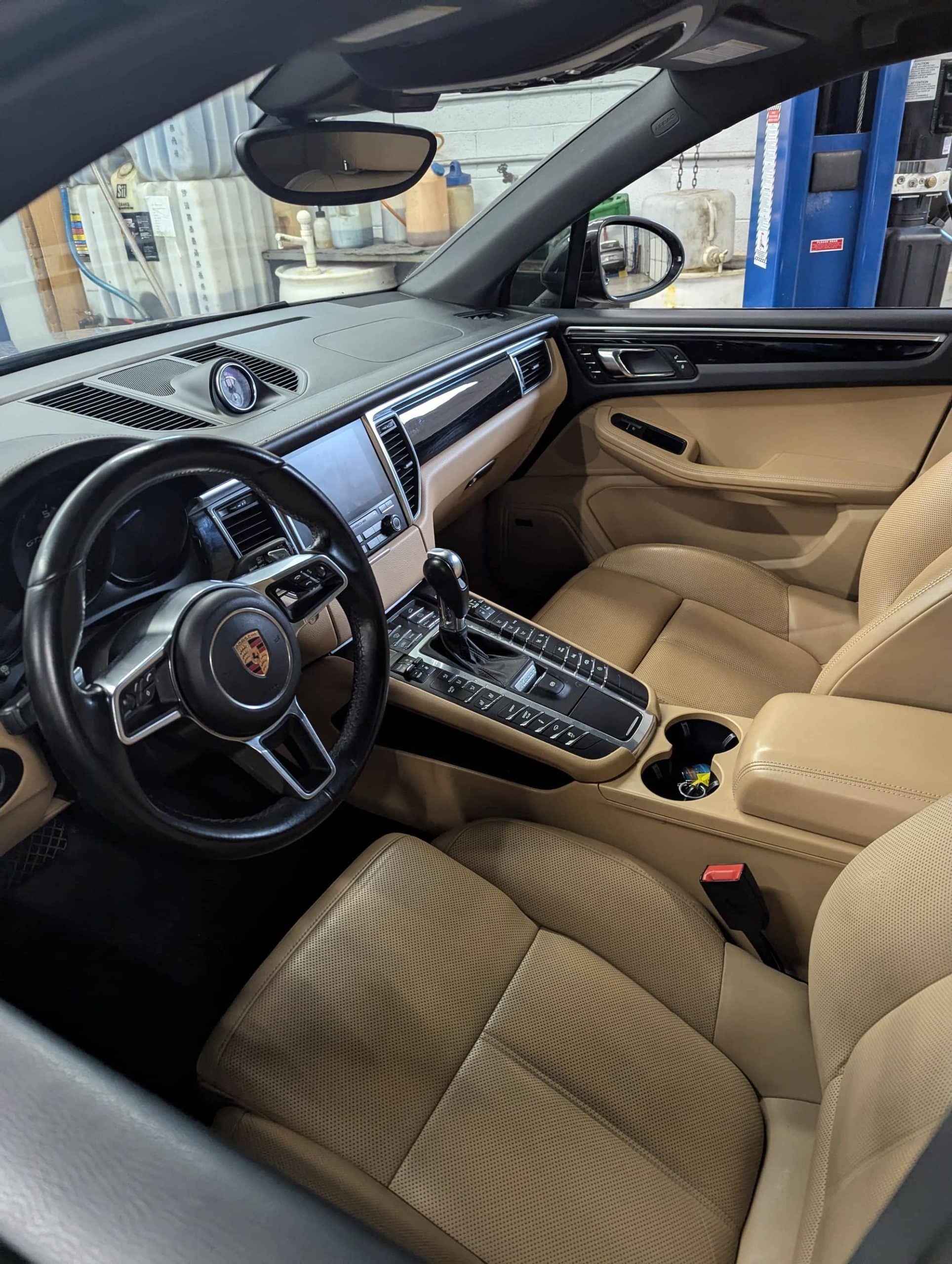
Mercedes-Benz Steering Repair at DART Auto
Mercedes-Benz steering systems blend hydraulic precision with electronic control in ways that catch generic shops off guard. The W221 S-Class introduced Active Body Control with steering-linked damping that requires simultaneous hydraulic and CAN-bus diagnostics. The W204 C-Class and W212 E-Class use electric power steering with torque-sensor calibration that drifts when rack bushings wear, creating phantom pull complaints that parts-swapping won't fix. Miss the software recalibration after a rack replacement on a 2015-2019 W205, and the driver fights constant lane-departure corrections that feel like a bent frame.
We use factory XENTRY diagnostics to baseline steering angle, torque curves, and hydraulic pressure before we turn a wrench. On AMG models with speed-sensitive variable-ratio racks, we follow Mercedes-Benz torque sequences and bleeding procedures that prevent air pockets in the tandem-pump system. Our salaried master technicians have dealer training on the transition from hydraulic to electromechanical systems across every platform since 2000, so we catch the interaction between steering faults and ESP/ABS modules that trigger limp-mode without obvious warnings.
When you bring your Mercedes-Benz to DART Auto for steering repair, expect:
- Complete hydraulic-pressure testing and fluid analysis to distinguish pump wear from rack leaks
- CAN-bus interrogation of steering-control modules, yaw sensors, and wheel-speed data
- OEM or premium aftermarket components with Mercedes-Benz-spec fluid and torque calibration
- Post-repair software adaptation and road-test validation backed by our 3-year/36,000-mile warranty
Common Steering Repair Issues on Mercedes-Benz Vehicles
Mercedes-Benz steering systems are engineered for precision, but certain platform-specific vulnerabilities surface as mileage accumulates. Generic shops often misdiagnose these failures or overlook the brand's unique calibration requirements, leading to repeat visits and escalating costs.
- Steering rack leaks on W211/W212 E-Class (2003–2016): The power steering rack develops seepage at the input shaft seal and rack boot connections, often mistaken for hose leaks. These platforms use ZF Servotronic II racks that require specific fluid (MB 236.3) and exact torque specs on the tie-rod lock nuts to preserve Agility Control calibration.
- Electromechanical steering column lock failure on W204/W212/W221 (2007–2014): The ELV module seizes or fails to release, stranding the vehicle. This is a known weakness tied to insufficient lubrication in the locking pawl mechanism. Replacement requires SCN coding via Xentry to marry the new module to the EIS (Electronic Ignition Switch).
- Steering damper wear on W463 G-Class (all generations): The recirculating-ball steering box and external damper absorb tremendous off-road and on-road shock. When the damper loses gas charge, the steering wheel oscillates violently over 50 mph. OEM Sachs dampers are valved specifically for the G-Wagen's high center of gravity and short wheelbase.
- Dynamic handling package valve-block clogs on W205/W213/W222 (2014–present): Vehicles equipped with Active Body Control or Dynamic Select use electrohydraulic valves to adjust rack assist. Contaminated fluid (often from deferred changes) clogs the valve spools, triggering "Steering malfunction – visit workshop" warnings and forcing the system into limp mode with heavy, unassisted steering.
- Tie-rod end play on W166/X166 ML/GL/GLE (2012–2019): The outer tie-rod ball joints develop excessive radial play due to dust-boot tears and road-salt intrusion. These platforms use a specific taper and thread pitch; aftermarket parts often lack the OEM's case-hardened ball stud, leading to premature wear and alignment drift.
- Steering angle sensor drift on pre-2010 models with ESP: The sensor ring inside the steering column loses its zero-point reference after battery disconnects or rack replacement. Without proper calibration using Star Diagnosis, ESP intervention becomes erratic and the ABS light illuminates intermittently.
Why Choose DART Auto for Mercedes-Benz Steering Repair
Mercedes-Benz steering systems – especially on models with Direct-Steer, Active Body Control, or the earlier Sensotronic Brake Control – demand more than a generic alignment and a parts swap. W221 S-Class platforms (2007–2013) are notorious for steering-column module failures that mimic rack issues, while W204 C-Class and W212 E-Class cars often suffer from flex-disc wear that transmits vibration into the steering wheel. Generic shops guess; we diagnose with factory-level tooling and cross-reference Mercedes-Benz Technical Service Bulletins before recommending a single part.
Our master technicians bring dealer training and at least a decade of hands-on experience with European platforms. We own the complete XENTRY diagnostic suite and the specialty pullers, alignment fixtures, and torque-angle tooling that Mercedes-Benz procedures specify. Because our techs are salaried – not flat-rate – they have every incentive to isolate the root cause rather than shotgun expensive components. You get an honest diagnosis, OEM or premium aftermarket parts from vetted suppliers, and a 3-year/36,000-mile warranty that backs the repair long after you drive away.
- Platform-specific knowledge: We recognize when a steering complaint traces to software calibration, hydraulic-fluid contamination, or a failing yaw sensor.
- Complete system verification: Every steering repair includes a post-work road test, scan-tool re-check for fault codes, and precision alignment to factory geometry.
- Transparent process: You receive a written estimate with photos and explanations before we turn a wrench, so there are no surprises at pickup.
Symptoms – How to Know You Need This Service
You may notice these warning signs that your Mercedes-Benz steering system needs attention:
- Groaning or whining from the front end during low-speed turns, especially when cold – hydraulic pump cavitation or low fluid from a leaking rack
- Steering wheel off-center after hitting a pothole or curb, even though the car tracks straight – inner tie-rod shift or rack bushing collapse
- Intermittent heavy steering that comes and go with engine load – failing serpentine belt or pump pulley bearing on hydraulic systems
- Dashboard warning "Visit Workshop" with steering-wheel icon – torque-sensor drift or control-module fault in electric power-steering models
- Vibration through the wheel at highway speed that changes with lane position – inner tie-rod play or rack-mount bushing wear
- Fluid puddle under the engine with oily residue on the subframe – high-pressure hose or rack seal leak
- Sudden loss of power assist with red steering warning – stop driving immediately; pump seizure or control-module failure can damage the rack
- Clunking over bumps that feels like it's coming from inside the dashboard – rack mounting points elongated in the subframe
Red steering warnings or complete loss of assist mean stop driving and arrange a tow. Groaning, off-center wheels, and fluid leaks should be scheduled within the week to prevent secondary damage.
Which Mercedes-Benz Models We See for Steering Repair
We service steering systems across the full Mercedes-Benz range, with particular depth on platforms from 2000 forward where hydraulic and electric systems overlap:
- W203 C-Class (2001–2007) – hydraulic rack seal leaks and pump-pulley bearing noise
- W204 C-Class (2008–2014) – electric power-steering torque-sensor drift and rack bushing wear
- W205 C-Class (2015–2021) – steering-angle recalibration after rack replacement, lane-keep interaction faults
- W211 E-Class (2003–2009) – SBC brake interaction with steering-control module, hydraulic hose failures
- W212 E-Class (2010–2016) – electric steering rack internal failures on high-mileage examples
- W213 E-Class (2017–2023) – software-dependent steering calibration and active-steering variants
- W221 S-Class (2007–2013) – Active Body Control hydraulic crossover with steering, tandem-pump diagnostics
- W222 S-Class (2014–2020) – Magic Body Control and active-steering integration requiring XENTRY
- W164 / W166 / W167 ML / GLE – heavier hydraulic loads, rack-mount fatigue from off-road use
- AMG variants (all platforms) – speed-sensitive variable-ratio racks, higher hydraulic pressures, sport-calibration software
We handle both hydraulic and electric power-steering architectures. For pre-2000 models or ultra-low-production Maybach variants, we evaluate on a case-by-case basis to confirm parts availability and diagnostic coverage.
Causes & Risks – What Happens if Ignored
Mercedes-Benz steering failures stem from a combination of high-mileage wear, fluid degradation, and Colorado's freeze-thaw cycles that accelerate boot cracking and seal deterioration. The brand's electrohydraulic and electromechanical systems are sensitive to contamination – a single moisture ingress event can corrode valve bodies or short control modules. Deferred maintenance on power steering fluid (MB specifies changes every 40,000 miles on many platforms) allows varnish to coat internal passages, restricting flow and overheating the pump.
Ignoring early symptoms – a slight pull, intermittent stiffness, or faint whine – allows secondary damage to compound rapidly:
- Rack seal leaks progress to internal bushing wear: What starts as a small seep at the boot becomes metal-on-metal contact inside the rack housing. Within 6–12 months, the rack develops slop and requires full replacement instead of a seal kit.
- Pump failure cascades to rack damage: A failing pump runs hotter and pushes debris downstream. The rack's control valve scores, and the entire hydraulic circuit becomes contaminated. Replacing only the pump leaves metal particles circulating, destroying the new unit within months.
- Tie-rod play accelerates tire wear and alignment instability: Loose outer ends allow the wheel to toe in and out under load. You'll burn through a set of front tires in 8,000 miles and fight constant steering-wheel wander. The inner tie-rod then fatigues from the oscillating stress.
- Electronic module corrosion becomes irreversible: Moisture that enters an ELV or steering control unit initially causes intermittent faults. Left unaddressed, the circuit boards corrode beyond repair, turning a $400 module replacement into a $1,200 emergency with programming.
- Loss of stability control during evasive maneuvers: A drifting angle sensor or failing rack means ESP can't calculate yaw rate accurately. In a panic stop or swerve, the system either fails to intervene or applies brakes asymmetrically, increasing crash risk.
Safety Impact – Why Steering Repair Matters
Steering system integrity is the foundation of vehicle control. On Mercedes-Benz platforms with integrated ESP, ABS, and active safety features, a compromised steering component doesn't just affect driver input – it blinds or misinforms every electronic stability system. A failed steering angle sensor feeds false data to the ESP controller, which then miscalculates slip angle and applies braking force to the wrong wheels during emergency lane changes. Rack play introduces unpredictable geometry changes that confuse lane-keeping assist and collision-avoidance systems, causing them to disengage or behave erratically.
When to stop driving immediately versus schedule promptly:
- Stop now: Sudden loss of power assist, steering wheel locked at ignition, clunking felt through the wheel during turns, fluid pouring onto the ground, or "Steering malfunction" message with red warning triangle.
- Schedule within days: Gradual increase in steering effort, whining noise that rises with RPM, visible seepage on the rack boots, steering wheel off-center after hitting a pothole, or intermittent ESP/ABS warning lights.
- Plan within weeks: Minor steering-wheel vibration at highway speed, slight pull to one side that's correctable with light pressure, or faint groaning during full lock in parking lots.
Insurance and liability considerations come into play if a known defect – documented by a warning light or prior inspection – goes unaddressed and contributes to a collision. Colorado law holds drivers responsible for maintaining vehicle safety systems; a failed steering component discovered post-accident can complicate claims and expose you to negligence arguments.
How Mercedes-Benz Steering Repair Actually Works
Mercedes-Benz employs rack-and-pinion steering with either hydraulic assist (older platforms) or electrohydraulic/electromechanical assist (2005-onward). The hydraulic systems use a belt-driven pump, high-pressure hoses, and a control valve integrated into the rack. Electrohydraulic setups replace the belt-driven pump with an electric motor driving a hydraulic pump on-demand, reducing parasitic drag and enabling speed-sensitive assist curves. Fully electric systems (EPS) on newer compact models use a brushless motor acting directly on the steering column or rack, with no fluid at all. Every configuration ties into the CAN bus, feeding steering angle, torque, and rate data to ESP, ABS, and driver-assistance modules.
Mercedes-Benz-specific design choices that shape the repair process:
- SCN coding and component protection: Steering control modules, angle sensors, and ELV units are VIN-locked. Replacement parts must be coded via Xentry Diagnostics to authenticate and enable full function. Generic scan tools cannot perform this step.
- Fluid specifications and bleeding sequences: MB 236.3 fluid (or CHF 11S on some AMG models) has specific viscosity and additive packages. Using generic ATF damages seals and valve coatings. Bleeding requires a defined steering-lock-to-lock sequence with the engine running to purge air from the rack's internal chambers.
- Torque-angle tightening on tie-rod lock nuts: Many platforms specify a two-stage torque-plus-angle procedure (e.g., 55 Nm + 90°) to preload the taper correctly. Under-torquing allows play; over-torquing cracks the taper seat. Both lead to premature failure.
- Steering angle sensor calibration: After rack replacement, tie-rod adjustment, or battery disconnect, the sensor has to be re-zeroed with factory software. Until that is done, ESP and the driver-assistance systems work from a false straight-ahead reference and can intervene when the car is tracking true.
How We Diagnose Steering Repair Issues on Mercedes-Benz
Most shops plug in a scanner, pull codes, and start guessing. That approach misses the platform-specific quirks Mercedes-Benz engineers built into the steering calibration and self-diagnostics – especially on W205 C-Class and W213 E-Class models with Dynamic Select and variable-ratio racks. We use factory-level XENTRY diagnostics and a structured process to pinpoint the actual failure before we turn a wrench.
- XENTRY scan and live data capture. We pull fault codes and monitor live steering-angle sensor data, rack position, and hydraulic or electric-assist parameters. On W222 S-Class and newer platforms with active steering, the scan reveals calibration drift and motor encoder faults that generic tools cannot see.
- Road test with data logging. We drive the vehicle through slow-speed parking maneuvers and highway lane changes while logging steering effort, return-to-center behavior, and any torque overlay anomalies. This captures intermittent faults that disappear when the car is stationary.
- Rack-and-pinion inspection on the lift. We check tie-rod end play, inner tie-rod socket condition, rack boot integrity, and fluid leaks on hydraulic systems. On electric-assist racks (common since 2014 on most platforms), we inspect the assist motor mounting and wiring harness for corrosion or physical damage.
- Steering-angle sensor calibration check. After any component replacement or alignment, we verify the sensor zero-point and recalibrate using XENTRY. Skipping this step leaves the ESP and lane-keeping systems fighting the corrected geometry.
Once diagnostics are complete, we walk you through what failed, why it failed, and the repair plan – with a detailed quote that separates parts, labor, and alignment so you know exactly what you're paying for and why.
Steering Repair on Mercedes-Benz: Repair vs. Replacement
The word "repair" can mean anything from tightening a loose bolt to swapping an entire rack assembly. Here's how we decide what makes sense for your Mercedes-Benz and your budget.
When a True Repair Is the Right Move
- Tie-rod ends and ball joints. These wear items can be replaced individually without touching the rack. On W204 C-Class and W212 E-Class, outer tie-rod ends are a common 80,000–100,000-mile wear item and take less than an hour per side.
- Steering-angle sensor recalibration. If the only fault is a calibration drift after an alignment or battery disconnect, we recalibrate the sensor using XENTRY – no parts required.
- Hydraulic fluid flush and seal replacement. On older hydraulic racks (pre-2014 on many platforms), a fluid flush and new seals can restore smooth operation if the rack itself isn't scored or leaking internally.
When Partial or Full Replacement Makes Sense
- Electric-assist motor failure. On 2014+ W205 and W213 platforms, the assist motor is a separate assembly. If the motor fails but the rack is sound, we replace the motor and reprogram the control module – saving the cost of a complete rack.
- Rack-and-pinion internal wear. If the rack has internal play, scoring, or persistent leaks, attempting a repair wastes your money. We install a remanufactured or new rack, align the car, and recalibrate the sensors in one visit.
We present both options with clear cost and longevity trade-offs, so you make the call that fits your plans for the vehicle.
How to Make Your Mercedes-Benz Steering Repair Last Longer
Once the steering is sorted, a few habits will keep it that way for years. Most of these cost nothing and take seconds.
Driving Habits That Protect the Rack and Linkage
- Avoid holding the wheel at full lock. Parking-lot three-point turns with the wheel cranked hard against the stop stress the rack and assist motor. Turn smoothly and release pressure once you're at the stop.
- Watch for curb strikes and pothole hits. A single hard impact can bend a tie-rod or knock the steering-angle sensor out of calibration. If you hit something, have the alignment and sensor checked even if the car feels fine.
- Let the hydraulic system warm up. On older hydraulic racks, the fluid is thick when cold. Give the car 30 seconds of idle before making sharp turns in freezing weather.
Owner-Level Checks You Can Do at Home
- Listen for new noises. Groaning during slow turns or clunking over bumps often means a tie-rod or rack mount is starting to fail. Catching it early keeps the repair small.
- Check for fluid spots under the car. Hydraulic racks leak as they age. A small spot today becomes a failed rack in six months if ignored.
- Monitor the steering-wheel position. If the wheel sits crooked when driving straight, the alignment has shifted or a tie-rod has bent. Get it checked before tire wear accelerates.
What to Leave to the Shop
Steering and suspension work directly affects your safety. Tie-rod replacement, alignment, and sensor calibration require torque specs, specialty tools, and factory procedures. We use OEM-spec parts and XENTRY calibration to keep your Mercedes-Benz tracking straight and your safety systems working as designed.
What to Expect When You Bring Your Mercedes-Benz In
Steering concerns deserve methodical attention. Here's how we handle your visit from the moment you schedule an appointment:
- Drop-off and intake: Bring your Mercedes-Benz at the agreed time. We'll ask you to describe the symptom – whether it's a pull, a vibration at highway speed, play in the wheel, or an intermittent warning light – and note any recent repairs or part replacements. Remove personal items from the cabin; we'll keep your key secure.
- System-wide inspection: Our technician connects XENTRY to pull stored and pending fault codes, then performs a static inspection of the rack, tie rods, flex disc, steering column, and all mounting bushings. On hydraulic systems we check fluid condition and pump operation; on electric-assist models we verify module communication and torque-sensor readings.
- Written estimate with photos: You'll receive a detailed quote that breaks down each failing component, explains why it matters, and outlines the consequences of delaying the fix. We include photos so you see exactly what we see.
- Authorized repair: Once you approve the estimate, we order OEM or premium parts, perform the repair to factory torque specs, and complete a four-wheel alignment if suspension geometry was disturbed.
- Road test and final scan: Before we call you, a technician drives your car to confirm the symptom is gone and re-scans for any new codes. If something still feels off after pickup, bring it back – we'll make it right at no additional charge.
We offer loaner vehicles and local shuttle service when available, so you stay mobile while we work. After-hours key drop and pickup can be arranged if your schedule demands it. You'll leave with a printed invoice, warranty documentation, and our direct shop number for any follow-up questions.
Our Mercedes-Benz Services
- Air Conditioning AC Repair
- Battery Repair Replacement
- Brake Repair & Brake Fluid Change
- Check Engine Light Diagnostics
- Clutch Repair & Replacement
- Coolant Leak Repair
- Cooling System Repair
- Drive Shaft Repair
- Engine Repair
- Exhaust & Catalytic Converter Repair
- Head Gasket Repair & Replacement
- Oil Change
- Oil Leak Repair
- Scheduled Service Maintenance
- Suspension Repair
- Cambelt Timing Belt Replacement
- Transmission Repair
- Tune Up
- Wheel Alignment


