
Mercedes-Benz Coolant Leak Repair at DART Auto
Last winter, a client drove his 2014 E350 into our shop with a faint sweet smell in the cabin and a coolant warning light that flickered on during his morning commute. By the time he arrived, we found coolant pooling beneath the thermostat housing – a common failure point on the M276 V6 where plastic components meet aluminum under constant thermal cycling. That small leak, left unattended, would have escalated into overheating, warped cylinder heads, and a repair bill ten times higher. Mercedes-Benz coolant systems demand precision: they run tighter tolerances, higher operating temperatures, and integrate electronic monitoring that generic shops often misinterpret.
Coolant leak repair on a Mercedes-Benz is not a universal procedure. The OM651 diesel, M276 and M278 gasoline engines, and older M272/M273 V6/V8 platforms each have distinct vulnerabilities – from brittle crossover pipes on the M272 to leaking oil cooler seals on the OM642 diesel. We use factory diagnostic software (Xentry, DAS) to read freeze-frame data, verify thermostat cycling, and confirm that the cooling fan clutch and auxiliary electric pump operate within spec. Our technicians follow OEM torque sequences for aluminum head bolts, use Mercedes-approved coolant (MB 325.0 or 326.0 spec), and bleed the system using the prescribed purge procedure to prevent air pockets that trigger false overheating warnings.
When you bring your Mercedes-Benz to DART Auto for coolant leak diagnosis and repair, you can expect:
- Comprehensive pressure testing of the entire cooling circuit, including expansion tank, radiator, hoses, heater core, and all engine-mounted seals
- OEM-spec parts and fluids sourced from trusted suppliers – genuine Mercedes or premium aftermarket components that meet or exceed factory standards
- Complete system bleed and verification using factory procedures, ensuring no air locks and confirming proper thermostat operation with live data
- 3-year/36,000-mile warranty on parts and labor, backed by transparent estimates and no-rush, salaried technicians who fix it right the first time
Common Coolant Leak Repair Issues on Mercedes-Benz Vehicles
A customer brought in a 2013 E350 last month with a persistent coolant smell but no visible puddles. The leak only appeared after the engine reached full operating temperature – a telltale sign of expansion-related failure. Within two days of that first visit, the low-coolant warning turned into a full overheat on I-25. What started as a slow seep became a tow truck call and a warped cylinder head.
Mercedes-Benz coolant systems are engineered for precision, but that same precision makes them vulnerable to specific failure modes as components age. Here's what we see most often:
- Plastic thermostat housing cracks on M272 and M273 V6/V8 engines (2006–2011): The factory housings are molded plastic with integrated coolant passages. Thermal cycling causes stress fractures at mounting bolt bosses and around the thermostat seat. The housing often weeps coolant onto the alternator and serpentine belt, creating secondary electrical faults.
- Auxiliary water pump failures on W204 and W212 platforms (2008–2016): Mercedes-Benz uses electric auxiliary pumps to circulate coolant after shutdown for turbo cooling and cabin heat. The pump seals degrade, leaking coolant into the motor windings. You'll smell coolant in the cabin or see steam from the firewall area when parked.
- Radiator end-tank separation on W211 E-Class and W220 S-Class (2003–2009): The crimped seam between the aluminum core and plastic end tanks fails under pressure cycling. Leaks start as slow seepage at the tank joint, then progress to catastrophic separation during highway driving when the system is at peak pressure.
- Oil cooler O-ring leaks on OM642 diesel V6 (2007–2016 GL, ML, E, S-Class): The oil-to-coolant heat exchanger sits in the valley of the V6. The large O-rings harden and shrink, allowing coolant to weep into the valley and mix with engine oil. Early signs include milky oil on the dipstick or rapid coolant loss with no external puddles.
- Expansion tank cracking on W221 S-Class and W164 ML-Class (2006–2013): The pressurized reservoir develops stress cracks at the seams and sensor mounting points. Cracks often start invisibly small, then split wide open during a cold start when the system pressurizes quickly.
- Heater core leaks on W211 and W219 platforms (2003–2011): The core sits deep behind the dashboard. Leaks drip onto the passenger-side carpet or fog the windshield from the inside. Replacement requires full dash removal – a job that escalates quickly if delayed until the carpet is soaked and mold sets in.
Why Choose DART Auto for Mercedes-Benz Coolant Leak Repair
A customer brought in a 2014 E350 last month with a faint sweet smell and a damp spot under the engine. The dealer quoted a full radiator replacement. Our technician pressure-tested the system with Mercedes-Benz STAR diagnostic equipment and found the real culprit: a failed thermostat housing gasket, a known weakness on the M276 V6. We replaced the housing with an OEM part, verified coolant flow with live data, and saved the owner over $800 compared to the dealer's estimate.
That level of precision is what sets DART Auto apart for Mercedes-Benz coolant leak repair:
- Platform-specific diagnostics: We use STAR and Xentry diagnostic software to read coolant temperature sensors, monitor pump operation, and spot air pockets that generic scan tools miss.
- OEM repair procedures: Mercedes-Benz coolant systems require specific bleeding sequences and torque specs. We follow factory service information to the letter, ensuring proper fill and zero air locks.
- Master technicians with dealer training: Every tech has at least ten years of experience and knows the common failure points across W204, W212, W221, and newer MRA platforms.
- Salaried compensation model: Our technicians aren't paid flat-rate, so there's no incentive to rush diagnosis or recommend parts you don't need.
- Three-year, 36,000-mile warranty: We stand behind every coolant leak repair with parts and labor coverage that rivals or exceeds the dealer.
Symptoms – How to Know You Need This Service
Mercedes-Benz cooling systems give you clear warnings when a leak develops, but the severity varies. You may notice:
- Sweet smell in the cabin or under the hood – ethylene glycol has a distinctive odor, often strongest after shutdown when residual heat vaporizes coolant from a leak point
- Coolant level warning on the instrument cluster – Mercedes systems monitor reservoir level electronically; repeated low-coolant messages mean you're losing fluid faster than evaporation alone
- Puddles or stains beneath the car – pink, green, or orange fluid pooling under the engine bay, often visible on your garage floor after overnight parking
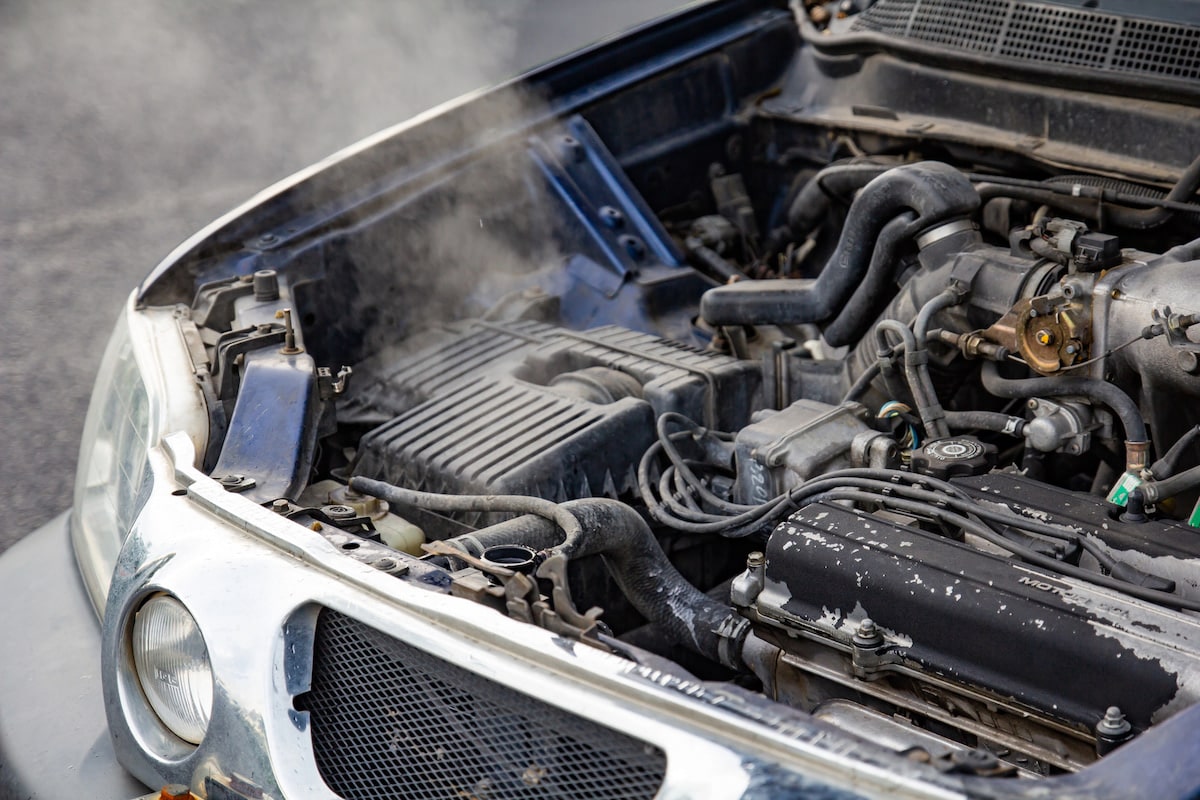
- Steam or mist from the engine compartment – pressurized coolant escaping onto hot exhaust manifolds or turbocharger housings creates visible vapor
- Temperature gauge climbing above normal – if the needle moves toward the red zone or the auxiliary fan runs constantly, you've lost enough coolant to compromise heat transfer
- White residue or crusty deposits around hose connections, thermostat housing, or radiator end tanks – dried coolant leaves telltale mineral streaks
- Heater blowing cold air at idle – air pockets from a leak prevent hot coolant from reaching the heater core, especially noticeable in winter
- Overheating warning with limp mode activation – if you see a red temperature warning and the engine cuts power, stop immediately and call for a tow; continued driving risks catastrophic head gasket or block damage
Minor seepage can often wait a few days for an appointment, but any combination of rising temperature, steam, or dashboard warnings means you should stop driving and arrange transport to avoid engine damage.
Which Mercedes-Benz Models We See for Coolant Leak Repair
We diagnose and repair coolant leaks across the full range of modern Mercedes-Benz platforms. The most common visits involve:
- W204 C-Class (2008–2014) – M272 V6 and M276 V6 engines, frequent thermostat housing and crossover pipe leaks
- W212 E-Class (2010–2016) – M276 V6, M278 V8, and OM642 diesel; oil cooler seals and auxiliary water pump failures common on diesel variants
- W221 S-Class (2007–2013) – M273 and M278 V8 platforms, radiator end-tank cracking and expansion tank splitting under pressure cycling
- W166 ML/GLE (2012–2019) – M276 V6 and OM642 diesel, heater core leaks and coolant crossover pipe brittleness on higher-mileage examples
- W205 C-Class (2015–2021) – M274 turbo four-cylinder and M276 V6, thermostat housing and water pump seal leaks
- W213 E-Class (2017–present) – M264 and M256 inline-six mild-hybrid platforms, integrated electric water pump and coolant control valve diagnostics require Xentry software
- X253 GLC (2016–present) – M274 four-cylinder turbo, coolant flange and expansion tank failures, particularly on early production years
- AMG variants (C63, E63, S63, GLC63) – M156, M157, and M177/M178 twin-turbo V8 engines; high-performance cooling demands lead to accelerated hose and seal wear
- Sprinter vans (2007–present) – OM651 and OM654 diesel engines, EGR cooler and charge air cooler leaks into the coolant circuit
We also service older W203, W211, and R230 SL platforms, though parts availability and repair complexity increase on pre-2005 models. If you drive a rare or limited-production variant, call ahead so we can confirm parts sourcing and diagnostic capability for your specific chassis.
Causes & Risks – What Happens if Ignored
Mercedes-Benz coolant leaks don't appear randomly. The primary culprits are thermal stress, pressure cycling, and material aging. Denver's temperature swings – from subzero winter mornings to 95-degree summer afternoons – accelerate the expansion and contraction that fatigues plastic components. Mercedes-Benz engineers specify long-life coolant and high-pressure systems (often 20+ PSI at operating temperature), which places continuous stress on every seal, hose, and joint. Add in the fact that many Mercedes-Benz platforms use plastic housings and composite radiators to save weight, and you have components with a finite service life.
When a small leak is ignored, the damage compounds in predictable stages:
- Week one: Low coolant level reduces heat transfer efficiency. The engine runs slightly hotter than design spec, stressing head gaskets and valve seals.
- Week two to four: Air enters the system through the leak point. Air pockets prevent proper circulation, causing localized hot spots. The temperature gauge may fluctuate erratically or the heater may blow cold intermittently.
- Month two: Repeated low-coolant cycles cause the water pump to cavitate, accelerating bearing wear. The auxiliary electric pump runs longer cycles trying to compensate, shortening its lifespan. Coolant mixing with oil (in the case of oil cooler leaks) begins to sludge the lubrication system.
- Month three and beyond: A full overheat event warps the aluminum cylinder head. On M272/M273 engines, head bolt threads in the block can pull out, requiring a complete short-block replacement. Turbochargers on diesel and AMG models can seize from inadequate cooling. Transmission coolers integrated into the radiator can fail, cross-contaminating coolant and ATF.
The cost difference between addressing a leaking thermostat housing today versus replacing a warped head and damaged turbo six months from now is often ten-fold. More immediately, an overheat on the highway leaves you stranded and at risk.
Safety Impact – Why Coolant Leak Repair Matters
Coolant leaks compromise more than just engine longevity. When the cooling system fails, multiple safety-critical systems lose function. Modern Mercedes-Benz vehicles rely on stable engine temperatures to maintain emissions compliance, throttle response, and transmission shift logic. An overheating engine triggers limp mode, cutting power to 30% and disabling cruise control – dangerous when merging onto a highway or climbing a mountain pass.
Specific safety risks include:
- Loss of cabin heat in winter: A low coolant level or air-locked heater core means no defrost capability. Iced-over windshields and fogged windows create zero-visibility conditions.
- Sudden power loss: Limp mode activation can occur without warning if a temperature sensor detects a dangerous spike. You lose acceleration authority in traffic, increasing rear-end collision risk.
- Steam and vapor in the cabin: Heater core leaks release hot, pressurized coolant vapor into the HVAC system. Inhaling ethylene glycol vapor causes dizziness and respiratory irritation, impairing driver alertness.
- Fire risk from coolant on hot components: Coolant spraying onto exhaust manifolds, turbochargers, or catalytic converters can ignite. We've seen engine bay fires start from a failed upper radiator hose soaking the exhaust.
When to stop driving immediately: temperature gauge in the red, steam from the hood, sweet smell in the cabin, or a "Stop Vehicle Leave Engine Running" message. When to schedule within the week: visible puddles under the car, low-coolant warning light, erratic temperature readings, or coolant smell after shutdown.
How Mercedes-Benz Coolant Leak Repair Actually Works
Mercedes-Benz cooling systems are closed-loop, pressurized networks designed to maintain a precise operating temperature – typically 90–105°C depending on the engine. The system uses a mechanical water pump driven by the serpentine belt, one or more electric auxiliary pumps for post-shutdown circulation, a thermostat to regulate flow, and a radiator with integrated transmission and oil coolers. The expansion tank is pressurized, not vented, which allows the coolant to absorb more heat without boiling but also places continuous stress on every seal and joint.
What makes Mercedes-Benz different:
- Integrated cooling modules: Many platforms combine the radiator, condenser, transmission cooler, and oil cooler into a single front-end assembly. A leak in one component often requires replacing the entire module due to crimped or welded construction.
- Electronic auxiliary pumps with CAN-bus control: The engine control unit commands the aux pump based on coolant temperature, turbo spool-down needs, and cabin heating demand. Diagnosing a pump fault requires reading fault codes from the ECU and testing pump activation with factory-level scan tools.
- Coolant-spec requirements: Mercedes-Benz specifies low-silicate, ethylene-glycol coolant meeting MB 310.1 or 325.0 standards. Using generic "universal" coolant causes corrosion in aluminum components and clogs the heater core. Mixing coolant types creates gel that blocks passages.
- Bleeding and purge procedures: After any cooling system repair, the system must
How We Diagnose Coolant Leak Repair Issues on Mercedes-Benz
A customer arrived last month with a 2015 Mercedes-Benz C300 (W205 platform) complaining of a sweet smell in the cabin and a low coolant warning. The leak was small enough that it hadn't left obvious puddles, but the expansion tank level kept dropping. That's the kind of problem where rushed guesswork costs owners hundreds in unnecessary parts. We follow a methodical diagnostic sequence designed around Mercedes-Benz architecture and common failure points on platforms like the W205, W212, and W222.
- Visual and Static Inspection: We start with the engine cold, checking the expansion tank, radiator, hoses, and thermostat housing for visible seepage, corrosion staining, or brittle plastic. On M274 and M276 engines, the thermostat housing and coolant crossover pipes are known weak points. We also inspect the auxiliary water pump and heater core connections, which often show early signs of weeping on higher-mileage cars.
- Pressure Testing: We use a cooling system pressure tester to pressurize the system to factory specification (typically 1.4–1.8 bar depending on model). This static test reveals slow leaks that only appear under operating pressure. We watch for pressure drop and trace the source – sometimes it's a pinhole in a plastic flange, sometimes a failing water pump seal.
- Dye Injection and UV Inspection: For elusive leaks, we add UV-reactive dye to the coolant and run the engine through heat cycles. Under UV light, even trace leaks fluoresce brightly. This is especially useful on V6 and V8 models where components are buried behind intake manifolds or accessory drives.
- XENTRY Diagnostics: We connect Mercedes-Benz XENTRY diagnostic equipment to read fault codes and live data from the engine control module and auxiliary coolant pump controllers. The system logs coolant temperature deviations, pump duty cycle anomalies, and thermostat performance – data that pinpoints internal failures like a stuck thermostat or failing auxiliary pump before they cause overheating damage.
- Road Test and Heat Cycle: We drive the vehicle to bring it to full operating temperature, monitoring coolant temp and watching for steam or drips once parked. Some leaks only appear when the system is hot and pressurized, or when the auxiliary pump cycles on after shutdown.
Once we've isolated the source, we document findings with photos and provide a detailed quote that explains exactly what's leaking, why it matters, and what the repair entails. You'll know whether you're looking at a simple hose clamp or a full water pump replacement before any wrench turns.
Coolant Leak Repair on Mercedes-Benz: Repair vs. Replacement
Not every coolant leak means replacing an entire assembly, but knowing when to repair versus replace requires experience with Mercedes-Benz engineering and failure patterns. We walk through the decision with every customer so you understand what you're paying for and why.
When a True Repair Makes Sense
- Loose or degraded hose clamps: Often the fix is as simple as replacing spring clamps with proper worm-drive clamps and inspecting hose ends for hardening. If the hose itself is still pliable and crack-free, we reuse it.
- Thermostat housing O-rings: On many M276 and M278 engines, the thermostat housing uses replaceable O-rings. If the housing plastic isn't cracked or warped, we can replace just the seals and thermostat element, saving the cost of the full housing assembly.
- Expansion tank cap: A failing pressure cap can cause coolant to vent prematurely or allow air into the system. Replacing the cap is a low-cost repair that sometimes solves nuisance overflow issues without touching the tank itself.
When Partial Replacement Is the Right Call
- Water pump with serviceable components: Some Mercedes-Benz water pumps allow replacement of the seal and impeller without replacing the entire pump housing. If the housing and bearings are sound, this extends service life at lower cost.
- Coolant crossover pipe on M274 engines: The plastic crossover pipe on the 2.0L turbo four is a known failure point. We replace the pipe and its O-rings as an assembly, but the surrounding hoses and fittings often remain serviceable.
When Full Replacement Is Necessary
- Cracked expansion tanks: Plastic expansion tanks on W212 E-Class and W221 S-Class models often develop stress cracks around mounting tabs or seams. Once cracked, the tank must be replaced – repairs don't hold under pressure and heat cycling.
- Failed auxiliary water pumps: The electric auxiliary coolant pump on many Mercedes-Benz models (especially turbocharged engines) is a sealed unit. When the motor or impeller fails, the entire pump assembly is replaced.
- Radiator with internal corrosion or tank separation: If the radiator core is corroded or the plastic end tanks are separating from the aluminum core, replacement is the only safe option. Attempting to patch a radiator on a modern Mercedes-Benz invites catastrophic failure and potential engine damage.
We explain the pros, cons, and expected service life of each option. Our technicians are salaried, not flat-rate, so there's no incentive to upsell you into parts you don't need. If a repair will get you another 50,000 miles safely, we'll tell you. If replacement is the smarter long-term investment, we'll explain why.
How to Make Your Mercedes-Benz Coolant Leak Repair Last Longer
Once we've fixed your coolant leak, a few proactive habits will help you avoid repeat failures and catch small issues before they become expensive problems. Mercedes-Benz cooling systems are engineered for long service intervals, but they reward owners who pay attention to the details.
Driving Habits That Protect Your Cooling System
- Allow proper warm-up: Let the engine reach operating temperature before aggressive acceleration or high loads. Cold starts with immediate hard driving stress the thermostat and water pump, especially on turbocharged models.
- Avoid prolonged idling in extreme heat: Sitting in traffic on hot days with the air conditioning running puts maximum load on the cooling system. If you notice the temperature gauge climbing, turn off the A/C and turn on the heater to help dissipate heat.
- Monitor coolant temperature on spirited drives: If you enjoy using your Mercedes-Benz's performance, keep an eye on coolant temp during extended high-RPM driving. If temps climb above normal, back off and let things cool down before continuing.
Maintenance and Monitoring You Can Do
- Check coolant level monthly: Pop the hood when the engine is cold and verify the expansion tank level is between the min and max marks. A slow drop over weeks indicates a small leak that's worth investigating before it becomes a roadside emergency.
- Look for staining or residue: White or green crusty deposits around hose connections, the radiator cap, or under the engine suggest seepage. Catching these early means a simple hose clamp or O-ring instead of a full component replacement.
- Listen for unusual sounds: A failing water pump or auxiliary pump often makes a whining, grinding, or rattling noise. If you hear something new from the front of the engine or near the firewall, have it checked promptly.
- Pay attention to warning lights and messages: Mercedes-Benz instrument clusters display specific coolant-related warnings. Don't ignore a "Coolant Low" or "Check Coolant" message – address it within a few days, not a few weeks.
Brand-Specific Care That Matters
- Use only MB-approved coolant: Mercedes-Benz specifies coolant formulations (MB 325.0, 325.3, 325.5, 326.0, 326.3, 326.5, 326.6 depending on model year and engine) engineered for the alloys and plastics in your cooling system. Mixing generic coolant can cause corrosion and gasket degradation. We use OEM or approved-equivalent coolant on every service.
What to Expect When You Bring Your Mercedes-Benz In
We've designed our process to keep you informed at every step, so you know exactly what's happening with your vehicle and why.
- Drop-off and intake: Schedule an appointment or call ahead. We'll ask about symptoms – low coolant warnings, visible leaks, overheating, or steam from the engine bay. If you need a loaner or shuttle service, let us know when you book.
- Initial inspection and pressure test: A technician performs a visual inspection of hoses, reservoir, radiator, water pump, and thermostat housing. We then pressure-test the cooling system and use STAR diagnostics to check sensor readings and scan for fault codes related to coolant temperature or flow.
- Written estimate and explanation: You'll receive a detailed estimate that names the failed component, explains why it's leaking, and outlines the repair procedure. We'll also note any related items – like aged hoses or a weak expansion tank – and let you decide whether to address them now or monitor them.
- Repair and OEM parts sourcing: We use genuine Mercedes-Benz parts or premium aftermarket equivalents from trusted European suppliers. Every repair follows factory torque specs and bleeding procedures to prevent air pockets.
- Post-repair verification: After the repair, we road-test the vehicle to operating temperature, verify coolant flow with live data, and re-scan for codes. You'll get a walk-through at pickup, and if anything feels off in the days that follow, call us – we'll make it right.
Remove personal items from the cabin before drop-off. If you need after-hours pickup, we can arrange secure key drop and vehicle release.
Our Mercedes-Benz Services
- Air Conditioning AC Repair
- Battery Repair Replacement
- Brake Repair & Brake Fluid Change
- Check Engine Light Diagnostics
- Clutch Repair & Replacement
- Cooling System Repair
- Drive Shaft Repair
- Engine Repair
- Exhaust & Catalytic Converter Repair
- Head Gasket Repair & Replacement
- Oil Change
- Oil Leak Repair
- Scheduled Service Maintenance
- Steering Repair
- Suspension Repair
- Cambelt Timing Belt Replacement
- Transmission Repair
- Tune Up
- Wheel Alignment