
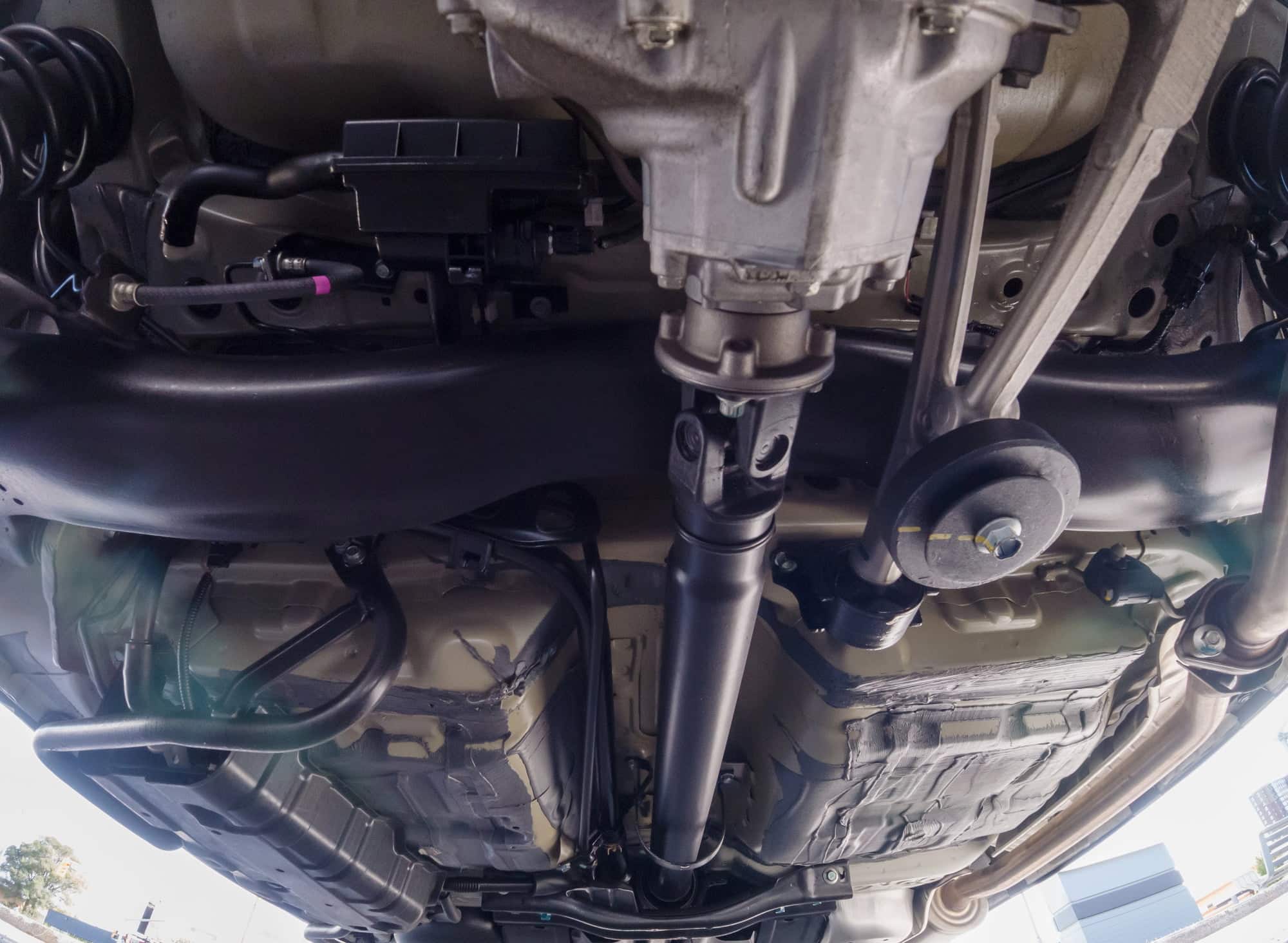
Audi Drive Shaft Repair at DART Auto
Audi quattro systems place unique demands on drive shafts that generic shops routinely underestimate. The C5/C6 A6 and D3/D4 A8 quattro platforms, for example, use a two-piece front drive shaft with a center support bearing that fails prematurely when torque specifications aren't followed during installation. We've seen shops reuse one-time-use hardware or skip the alignment procedure entirely, leading to vibration and premature CV joint wear within months. B8/B8.5 A4 and Q5 models with the eight-speed automatic transmissions require precise phasing of the front and rear shafts to avoid driveline harmonics that manifest as a 70-mph drone.
DART Auto uses factory repair information and the same diagnostic protocols Audi technicians follow. We verify run-out with a dial indicator, replace all stretch bolts and crush washers per OEM procedure, and torque every fastener to the platform-specific value. Our master technicians have dealer training on quattro systems and understand how the Haldex or Torsen differential affects drive shaft loading. Salaried compensation means they take the time to inspect companion flanges, flex discs, and the transmission output seal – catching secondary issues before they strand you.
When you bring your Audi to DART Auto for drive shaft repair, you can expect:
- Complete driveline inspection including CV boots, center support bearings, flex discs, and companion flanges
- OEM or premium aftermarket components sourced from ZF, GKN, or Audi Genuine Parts
- Proper phasing and alignment using factory procedures and specialty tooling
- 3-year/36,000-mile warranty on parts and labor – confidence in long-term reliability
Common Drive Shaft Repair Issues on Audi Vehicles
Audi's Quattro all-wheel-drive architecture puts unique stress on driveline components that front-wheel-drive platforms never see. The constant torque split between front and rear axles, combined with Audi's preference for longitudinal engine mounting, creates specific failure patterns that generic shops often misdiagnose as transmission or differential problems.
- CV joint boot tears on B8/B8.5 A4/A5 Quattro (2009–2016): The front drive shafts on these platforms use a triple-roller CV joint design that's particularly vulnerable to boot failure from road debris and winter salt exposure. Once the boot tears, contamination reaches the bearing surfaces within weeks, leading to clicking under load and eventual joint seizure. The OEM boot material changed mid-generation but remains a high-wear item.
- Center bearing carrier failure on C7 A6/A7 3.0T (2012–2018): The two-piece rear drive shaft assembly uses a rubber-isolated center support bearing that deteriorates from heat cycling and road salt. Early symptoms include a vibration at 45–55 mph that feels like a tire balance issue. Left unaddressed, the bearing disintegrates, allowing the shaft to contact the underbody and damaging exhaust components or fuel lines.
- Rear CV axle wear on MQB-platform Q3/Q5 (2018+): The compact transverse-mounted Quattro system on these crossovers runs shorter, more acutely angled rear axles that accelerate inner CV joint wear. Owners report clunking during tight parking-lot turns – a telltale sign the tripod joint has developed play. The factory torque spec for the axle nut is platform-specific and requires a calibrated torque wrench; undertightening leads to hub bearing damage.
- Propeller shaft flex disc deterioration on older longitudinal Quattro models (pre-2010): The guibo-style coupling between the transmission and center differential uses a rubber disc that hardens with age and eventually cracks. This creates a rhythmic clunk during acceleration/deceleration and can shear completely, leaving the vehicle stranded with no rear-axle power delivery.
- Spline wear on manual-transmission Quattro models (B5/B6/B7 S4, TT): Hard launches and aggressive clutch dumps cause the inner splines on the drive shaft to wear oval, creating rotational slop. The symptom is a metallic clunk when transitioning from throttle to coast. Replacement requires OEM-spec spline engagement depth measurement to prevent premature failure of the new shaft.
- Haldex coupling contamination affecting rear axle delivery on transverse Quattro (A3, TT, Q3): While not the drive shaft itself, contaminated Haldex fluid or a failing pump starves the rear differential of torque, causing the rear axles to see uneven load distribution and accelerated CV joint wear. Addressing Haldex service alongside drive shaft work prevents comebacks.
Why Choose DART Auto for Audi Drive Shaft Repair
Audi quattro and longitudinal FWD platforms place unique demands on drive shafts that generic shops often overlook. B8/B9 A4 allroad models frequently develop CV joint wear due to increased articulation angles under load, while C7 A6 3.0T quattro variants see inner tripod joint failures when shops reuse original clamps during axle replacement. We stock OEM-spec constant-velocity joints and use the factory-prescribed grease formulations – not the universal substitutes that cause premature wear.
Our diagnostic process starts with ODIS-compatible scan tools that read Audi-specific fault codes in the drivetrain control modules, catching issues like wheel-speed sensor drift or torque-vectoring faults that mimic drive shaft symptoms. We verify drive shaft runout and balance on a dedicated fixture before installation, then road-test under the exact conditions that triggered your concern – highway merges, tight parking-lot turns, cold starts. Because our technicians are salaried rather than flat-rate, there's zero incentive to swap parts without confirming root cause. We've been diagnosing Audi driveline vibrations since the B5 Passat platform, and that two-decade depth shows in how quickly we isolate whether you need a shaft, a wheel bearing, or just a rebalanced wheel.
- Platform-specific torque specs: We follow Audi's angle-torque procedures for triple-square drive shaft bolts, preventing the loosening that causes clunking on MQB and MLB platforms.
- Post-repair calibration: After any quattro drive shaft work, we verify torque distribution with live data to confirm the differential isn't compensating for a lingering imbalance.
- OEM and premium aftermarket sources: GKN, Lobro, and Rein components meet or exceed original equipment standards without the dealer markup.
Symptoms – How to Know You Need This Service
Drive shaft issues announce themselves through vibrations and noises that change with speed and load. You may notice:
- Vibration at highway speed – a rhythmic shudder between 60 and 75 mph that smooths out above or below that range, often pointing to an out-of-balance drive shaft or worn center support bearing
- Clunking when accelerating or shifting – a distinct thunk from underneath the car during throttle application or gear changes, indicating worn CV joints or loose flex disc bolts
- Squeaking or grinding during turns – especially in tight parking maneuvers, suggesting outer CV joint wear on quattro models
- Visible grease on the undercarriage – torn CV boots allow grease to fling outward, leaving streaks on the underbody and exhaust components
- Metallic clicking that increases with speed – a rapid ticking noise that accelerates with wheel speed, signaling advanced CV joint damage
- Drivetrain warning light – on newer Audi models with torque vectoring, a failing drive shaft can trigger fault codes for the quattro system or transmission
If you hear loud clunking, grinding, or experience sudden vibration accompanied by loss of power delivery, stop driving immediately. A separated CV joint or failed center bearing can damage the transmission, transfer case, or differential. For persistent vibration or early-stage clicking, schedule an inspection soon to prevent collateral damage.
Which Audi Models We See for Drive Shaft Repair
Drive shaft work spans nearly every Audi quattro platform, though failure modes and service procedures vary by generation. We routinely service:
- B5/B6/B7 A4 and S4 (1996–2008) – front and rear CV joints, center support bearings on V6 and V8 models
- B8/B8.5 A4, A5, S4, S5 (2009–2016) – two-piece front drive shafts with problematic center bearings, eight-speed transmission phasing requirements
- C5/C6/C7 A6, allroad, S6 (1998–2018) – complex multi-piece drive shafts, flex disc replacements, and output shaft seal issues on 2.7T and 3.0T engines
- D2/D3/D4 A8, S8 (1997–2017) – heavy-duty drive shafts with large-diameter CV joints, aluminum propeller shafts requiring careful balancing
- Q5, Q7, Q8 (2009–present) – Haldex-equipped models with rear drive module integration, software adaptation after drive shaft replacement
- TT, TTS, TTRS (Mk2/Mk3, 2007–present) – transverse-engine quattro with front axle half-shafts prone to boot tears
- R8 (2008–present) – mid-engine layout with short, high-angle CV shafts requiring precision installation
Manual transmission and S/RS variants often use upgraded CV joints with different service intervals. We stock components for both Torsen and Haldex quattro systems. Older C4 and early B5 platforms require sourcing, so call ahead for pre-2000 models.
Causes & Risks – What Happens if Ignored
Drive shaft issues on Audi Quattro models stem from three primary sources: the constant torque delivery inherent to all-wheel drive, Colorado's temperature extremes cycling rubber components through freeze-thaw cycles, and road salt attacking protective boots and bearings. Audi's longitudinal driveline layout means the propeller shaft runs the length of the vehicle, exposed to road debris, undercarriage moisture, and thermal stress from the exhaust system. Unlike front-drive platforms where axles see intermittent load, Quattro shafts work continuously.
Delaying repair transforms a contained component failure into a cascading system problem:
- Torn CV boot ignored for 500–1,000 miles: Grease flings out, water and grit enter the joint, bearing surfaces pit and score. What starts as a $180 boot replacement becomes a $650 axle assembly replacement plus potential hub bearing damage from the vibration.
- Center bearing vibration left unaddressed for 2,000+ miles: The failing bearing allows shaft runout, which hammers the transmission output seal and rear differential input seal. Now you're chasing fluid leaks, risking differential bearing damage from low oil, and facing a repair bill that includes seals, fluid, and potentially differential work – easily tripling the original cost.
- Clunking CV joint driven through winter: The worn tripod bearings allow the axle to shift under load, ovaling out the differential side-gear splines. Replacing the axle no longer solves the problem; the differential now needs internal work or replacement, turning a $400 repair into a $2,200+ job.
- Flex disc cracks propagating: The rubber disc fails catastrophically during hard acceleration, and the unsupported propeller shaft flails against the exhaust system, denting the catalytic converter or severing an oxygen sensor harness. You're stranded, and the tow bill is just the beginning.
- Spline wear creating slop: The rotational play hammers the transmission output shaft bearing, eventually causing internal transmission noise and requiring a transmission-out repair that dwarfs the cost of addressing the drive shaft early.
Safety Impact – Why Drive Shaft Repair Matters
A failing drive shaft compromises Audi's Quattro torque vectoring and stability control systems. The ESP and ABS modules rely on predictable torque delivery to all four wheels; when a CV joint binds or a center bearing allows shaft deflection, the wheel-speed sensors detect anomalies that can trigger limp mode or disable stability intervention at exactly the wrong moment – mid-corner on a snowy I-70 descent, for example.
Specific safety risks include:
- Sudden torque loss to one axle: A catastrophic flex disc or CV joint failure cuts power to the rear wheels without warning. On a slippery uphill grade, the front wheels alone may not provide enough traction, leaving you stuck in traffic or sliding backward.
- Vibration-induced steering interference: Severe center bearing runout transmits through the chassis, creating steering wheel shake that masks road feedback and makes emergency maneuvers less precise.
- Wheel separation risk: An improperly torqued axle nut (common when DIYers skip the OEM spec) allows the CV joint to back out of the hub, potentially separating the wheel assembly at highway speed.
- Undercarriage component damage: A detached propeller shaft can sever brake lines, fuel lines, or ABS sensor wiring, creating multiple simultaneous failures.
Stop driving immediately if: you hear a loud snap followed by loss of power, see fluid pooling under the center of the vehicle, or experience violent vibration above 30 mph. Schedule within the week if: you notice clicking during turns, clunking when shifting from drive to reverse, or vibration at specific speeds that wasn't present before.
How Audi Drive Shaft Repair Actually Works
Audi's Quattro system uses a longitudinally mounted engine with the transmission ahead of the front axle, sending power rearward through a center differential (mechanical Torsen on most models, electronically controlled on S/RS variants) and a two- or three-piece propeller shaft to the rear differential. The front and rear axles use constant-velocity joints – typically a fixed Rzeppa joint at the wheel hub and a plunge-capable tripod or double-offset joint at the differential – allowing suspension travel while transmitting torque through variable angles.
What makes Audi driveline work different:
- Torque distribution calibration: After replacing a drive shaft or CV axle, the Quattro controller may need adaptation using VAS or ODIS diagnostic software to relearn torque split parameters. Generic OBD-II scanners can't access these modules.
- Specific torque sequences: Audi specifies angle-torque procedures (torque to X ft-lbs, then rotate an additional Y degrees) for critical fasteners like axle nuts and propeller shaft flanges. Standard torque wrenches can't perform this; it requires a digital angle gauge or electronic torque wrench with angle measurement.
- Spline engagement depth: Inner CV joints must seat to a precise depth to avoid bottoming out during suspension compression. The factory service information specifies measurement from the snap-ring groove to the housing face – a step many aftermarket repair manuals omit.
- Center bearing pre-load: The rubber-isolated center support bearing requires specific bolt torque and sometimes shim adjustment to achieve the
How We Diagnose Drive Shaft Repair Issues on Audi
Audi quattro systems place unique demands on drive shafts, and diagnosing problems correctly means understanding how torque distribution affects wear patterns across different platforms. B8/B9 A4 and Q5 models with Torsen differentials develop distinct vibration signatures compared to Haldex-equipped A3 and Q3 variants. We start every diagnosis by isolating whether the issue stems from the drive shaft assembly itself, CV joints, center support bearings, or related components like the transfer case or differential mounts.
- Scan for fault codes and live data. We connect factory-level diagnostic equipment to pull codes from the drivetrain control modules and quattro management system. On MLB-platform vehicles (2017+ A4, Q5, Q7), the system logs torque distribution events that reveal imbalanced load conditions pointing to failing CV joints or flex discs.
- Road test under load. We replicate the conditions where symptoms appear – acceleration from a stop, highway cruising, tight turns – and listen for clunking, clicking, or droning that changes with throttle input or steering angle. Audi's longitudinal engine layout means front and rear shaft assemblies exhibit different failure modes.
- Lift inspection and measurement. With the vehicle on the lift, we rotate each drive shaft by hand, checking for play in CV joints, torn boots, and center bearing wobble. We measure runout with a dial indicator; even 0.010" can generate vibration at highway speed. On older C5 A6 and D2/D3 A8 models, we inspect the flex disc (giubo) for cracking – a common failure point that generic shops often overlook.
- Component-level testing. We assess each CV joint's range of motion, check spline wear at the transmission and differential ends, and verify that support bearings spin freely without grinding. If the center bearing has collapsed, we'll see uneven tire wear and hear a characteristic droning around 45–55 mph.
After completing the inspection, we document findings with photos and measurements, then walk you through which components need attention now versus what can wait. You'll receive a detailed quote that separates parts, labor, and any related work – like replacing differential or transmission seals while the shafts are out – so you can make an informed decision without surprises.
Drive Shaft Repair on Audi: Repair vs. Replacement
True drive shaft repair means addressing a specific fault without replacing the entire assembly. On Audi platforms, that distinction matters because of how these systems are engineered. Here's when each approach makes sense:
When Repair Is the Right Call
- Boot replacement on serviceable CV joints. If the joint itself shows no wear but the boot tore recently, we can repack the joint with OEM-spec grease and install a new boot. This works when contamination hasn't begun – once dirt enters the joint, bearing surfaces pit and repair becomes impossible.
- Center bearing replacement. On two-piece drive shafts common to quattro models, the center support bearing can be pressed out and replaced independently. We replace the bearing, mount, and hardware as an assembly, preserving the shaft itself.
- Balance correction. If a shaft is slightly out of balance but structurally sound, we can rebalance it on a precision machine. This addresses vibration without the cost of a new shaft.
When Partial Replacement Makes Sense
Many Audi drive shaft assemblies use modular construction. We can replace a single CV joint, flex disc, or shaft section while retaining serviceable components. On B6/B7 A4 and C6 A6 models, the front axles use bolt-on CV joints that swap independently of the shaft.
When Full Replacement Is Necessary
- Worn CV joints with pitting or play. Once the tripod bearings or ball races show damage, the joint will fail progressively. Attempting repair risks a breakdown.
- Bent or cracked shafts. Impact damage or severe vibration can compromise structural integrity. A weakened shaft poses a safety risk.
- Cascading wear. If multiple components – joints, bearing, and balance – are compromised, replacement becomes more cost-effective than stacking repairs.
We present options with transparent cost breakdowns and explain how each choice affects longevity and reliability. You'll never be pushed toward the most expensive solution if a targeted repair solves the problem correctly.
How to Make Your Audi Drive Shaft Repair Last Longer
Once we've restored your Audi's drive shaft system, a few deliberate habits will protect that investment and delay future wear. Audi's quattro architecture distributes power dynamically, which means how you drive directly affects component longevity.
Driving Habits That Reduce Stress
- Avoid full-throttle launches from a stop. Quattro systems can handle aggressive starts, but repeated hard acceleration from rest loads CV joints and flex discs unevenly, accelerating wear.
- Minimize tight-radius turns under power. Sharp parking-lot maneuvers with the throttle open force CV joints to articulate at extreme angles while transmitting torque – the condition most likely to damage boots and bearings.
- Let the drivetrain warm up. Cold transmission and differential fluid increases resistance. Drive gently for the first few minutes, especially in winter, to let lubricants reach operating temperature and protect splines and bearings.
Maintenance You Can Monitor
- Listen for changes. New clicking during turns or droning at highway speed signals developing CV joint or bearing wear. Addressing these early prevents damage to adjacent components.
- Inspect boots during tire rotations. A quick visual check every six months can catch torn CV boots before contamination destroys the joint. Look for grease splatter on the inside of wheels.
- Follow Audi's differential and transmission service intervals. Clean, fresh fluid reduces friction and heat in the drivetrain, protecting seals and extending component life. Many quattro models specify synthetic gear oil changes every 40,000 miles.
What to Leave to the Professionals
Drive shaft work requires specialized tools – torque wrenches calibrated to OEM specs, bearing presses, and alignment fixtures. Incorrectly torqued fasteners or improperly seated bearings create vibration and premature failure. We handle these tasks with factory procedures and the right equipment, so the repair delivers the reliability you expect from your Audi.
What to Expect When You Bring Your Audi In
Schedule an appointment online or by phone, and let us know the symptoms you're experiencing – vibration at certain speeds, clicking during turns, clunking on acceleration. When you arrive, we'll ask you to demonstrate the concern if it's intermittent, then arrange a loaner vehicle or shuttle service while we work. Remove personal items from the cabin; we'll handle the rest.
- Initial inspection and scan: We lift the vehicle, check for visible CV boot tears or grease spray, then connect ODIS to pull stored fault codes and review live drivetrain data. This reveals whether the noise is mechanical or electronic.
- Written estimate and approval: You'll receive a detailed breakdown of the failed component, the replacement part we recommend, and what happens if you delay the repair. We explain the difference between a remanufactured shaft and a new OEM unit so you can make an informed choice.
- Repair and verification: Once approved, we remove the old drive shaft, inspect the hub splines and differential output for wear, install the new assembly with fresh hardware, and torque everything to Audi's latest service-information specs. A road test under varied loads confirms the vibration or noise is gone.
- Pickup walkthrough: We'll show you the old parts, walk you through what we found, and answer any questions about long-term care – like inspecting CV boots during tire rotations.
If anything feels off in the days after pickup, call us immediately. We'll bring the car back in, re-scan for new codes, and verify wheel balance or alignment if needed. Our 3-year/36,000-mile warranty covers both the part and the labor, so there's no risk in addressing a concern early rather than waiting for it to worsen.
Our Audi Services
- Air Conditioning AC Repair
- Battery Repair Replacement
- Brake Repair & Brake Fluid Change
- Check Engine Light Diagnostics
- Clutch Repair & Replacement
- Coolant Leak Repair
- Cooling System Repair
- Engine Repair
- Exhaust & Catalytic Converter Repair
- Head Gasket Repair & Replacement
- Oil Change
- Oil Leak Repair
- Scheduled Service Maintenance
- Steering Repair
- Suspension Repair
- Cambelt Timing Belt Replacement
- Transmission Repair
- Tune Up
- Wheel Alignment