
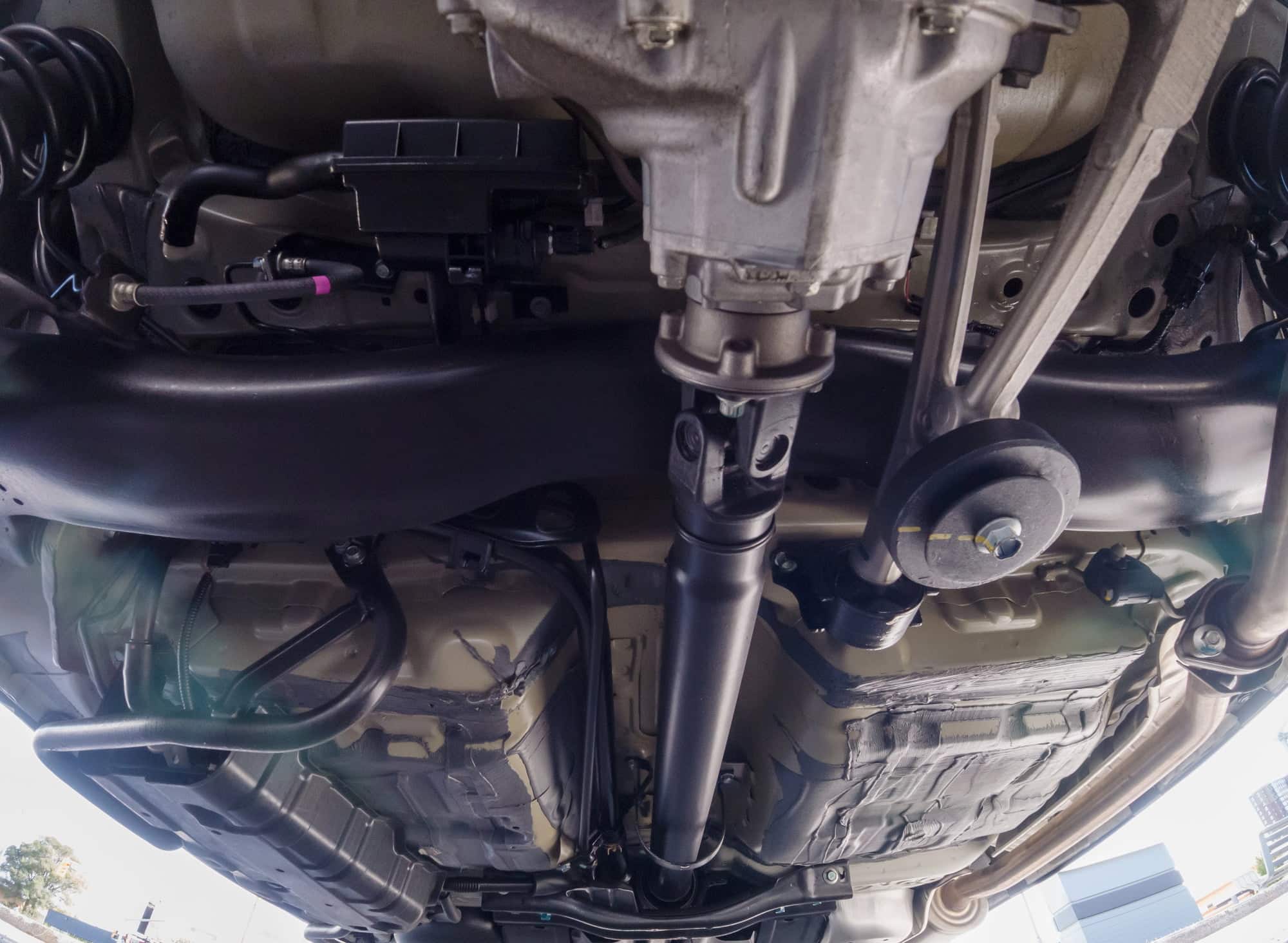
Alfa Romeo Drive Shaft Repair at DART Auto
You're accelerating onto I-25 when you feel it – a vibration that shouldn't be there, a clunk that makes you wince. Your Alfa Romeo's drive shaft connects the transmission to the differential, transferring power to the wheels through a precisely balanced assembly of tubes, universal joints, and center support bearings. When something fails in this system, the symptoms range from annoying to dangerous, and the fix demands someone who understands how Alfa Romeo engineered these components for performance and balance.
Alfa Romeo drive shafts differ significantly from mass-market vehicles. The Giulia and Stelvio platforms use aluminum two-piece drive shafts with rubber-isolated center support bearings tuned for NVH (noise, vibration, harshness) characteristics specific to the Giorgio platform. The 4C uses a completely different approach with its mid-engine layout. Universal joint phasing, torque specifications, and balancing tolerances are tighter than typical domestic vehicles. Generic shops often overlook the critical step of marking the drive shaft orientation before removal – reinstalling it even one spline off throws the entire assembly out of balance. We follow factory procedures that include torque-angle tightening sequences and specific grease compounds for the splined connections.
When you bring your Alfa Romeo to DART Auto for drive shaft service, here's what sets our work apart:
- Factory diagnostic procedures to isolate whether vibration originates from the drive shaft, wheel balance, or suspension components
- Proper indexing and marking before disassembly to maintain factory balance
- OEM or premium aftermarket components – we source Genuine Mopar parts for Alfa Romeo when center bearings or U-joints are needed
- Post-repair road testing across multiple speed ranges to verify smooth operation and proper torque transfer
Common Drive Shaft Repair Issues on Alfa Romeo Vehicles
You're backing out of your driveway on a cold Denver morning when you hear it – a rhythmic clunk-clunk-clunk that speeds up as you accelerate. Or maybe you've noticed vibration through the floor at highway speed that wasn't there last month. Drive shaft problems on Alfa Romeo vehicles announce themselves in distinctive ways, and recognizing the patterns early makes all the difference between a straightforward repair and a cascade of expensive damage.
- Center bearing failure on 159 and Brera (2006-2011): The two-piece propeller shaft design uses a rubber-isolated center support bearing that degrades from road salt and temperature cycling. When the rubber deteriorates, you'll feel vibration between 45-60 mph that smooths out at higher speeds. The GM-platform underpinnings of these models share this vulnerability with Cadillac CTS and STS of the same era, but Alfa Romeo's European-spec bearing suppliers often use softer rubber compounds that crack faster in Colorado's freeze-thaw cycles.
- CV joint boot tears on Giulia and Stelvio (2017-present): The Giorgio platform uses constant-velocity joints at both ends of the half-shafts. Road debris and winter gravel tear the protective boots, allowing moisture and grit into the precision bearings. Once contaminated, the joints develop clicking during tight turns within weeks. The lightweight aluminum suspension components magnify these sounds, making diagnosis easier but also accelerating wear on surrounding bushings.
- Giubo (flex disc) deterioration on older rear-drive models: Spider, GTV, and 164 models use a rubber coupling disc between the transmission output and drive shaft. Heat cycling from the exhaust proximity and age cause the rubber to crack and chunk out. You'll notice a sharp clunk when shifting from reverse to drive, followed by driveline shudder under acceleration. These Italian OEM giubos were often softer than German equivalents, prioritizing NVH isolation over longevity.
- Spline wear on 4C (2014-2020): The mid-engine layout subjects the short half-shafts to extreme angles during spirited cornering. The splined connections at the differential can wear oval, creating rotational play that manifests as metallic clicking during launch and deceleration. Carbon-fiber tub chassis transmit every vibration directly to the cabin, so drivers notice this issue earlier than they would in a conventional chassis.
- Universal joint failure on Giulietta (2010-2020): Front-drive platform uses intermediate shafts with U-joints that can develop play after 80,000 miles, particularly in vehicles that see frequent full-lock parking maneuvers. The symptom is a rhythmic clicking that matches wheel speed, often mistaken for wheel bearing noise until the joint seizes and leaves you stranded.
Why Choose DART Auto for Alfa Romeo Drive Shaft Repair
You're accelerating onto I-25 when a rhythmic vibration starts under your seat, intensifying with speed. Your Giulia or Stelvio deserves more than guesswork – it needs technicians who understand how Alfa Romeo's rear-wheel-drive and all-wheel-drive architectures behave when center bearings fail or CV joints wear.
DART Auto brings over two decades of European-platform experience to every drive shaft diagnosis. Our master technicians use factory-level scan tools and repair procedures specific to Alfa Romeo's Giorgio platform (2016+ Giulia, Stelvio) and legacy models, identifying whether you're dealing with a worn center support bearing, torn CV boot allowing contamination into the joint, or imbalanced shaft causing harmonic vibration. We don't swap parts hoping the noise stops – we measure runout, inspect U-joint play, and verify torque specs against Alfa Romeo's published data.
- Platform-specific tooling: Alignment fixtures and bearing presses calibrated for Alfa Romeo driveline geometry, preventing installation errors that cause premature failure
- OEM and premium aftermarket sourcing: We source GKN or equivalent-quality components that meet Alfa Romeo's engineering tolerances, not economy-grade parts that fail in 20,000 miles
- Salaried technician model: Our techs earn salaries, not flat-rate commissions, so they diagnose the actual cause rather than upselling unnecessary assemblies
- 3-year/36,000-mile warranty: Every drive shaft repair is backed by our comprehensive parts-and-labor guarantee
Symptoms – How to Know You Need This Service
Drive shaft problems announce themselves in ways that are hard to ignore. You might notice:
- Vibration at highway speeds – typically between 55–75 mph, often described as a "shudder" that intensifies with acceleration
- Clunking when shifting from park to drive or reverse – worn U-joints develop excessive play that creates metallic knocking sounds during direction changes
- Squeaking or chirping from underneath the vehicle – dry or failing universal joints produce high-pitched sounds, especially noticeable during low-speed maneuvers
- Rhythmic clicking that increases with vehicle speed – a failing center support bearing often creates a ticking sound synchronized with drive shaft rotation
- Visible grease spray on the undercarriage – torn U-joint boots allow grease to fling outward, coating nearby components
- Shuddering during acceleration from a stop – excessive play in worn joints causes the drive shaft to bind and release as torque is applied
- Metallic scraping or grinding – if a center bearing has completely failed, the drive shaft may contact the chassis or exhaust components
Stop driving immediately if you hear grinding metal-on-metal contact or experience severe vibration – a separated drive shaft can cause catastrophic damage to the transmission, differential, and undercarriage. Clunking and moderate vibration mean you should schedule service soon, but complete failure requires a tow.
Which Alfa Romeo Models We See for Drive Shaft Repair
We regularly service drive shaft systems across the Alfa Romeo lineup, with particular expertise in the modern rear-wheel-drive and all-wheel-drive platforms that share engineering with performance-oriented Maserati and Chrysler products. The Giorgio platform introduced aluminum drive shafts with specific balancing requirements, while earlier models used steel assemblies with different service intervals and failure modes.
- Giulia (2017–present, Type 952) – both RWD and Q4 AWD variants; center support bearing failures common after 50,000 miles on early production units
- Stelvio (2018–present, Type 949) – Q4 AWD system uses a front drive shaft in addition to the rear assembly; both require attention
- 4C / 4C Spider (2014–2020) – mid-engine layout with a completely different drive shaft configuration connecting the rear-mounted transaxle
- Giulia Quadrifoglio (2017–present) – higher-performance variant with upgraded U-joints and center bearing designed for 505 hp; requires OEM components to handle torque loads
- Stelvio Quadrifoglio (2018–present) – similar high-output considerations as the Giulia QV
Earlier front-wheel-drive Alfa Romeo models (159, Brera, Spider based on the GM Premium platform) don't use traditional drive shafts – they rely on CV axles instead, which is a different service. If you own a classic rear-drive Alfa (GTV, Spider, Milano), we're happy to discuss your specific needs, though our primary focus remains the modern Giorgio-platform vehicles where we see the highest volume and maintain the deepest parts relationships.
Causes & Risks – What Happens if Ignored
Drive shaft problems rarely appear overnight. Denver's combination of winter road treatments, summer heat, and elevation changes accelerates wear on the rubber isolators, boots, and bearings that keep your Alfa Romeo's driveline smooth and silent. Alfa Romeo engineers prioritized driving dynamics and NVH refinement, which often meant using softer rubber compounds and tighter tolerances than mass-market brands. That precision feels wonderful when everything is fresh but creates faster degradation curves when maintenance intervals slip.
Delaying repair sets off a predictable chain of damage:
- Torn CV boots progress to destroyed joints within 500-1,000 miles: Once moisture and grit enter the CV joint, the hardened steel balls and races begin grinding against contamination. What starts as occasional clicking becomes constant noise, then binding, then complete failure. A $180 boot replacement becomes a $900 half-shaft assembly, plus the secondary damage to wheel bearings from the vibration.
- Worn center bearings damage the drive shaft tube itself: When the rubber support collapses, the spinning shaft runs off-axis and whips at speed. This bends the thin-wall steel tube and ruins the balance. You'll replace the entire two-piece assembly instead of just the $240 center bearing, and the vibration often cracks the transmission tail housing or differential mount before you notice how bad it's gotten.
- Failed giubos send shock loads through the transmission: Every time you engage the clutch or shift gears with a deteriorated flex disc, metal-on-metal impacts hammer the transmission output shaft bearings and the differential input bearings. Giulia Q4 and Stelvio owners have reported $4,500 differential replacements that started as a $320 giubo that was ignored for six months.
- Spline wear creates runout that destroys seals: Once the splined connection develops slop, the shaft oscillates radially with every revolution. This pumps the differential or transaxle seals, causing fluid leaks that lead to bearing failure and gear damage. The 4C's limited-slip differential is particularly vulnerable, with replacement costs exceeding $8,000 when fluid loss goes unnoticed.
The safety risk escalates quickly. A CV joint that clicks in turns can lock up completely during a highway lane change, jerking the steering wheel violently. A separated drive shaft on a rear-wheel-drive Alfa Romeo can pole-vault the car or strike the fuel tank. These aren't theoretical scenarios – they're documented failure modes that move from "schedule soon" to "stop driving now" faster than most owners expect.
Safety Impact – Why Drive Shaft Repair Matters
Your Alfa Romeo's drive shaft doesn't just deliver power – it's a structural link that affects how stability control, ABS, and traction management systems interpret wheel speed and vehicle dynamics. When a CV joint binds or a center bearing allows shaft whip, the wheel speed sensors read erratic data that can trigger false interventions or, worse, prevent the systems from activating when you need them.
Specific failure modes create distinct hazards:
- Locked CV joint during cornering: The sudden resistance feels like hitting a curb mid-turn, upsetting the chassis balance exactly when weight transfer and steering inputs are most critical. On Giulia Q4 and Stelvio models with torque-vectoring rear differentials, a seized joint confuses the system's ability to modulate power side-to-side.
- Separated drive shaft on rear-drive models: When a giubo fails completely or a U-joint seizes, the spinning shaft can drop onto the road surface, dig in, and vault the rear of the car upward. The sudden deceleration and loss of control has caused rollovers, and the flailing shaft can rupture brake lines, fuel lines, or the exhaust system.
- Vibration-induced component failure: Severe drive shaft imbalance creates harmonics that crack exhaust hangers, loosen subframe bolts, and fatigue suspension bushings. We've diagnosed ABS sensor failures and wheel bearing disintegration traced back to uncorrected drive shaft vibration that transmitted destructive frequencies through the chassis.
When to stop driving versus schedule promptly:
- Stop immediately: Any grinding, binding, or complete loss of power delivery; visible grease spray around wheels; metal-on-metal scraping sounds; sudden vibration that worsens rapidly.
- Schedule within days: Rhythmic clicking during turns; vibration at specific speeds that's new or worsening; clunking when shifting between drive and reverse; visible torn boots or leaking grease.
From a liability perspective, continuing to drive an Alfa Romeo with known drive shaft damage can complicate insurance claims if a failure contributes to an accident. Documenting the issue and addressing it promptly protects both your safety and your financial interests.
How Alfa Romeo Drive Shaft Repair Actually Works
Alfa Romeo's approach to driveline engineering reflects the brand's racing heritage and obsession with weight distribution. Rear-drive models like the Giulia use aluminum drive shafts to reduce rotational mass, while all-wheel-drive Stelvio and Giulia Q4 variants employ a power transfer unit with active torque distribution that requires precise driveline geometry to function correctly. The Giorgio platform's near-perfect 50/50 weight distribution depends on keeping driveline components light and positioned exactly where the engineers intended – which means repair procedures follow tighter tolerances than most domestic or Asian brands.
What makes Alfa Romeo driveline work different:
- Aluminum shaft handling: Unlike steel shafts that tolerate some flex during removal, aluminum propeller shafts can be permanently deformed by improper support or prying. We use custom cradles and follow FCA's specified lift points to avoid introducing runout during
How We Diagnose Drive Shaft Repair Issues on Alfa Romeo
When you pull into our shop with a vibration that worsens at highway speed or a clunk during hard acceleration, we start with a systematic approach designed to pinpoint whether your Alfa Romeo's drive shaft, CV joints, center bearing, or differential mounts are the culprit. Many shops guess; we measure, test, and verify.
- Road test with the owner or service advisor: We replicate the symptom you're experiencing – vibration at 70 mph, clunk on throttle tip-in, or noise during tight turns. This tells us whether the issue is speed-dependent (often center bearing or balance), load-dependent (CV joints or U-joints), or angle-dependent (axle shafts on Giulia and Stelvio platforms).
- Lift inspection and visual assessment: With the vehicle on the rack, we check for torn CV boots (common on 2017+ Giulia and Stelvio with the Giorgio platform's long axle shafts), play in the center support bearing (a known wear point on rear-drive Alfa models), and rubber deterioration in the guibo flex disc (especially on older 159 and Brera models).
- Hand-rotation and play checks: We rotate each axle shaft and propeller shaft by hand, feeling for binding, roughness, or excessive radial play. On all-wheel-drive Stelvio models, we inspect the front drive shaft and transfer case output for wear that can telegraph vibration through the cabin.
- Scan tool and module interrogation: Using Alfa Romeo–compatible diagnostic platforms, we pull fault codes from the ABS, stability control, and drivetrain modules. Wheel-speed sensor discrepancies can mimic drive shaft symptoms, and we rule those out before recommending mechanical work.
- Measurement of runout and balance: If a propeller shaft is suspect, we measure runout with a dial indicator. Bent shafts (from road debris or curb strikes) often show runout beyond 0.020 inches, which creates the vibration you feel through the seat and steering wheel.
Once we've isolated the failed component, we walk you through what we found, show you photos or video if helpful, and provide a detailed quote that explains whether you need a boot and joint, a complete axle shaft, or a propeller shaft assembly. No surprises, no upselling – just the repair your Alfa Romeo needs to drive smoothly again.
Drive Shaft Repair on Alfa Romeo: Repair vs. Replacement
Not every drive shaft issue demands a complete assembly replacement. The right approach depends on what failed, how much collateral wear exists, and whether the repair restores full service life or simply buys time.
When True Repair Makes Sense
- CV boot replacement on an otherwise healthy joint: If the boot tore recently and the joint still has clean grease and no play, we can repack and re-boot the axle shaft. This is common on Giulia and Stelvio models where a road hazard splits the outboard boot before the joint itself wears.
- Guibo flex disc replacement: The rubber coupling between the transmission and propeller shaft (used on rear-drive 159, Brera, and Spider models) can be replaced as a standalone part when the rubber cracks or delaminates. The rest of the drive shaft remains in service.
- Center support bearing refresh: If the bearing is worn but the propeller shaft is straight and balanced, replacing the bearing and its mount restores smooth operation without the expense of a new shaft.
When Replacement Is the Right Call
- CV joint wear with contamination: Once dirt and moisture enter a CV joint, the bearing surfaces pit and the cage wears. At that point, a complete axle shaft replacement is faster, more reliable, and often less expensive than disassembly and repacking.
- Bent or out-of-balance propeller shaft: Impact damage or high-mileage fatigue can warp the shaft itself. Straightening rarely restores factory balance, so we replace the assembly with an OEM or premium remanufactured unit.
- Multiple failure points: When the CV joint, boot, and axle shaft all show wear – common on higher-mileage Giulietta and 159 models – replacing the entire shaft as an assembly ensures all wear points are addressed at once.
We walk you through the trade-offs, show you the parts in question, and help you decide based on your budget, how long you plan to keep the car, and whether a repair will genuinely last. Our technicians are salaried, not flat-rate, so there's no incentive to recommend the most expensive option when a targeted repair will do the job.
How to Make Your Alfa Romeo Drive Shaft Repair Last Longer
Once we've restored smooth, vibration-free operation, a few habits and maintenance practices will help you get the most life out of your new or repaired drive shaft components.
Driving Habits That Protect Drive Shafts and CV Joints
- Avoid full-lock launches and tight-radius acceleration: Hard throttle with the steering wheel cranked – common in parking garages and three-point turns – loads the CV joints at their maximum articulation angle. This accelerates wear, especially on front-drive Giulietta models and all-wheel-drive Stelvio variants.
- Ease into throttle after cold starts: Grease in CV joints and center bearings is stiffer when cold. Gentle acceleration for the first mile or two allows lubricants to flow and reduces shock loads on the joints.
- Mind road hazards and curbs: Curb strikes and pothole impacts can bend axle shafts, dent propeller shafts, and tear CV boots. Slow down for rough pavement, and give curbs a wide berth when parking.
Maintenance You Can Do Yourself
- Visual boot inspections: Every few months, glance at the CV boots (the rubber accordion covers at each end of the axle shafts). Look for cracks, splits, or grease leaking out. Catching a torn boot early – before dirt gets in – can save the joint.
- Listen for new noises: A clicking sound during turns or a vibration that appears suddenly often signals the start of CV joint or center bearing wear. Addressing it early prevents more expensive damage.
- Check for play during tire rotations: When your wheels are off, grab the axle shaft and try to move it in and out. Excessive play suggests a worn CV joint or loose center bearing.
What to Leave to the Shop
CV boot replacement and drive shaft removal require specialty tools, torque specs, and sometimes hub-nut settings that exceed 200 lb-ft. Attempting these repairs without the right equipment risks damaging the ABS tone ring, over-torquing the axle nut (which can preload the bearing and cause premature failure), or failing to properly seat the circlip that retains the inner CV joint. Let our master technicians – each with at least a decade of experience and dealer-level training – handle the mechanical work. You focus on the easy stuff: keeping an eye on the boots and listening for changes.
What to Expect When You Bring Your Alfa Romeo In
We've streamlined the repair process so you stay informed without the dealership markup. Here's how your visit unfolds:
- Drop-off and initial consultation: Describe the vibration, clunk, or noise you're experiencing. We'll ask about speed ranges, recent impacts, and whether the symptom changes during acceleration or coasting. Remove valuables from the cabin; we'll keep your key secure during the inspection.
- Complete driveline inspection: Our technicians lift your Alfa Romeo on the alignment rack, rotate the drive shaft by hand to check for play, inspect CV boots for tears or grease fling, and measure center bearing movement. We scan for stored fault codes related to ABS wheel-speed sensors (which sometimes mimic driveline vibration) and verify differential mounts aren't contributing to the issue.
- Written estimate and approval: You'll receive a detailed breakdown naming the failed component – center support bearing assembly, front or rear CV joint, or complete shaft replacement if runout exceeds spec. We explain why each repair is necessary and what happens if you delay it.
- Repair execution: We remove the drive shaft using Alfa Romeo's prescribed disconnection sequence to avoid damaging the transmission output seal or differential flange. New components are installed with OEM-spec fasteners torqued to exact values, and we rebalance if required.
- Post-repair verification: Before you arrive, we road-test your Alfa Romeo through the speed range where the symptom occurred, listening for any residual noise. A final scan confirms no new fault codes, and we inspect fluid levels at the differential and transmission.
Need a loaner vehicle or shuttle service while we're working? Ask when you schedule – we'll arrange transportation so your day isn't disrupted. If anything feels off after pickup, call us immediately. We'll recheck the work at no charge, because getting it right the first time is how we've built our reputation since 2000.
Our Alfa Romeo Services
- Air Conditioning AC Repair
- Battery Repair Replacement
- Brake Repair & Brake Fluid Change
- Check Engine Light Diagnostics
- Clutch Repair & Replacement
- Coolant Leak Repair
- Cooling System Repair
- Engine Repair
- Exhaust & Catalytic Converter Repair
- Head Gasket Repair & Replacement
- Oil Change
- Oil Leak Repair
- Scheduled Service Maintenance
- Steering Repair
- Suspension Repair
- Cambelt Timing Belt Replacement
- Transmission Repair
- Tune Up
- Wheel Alignment