
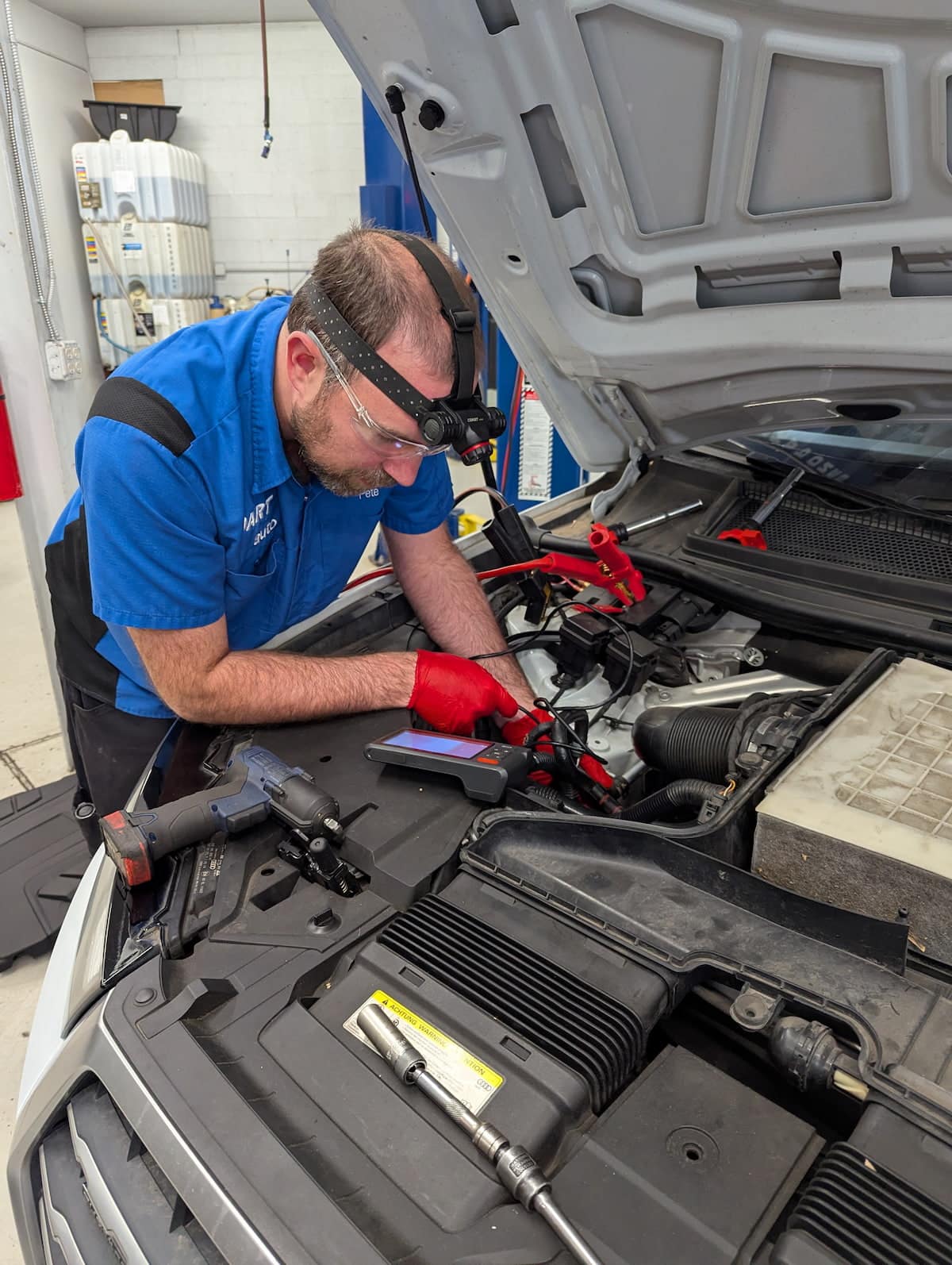
Audi Tune Up at DART Auto
Your Audi was engineered for precision, and keeping it running at peak performance requires more than swapping spark plugs and calling it done. Modern Audi engines – whether you're driving a turbocharged 2.0T EA888, a supercharged 3.0T, or a high-strung RS model – demand exact ignition timing, specific coil-pack configurations, and software-managed fuel delivery that generic shops often overlook. When you notice rough idle, hesitation under load, or a check-engine light pointing to misfires, the right tune up addresses the root cause and restores the smooth, responsive power delivery Audi drivers expect.
DART Auto has been Denver's European specialist since 2000, and our master technicians bring dealer-level training and factory repair procedures to every tune up. We use ODIS diagnostic software and VAS tooling to read adaptation values, monitor long-term fuel trims, and verify that new ignition components integrate correctly with your engine management system. On direct-injection platforms like the EA888 Gen3, we inspect for carbon buildup on intake valves – a common culprit behind misfires that a simple plug swap won't fix. Our salaried technicians take the time to diagnose completely before recommending parts, so you're not paying for guesswork.
What you can expect from an Audi tune up at DART Auto:
- Full ignition-system inspection using factory scan tools to identify misfires, coil-pack degradation, and fuel-trim anomalies
- OEM or premium aftermarket spark plugs torqued to Audi specification and gapped for your specific engine code
- Replacement of failing coil packs, PCV valves, and intake-boot components when diagnostics reveal wear
- Post-repair verification drive and scan to confirm smooth idle, responsive throttle, and cleared fault codes
Common Tune Up Issues on Audi Vehicles
Your Audi was built for precision performance, but even the most advanced engines need regular maintenance to stay sharp. Here's what we typically see when Denver-area Audi owners bring their cars in for tune-up work:
- Carbon buildup on EA888 Gen2 and Gen3 direct-injection engines (2008–2019 A4, A5, Q5 2.0T): Direct injection sprays fuel directly into the combustion chamber, bypassing the intake valves. Without fuel washing over them, carbon deposits accumulate on valve stems and heads, choking airflow and causing rough idle, misfires, and reduced power. The Gen3 revision improved the issue slightly, but both generations require periodic walnut-blasting to restore proper breathing.
- Ignition coil failures on B8/B8.5 platforms (2009–2016 A4, A5, Q5): Audi's coil-on-plug design subjects ignition coils to extreme heat cycles. They typically begin failing around 60,000–80,000 miles, triggering misfires on one or more cylinders. Replacing just the failed coil often leaves you stranded weeks later when the next one goes – we address all cylinders during tune-up service.
- Spark plug fouling on supercharged 3.0T engines (B8 S4, S5, Q5 3.0T): The supercharger's forced induction environment accelerates plug wear. OEM-spec plugs (NGK or Bosch) must be replaced at the factory interval – aftermarket "performance" plugs often cause misfires and poor cold starts on these engines.
- PCV valve and diaphragm failure on 2.0T and 3.0T engines: Audi's integrated PCV system uses a diaphragm inside the valve cover that hardens and cracks over time. When it fails, you'll see excessive oil consumption, rough idle, and a check-engine light for fuel trim faults. This isn't a standalone part – the entire valve cover assembly must be replaced.
- Mass airflow sensor contamination on all platforms: Oil vapor from the crankcase ventilation system coats the MAF's hot-wire element, skewing air-fuel calculations. Symptoms include hesitation under acceleration, surging at highway speeds, and poor fuel economy. Cleaning rarely lasts – replacement with an OEM Bosch unit restores accurate metering.
Why Choose DART Auto for Audi Tune Up
If your Audi is hesitating on acceleration, idling rough, or lighting up the check-engine lamp, you're likely facing ignition or fuel system wear. DART Auto approaches Audi tune-ups with factory-level diagnostic tooling – the same ODIS and VAS platforms Audi dealers use – so we see live misfires, fuel trim corrections, and coil-pack degradation in real time before we touch a wrench. That precision matters on EA888 Gen3 engines (2015+ A3, A4, Q5) where carbon fouling can mask a failing coil, or on B8/B8.5 3.0T supercharged V6s where spark-plug torque and heat-range specs are non-negotiable.
Our salaried master technicians – each with at least ten years of European experience and dealer training – don't rush through plug swaps. They inspect ignition coil boots for cracks, measure secondary resistance, check PCV valve flow, and verify intake-manifold runner control on engines that have it. We use OEM or premium aftermarket plugs (NGK, Bosch) spec'd to your engine code, not universal parts that fit "close enough." Because we've been Denver's European-specialist shop since 2000, we've seen the failure patterns: B7 A4 2.0T coil-pack failures around 60k miles, C7 A6 3.0T carbon buildup choking airflow by 80k. We fix the root cause, then road-test under load and re-scan to confirm every fuel trim and ignition advance value sits within Audi's tolerance.
- Factory diagnostic depth: ODIS software reads module-specific fault memory and adaptation values dealers see.
- Platform fluency: We know which model years need updated coil-revision numbers and which intake designs trap carbon.
- 3-year/36,000-mile warranty: Parts and labor covered because we stand behind the work long-term.
- No upsell pressure: Salaried techs recommend only what the data supports – no commission incentive to pad the ticket.
Symptoms – How to Know You Need This Service
Audi's sophisticated engine management will often alert you to ignition trouble before you feel it, but some symptoms appear gradually. You may notice a rough or uneven idle when stopped at a light, especially on cold starts. Hesitation or stumbling during acceleration – particularly between 2,000 and 3,500 rpm where the turbo spools – points to weak spark or failing coil packs. A flashing check-engine light means active misfires that can damage the catalytic converter; pull over and arrange a tow immediately to avoid costly secondary damage.
Common symptoms that indicate your Audi needs a tune up:
- Check-engine light with stored misfire codes (P0300–P0308 series)
- Rough, shaky idle or vibration felt through the steering wheel and seats
- Hesitation, stumbling, or flat spots during acceleration
- Reduced fuel economy or sluggish throttle response
- Hard starting or extended cranking, especially in cold or damp weather
- Smell of unburned fuel from the exhaust
- Flashing check-engine light (stop driving immediately – active misfire)
- Loss of power under load or uphill driving
If you're seeing a flashing MIL or experiencing severe power loss, don't continue driving. Schedule a diagnostic as soon as you notice persistent rough running or declining performance – early intervention prevents damage to oxygen sensors and catalytic converters.
Which Audi Models We See for Tune Up
We service the full range of modern Audi platforms, from everyday A-series sedans to high-performance RS models. The 2.0T EA888 engine (found across A3, A4, A5, Q3, and Q5 from roughly 2009 forward) is especially sensitive to coil-pack wear and carbon fouling on intake valves. The supercharged 3.0T V6 in B8/B8.5 A6, A7, Q5, and Q7 models benefits from regular ignition maintenance to preserve smooth power delivery. RS and S models with higher-output tunes see accelerated plug and coil wear due to elevated cylinder pressures.
Audi platforms we commonly service for tune up work:
- A3 / S3 / RS3: 8P (2006–2013), 8V (2015–2020), 8Y (2022+) – 2.0T EA888 and 2.5T inline-five engines
- A4 / S4 / RS4: B7 (2005–2008), B8/B8.5 (2009–2016), B9 (2017–2023) – 2.0T, 3.0T supercharged, and V8 variants
- A5 / S5 / RS5: 8T (2008–2016), F5 (2018+) – coupe, Sportback, and cabriolet body styles
- A6 / S6 / RS6: C6 (2005–2011), C7 (2012–2018), C8 (2019+) – including Avant wagon variants
- A7 / S7 / RS7: C7 (2012–2018), C8 (2019+) – 3.0T and twin-turbo V8 platforms
- A8 / S8: D3 (2004–2010), D4 (2011–2017), D5 (2018+) – V6, V8, and W12 engines
- Q3 / Q5 / Q7 / Q8: All generations with 2.0T EA888, 3.0T supercharged, or turbocharged V6/V8 powerplants
- TT / TTS / TT RS: 8J (2008–2014), 8S (2016–2023) – 2.0T and 2.5T five-cylinder engines
- R8: First and second generation (V8 and V10) – ignition service on naturally aspirated high-rev platforms
We have the tooling and experience for manual, S tronic dual-clutch, and Tiptronic transmissions across all drivetrain layouts. If you're driving an older C5 A6 or B5 S4 with the 2.7T twin-turbo V6, call us first – those platforms require additional access work that we're equipped to handle.
Causes & Risks – What Happens if Ignored
Audi's high-compression turbocharged and supercharged engines demand precise ignition timing and air-fuel ratios. When tune-up components drift out of spec, the engine management system compensates by adjusting fuel delivery and timing – but only within a narrow window. Denver's altitude (5,280 feet) and temperature swings accelerate wear on ignition components and sensors, shortening the interval between service needs.
Short trips and city driving worsen carbon buildup because the engine never reaches full operating temperature long enough to burn off deposits. If you're commuting from the suburbs into Denver, your intake valves are accumulating carbon every day. Here's what deteriorates when you delay tune-up work:
- Misfires damage catalytic converters: Unburned fuel from a misfiring cylinder enters the exhaust stream and ignites inside the catalytic converter, overheating the substrate. A $200 coil replacement becomes a $2,500 catalyst job within weeks of ignoring the check-engine light.
- Carbon buildup leads to valve damage: Severe deposits prevent intake valves from seating properly, causing compression loss and eventually requiring cylinder head work. What starts as a $600 carbon-cleaning service escalates to $4,000+ in head reconditioning.
- Fouled plugs trigger limp mode: Multiple misfires cause the ECU to limit engine power and boost pressure to prevent damage. You'll lose acceleration capability on I-25 merges and uphill climbs – a safety risk in fast-moving traffic.
- Failed PCV systems consume oil rapidly: A collapsed diaphragm creates excessive crankcase pressure, forcing oil past piston rings and valve seals. Owners often add a quart every 500 miles, and the resulting oil smoke can obscure visibility for drivers behind you.
- Sensor drift causes transmission issues: Incorrect MAF readings confuse the transmission control module, leading to harsh shifts, delayed engagement, and premature clutch wear in DSG-equipped models.
Safety Impact – Why Tune Up Matters
A poorly running engine doesn't just cost you fuel economy – it directly affects your ability to accelerate out of hazardous situations and maintain control in Colorado's variable weather. Misfires reduce available torque exactly when you need it most: merging onto highways, passing slower vehicles on two-lane roads, or climbing mountain grades. Electronic stability control and traction systems rely on predictable engine response; when cylinders misfire intermittently, the ESC can't modulate power delivery effectively on wet or icy pavement.
When to stop driving and call for service:
- Flashing check-engine light (indicates active misfire that can destroy the catalytic converter within minutes)
- Complete loss of power or engine stalling in traffic
- Strong fuel smell inside the cabin (potential fuel system leak or severe rich condition)
- Loud backfiring or popping from the exhaust (unburned fuel igniting)
Schedule service this week if you notice:
- Steady check-engine light with reduced power
- Rough idle that smooths out above 2,000 RPM
- Hesitation or stumble during acceleration
- Fuel economy drop of 15% or more
How Audi Tune Up Actually Works
Modern Audi engines use a coil-on-plug ignition system where each spark plug has its own dedicated coil mounted directly on top. The engine control module fires each coil independently based on input from the crankshaft position sensor, camshaft position sensors, and knock sensors. Direct fuel injection sprays precisely metered fuel at up to 2,200 psi directly into the combustion chamber during the compression stroke, allowing higher compression ratios and more aggressive turbo boost without detonation.
This sophistication requires Audi-specific service procedures. After replacing ignition components, the ECU must relearn adaptation values – fuel trims, ignition timing corrections, and throttle response maps. Without proper coding and adaptation using factory-level diagnostic tools (we use the same ODIS platform as Audi dealers), the engine will run rich or lean until it slowly relearns over hundreds of miles. Carbon cleaning on direct-injection engines requires removing the intake manifold and walnut-blasting each valve – a procedure that takes 4–6 hours and demands familiarity with Audi's plastic manifold fasteners and gasket replacement sequences.
What makes Audi tune-up work different:
- Torque-to-yield fasteners on valve covers and intake manifolds must be replaced, not reused
- Ignition coils require specific part numbers by engine code – using the wrong coil causes misfires even when new
- Spark plugs must meet exact heat range and reach specifications; incorrect plugs contact the piston crown on some 2.0T variants
- PCV replacement involves removing the entire valve cover assembly and installing updated revision parts to prevent repeat failures
- MAF sensor calibration data is VIN-specific and must be coded to the ECU after replacement
How We Diagnose Tune Up Issues on Audi
Your Audi is hesitating on acceleration, idling rough, or showing a check engine light – all signs that ignition and fuel delivery need attention. We start every tune up diagnosis by connecting factory-level scan tools that communicate directly with your Audi's engine control module, reading live data streams that reveal misfires, fuel trim corrections, and ignition timing anomalies. On EA888 and EA839 platforms, we pay special attention to carbon buildup patterns that strangle intake valves on direct-injection engines, a chronic issue on 2009–2016 A4, A5, and Q5 models with the 2.0T.
Our diagnostic process follows a structured path:
- Scan for fault codes and freeze-frame data. We retrieve stored and pending codes, then review the conditions under which they set – RPM, load, coolant temperature – to understand whether the issue appears cold, hot, or under load.
- Inspect ignition components. We pull each coil pack and spark plug, checking for oil fouling, carbon tracking, and electrode wear. On B8 and B9 platforms, coil-on-plug failures often cascade across cylinders if left unchecked.
- Test fuel delivery and pressure. We verify fuel pump output, injector spray pattern, and fuel pressure regulation. High-pressure fuel pumps on TSI engines are notorious for wearing cam lobes on the 2.0T, causing low rail pressure and lean conditions.
- Measure intake airflow and throttle response. We check the mass airflow sensor calibration and throttle body adaptation values, ensuring the engine receives accurate air metering.
- Perform a compression and leak-down test if misfires persist. This reveals whether valve sealing or piston ring wear is contributing to ignition problems.
Once diagnostics are complete, we translate the findings into a clear repair plan with transparent pricing, so you understand exactly what your Audi needs and why.
Tune Up on Audi: Repair vs. Replacement
Not every tune up issue demands wholesale replacement. When a single ignition coil fails on a low-mileage A3 or S4, replacing just that coil and its corresponding spark plug often restores smooth operation without touching the rest of the ignition system. Similarly, if carbon buildup is choking your intake valves but the injectors and coils test healthy, walnut blasting the intake ports solves the problem without replacing fuel system components.
Partial replacement makes sense when wear is isolated but the surrounding parts are still serviceable:
- Replacing all spark plugs and coils together when one coil fails on a high-mileage engine, because the remaining coils are likely near end-of-life and will fail soon.
- Swapping the high-pressure fuel pump on EA888 engines showing cam lobe wear, while keeping the low-pressure pump and injectors if they pass flow testing.
- Cleaning the throttle body and mass airflow sensor before replacing them, since contamination often mimics failure.
Full replacement becomes the right call when ignition or fuel components have cascaded into multiple failures, when safety is at stake, or when repair costs approach the price of new parts with a three-year warranty. We walk you through the decision by showing you the failed parts, explaining the failure mode, and outlining what happens if you delay – no pressure, just the information you need to choose wisely.
How to Make Your Audi Tune Up Last Longer
The way you drive shapes how long ignition and fuel components survive. Short trips without full warm-up cycles leave condensation in the combustion chamber, accelerating spark plug fouling and carbon buildup on direct-injection engines. Letting your Audi idle for extended periods floods the cylinders with unburned fuel, washing oil off cylinder walls and degrading coil insulation. Instead, drive gently for the first few minutes, allowing coolant and oil to reach operating temperature before demanding full throttle.
Maintenance habits you can adopt:
- Watch for changes in idle quality or throttle response. A subtle stumble or hesitation often signals a failing coil or fouled plug before the check engine light appears.
- Keep your fuel tank above a quarter full. Running low stirs up sediment that clogs fuel filters and wears pump internals.
- Use Top Tier gasoline with detergent additives. This reduces intake valve deposits on TSI and TFSI engines prone to carbon buildup.
- Check your air filter every oil change. A clogged filter forces the mass airflow sensor to work harder and skews fuel trim calculations.
Brand-specific care matters: Audi's direct-injection platforms benefit from periodic intake cleaning every 40,000 miles, and using OEM or OE-equivalent spark plugs ensures proper heat range and electrode material for your engine's compression ratio. Follow Audi's prescribed service intervals for fuel filter and spark plug replacement – skipping them invites expensive secondary damage. Leave high-pressure fuel system work and ignition timing adjustments to the shop; these systems operate under extreme pressure and precise tolerances that require factory tooling and training to service safely.
What to Expect When You Bring Your Audi In
From the moment you schedule, we treat your Audi like the precision machine it is. Here's how the process unfolds:
- Drop-off and intake: Bring your Audi in at your appointment time. We'll ask about symptoms – stumble on cold start, flashing CEL under load, fuel economy drop – and note your mileage. Remove valuables; we'll secure keys and document existing condition with photos.
- Diagnostic scan and inspection: Before we quote anything, a master tech connects ODIS, pulls stored and pending codes, reviews freeze-frame data, and logs live misfires across all cylinders. We pull at least one spark plug to check electrode wear and carbon fouling, inspect coil boots, and test fuel pressure if trims are out of range.
- Written estimate and your approval: You'll receive a detailed estimate listing each part by OEM number or premium equivalent, labor broken out by task, and an explanation of what we found. We'll call to walk you through it – no jargon, just what's failing and why it matters. You approve before we order parts.
- Repair execution: We replace spark plugs to factory torque spec, install new coils where resistance is out of tolerance, clean or replace PCV components if oil vapour is contributing to fouling, and clear adaptation values so the ECU relearns from a clean baseline.
- Post-repair validation: After the work, we road-test under varied load – highway merge, stop-and-go – then re-scan to confirm zero misfires and fuel trims centered. You'll see the before-and-after scan data at pickup.
- Pickup walkthrough: We'll show you the old plugs, explain what the wear pattern revealed, and answer any questions. If you notice anything unusual in the first few days, call us – we'll bring it back in and verify everything without a second diagnostic fee.
We offer loaner vehicles and local shuttle service when available; ask when you book. After-hours key drop-off is available if you need to pick up outside business hours – just let us know in advance. Every tune-up is backed by our 3-year/36,000-mile warranty, so you drive away confident the ignition system will hold up for the long haul.
Our Audi Services
- Air Conditioning AC Repair
- Battery Repair Replacement
- Brake Repair & Brake Fluid Change
- Check Engine Light Diagnostics
- Clutch Repair & Replacement
- Coolant Leak Repair
- Cooling System Repair
- Drive Shaft Repair
- Engine Repair
- Exhaust & Catalytic Converter Repair
- Head Gasket Repair & Replacement
- Oil Change
- Oil Leak Repair
- Scheduled Service Maintenance
- Steering Repair
- Suspension Repair
- Cambelt Timing Belt Replacement
- Transmission Repair
- Wheel Alignment