
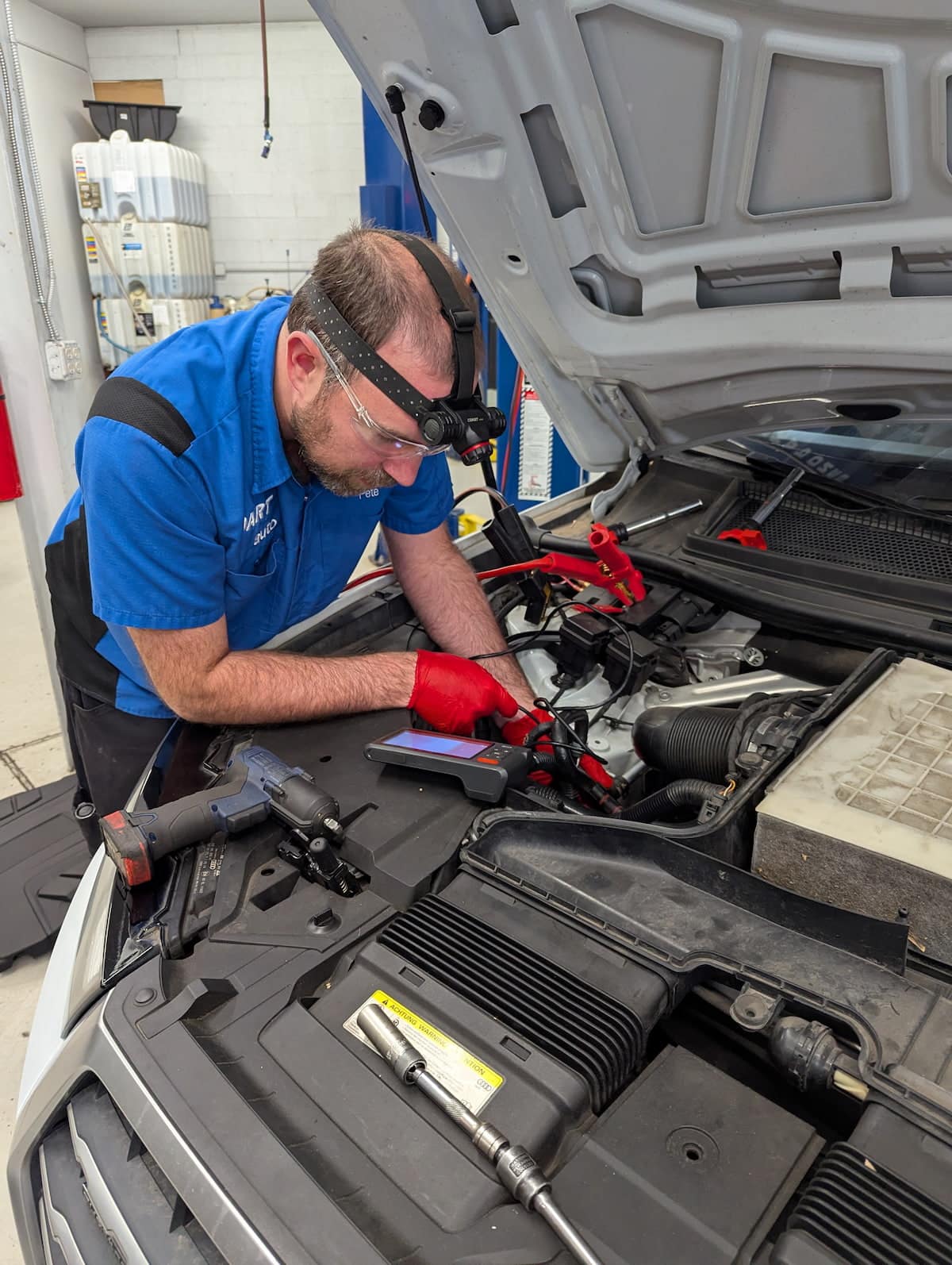
Mercedes-Benz Tune Up at DART Auto
Your Mercedes-Benz is engineered for precision, and that precision depends on spark plugs, coils, and filters performing exactly as Stuttgart intended. When you notice hesitation at highway speed or roughness at idle, your engine is telling you something. Modern Mercedes-Benz platforms – from the M276 V6 to the M264 turbo four – rely on direct injection, variable valve timing, and adaptive ignition timing that responds to fuel quality, altitude, and driving style. A generic shop swaps plugs and calls it done. We reset adaptation values, verify coil resistance across all cylinders, and confirm that your engine control module recognizes the new components so your car runs the way it did when it left the factory.
Mercedes-Benz tune up intervals vary by platform and engine code. The M272 V6 (2006–2011 E-Class, ML-Class, R-Class) is notorious for balance shaft wear and ignition coil failure, so we inspect both during every tune up. The M276 and M278 engines introduced after 2011 use iridium plugs rated for longer intervals, but Denver's altitude and ethanol-blended fuel can shorten plug life. We follow factory torque specs for plug installation – critical on aluminum heads – and use Star Diagnostic System (SDS) or Xentry to clear learned fuel trims and verify misfires are gone.
When you bring your Mercedes-Benz to DART Auto for a tune up, expect:
- OEM or premium aftermarket spark plugs matched to your engine code and model year
- Ignition coil inspection and replacement where resistance or boot condition indicates imminent failure
- Air filter and cabin filter replacement with OEM-spec media that maintains MAF sensor accuracy
- Diagnostic scan before and after service to confirm misfire counters are cleared and fuel trims return to normal range
Common Tune Up Issues on Mercedes-Benz Vehicles
When your Mercedes-Benz starts showing signs of reduced power, hesitation, or rough idling, you're likely facing one of several platform-specific tune-up issues. Here's what we see most often in our Denver shop:
- Ignition coil failure on M272/M273 V6 and V8 engines (2006–2011 E-Class, S-Class, ML, GL): These engines are notorious for coil-on-plug failures, often accompanied by misfires on cylinders 1, 4, or 7. The coils crack internally due to heat cycling, and when one fails, the others typically follow within months. We replace all coils and plugs together to avoid repeat visits.
- Carbon buildup on direct-injection M276 and M278 engines (2012–2016 E-Class, S-Class, CLS): Direct injection leaves intake valves without fuel wash, leading to carbon deposits that choke airflow. You'll notice rough cold starts, reduced fuel economy, and hesitation under load. Walnut-blasting the intake manifold is the only real fix, not additives.
- Spark plug fouling on turbocharged M274 and M276 engines (2015–present C-Class, E-Class, GLE): Factory intervals stretch to 60,000 miles, but Denver's altitude and stop-and-go traffic accelerate electrode wear. Misfires appear first on cold starts, then persist. We typically see plugs needing replacement closer to 40,000 miles here.
- Mass airflow sensor contamination on all platforms: Oil vapor from the PCV system coats the MAF element, causing lean codes, rough idle, and stumbling acceleration. This is especially common on higher-mileage W204 and W212 chassis. Cleaning rarely works long-term; replacement with an OEM Bosch unit restores proper air metering.
- Fuel injector clogging on older M112/M113 V6 and V8 engines (1998–2005 E-Class, S-Class, ML): Ethanol fuel and long service intervals leave injectors varnished. You'll feel uneven idle, loss of power, and see black smoke on acceleration. Ultrasonic cleaning and flow-testing each injector is the proper repair, not just throwing in a bottle of cleaner.
- Crankcase ventilation valve failure leading to oil consumption (W204, W212, W221 platforms): When the PCV valve sticks, crankcase pressure forces oil past seals and into the intake. This fouls plugs, triggers misfires, and leaves you adding a quart every 1,000 miles. Replacing the valve assembly and cleaning the intake system stops the cycle.
Why Choose DART Auto for Mercedes-Benz Tune Up
Your Mercedes-Benz demands more than a generic plug-and-play service. Modern Mercedes platforms – from M274 turbo-fours to M276 V6s and AMG's M157 twin-turbo V8s – require factory diagnostic protocols, TSB awareness, and software-version checks that most shops skip. DART Auto has invested in Mercedes-specific STAR diagnostic tooling and factory repair information, so we catch misfires caused by cam-adjuster solenoid drift on W204 C-Class models or ignition-coil failures common to 2012–2016 M276 engines before they cascade into catalytic converter damage.
Our salaried master technicians bring dealer-level training without the dealer markup. We perform complete pre-tune inspections – compression testing, fuel-trim analysis, and intake-valve carbon assessment on direct-injection platforms like the M274 – then explain what your car needs and why. Because our techs earn a steady salary rather than flat-rate pay, they have no incentive to rush or pad the ticket. Every tune-up includes post-repair scan verification and a road test to confirm smooth idle, throttle response, and closed-loop fuel control. We back that work with a 3-year/36,000-mile warranty on parts and labor, giving you confidence that the repair will hold.
Symptoms – How to Know You Need This Service
You may notice one or more of the following when your Mercedes-Benz is due for a tune up:
- Rough idle or vibration at stoplights – often felt through the steering wheel or seat, especially when the climate control compressor cycles on
- Hesitation or stumble during acceleration – the car feels like it's holding back for a moment before power arrives, most noticeable merging onto highways or passing
- Check Engine light with misfire codes – P0300 (random misfire) or P0301–P0312 (cylinder-specific misfire) stored in the engine control module
- Reduced fuel economy – you're filling up more often even though your driving habits haven't changed
- Hard starting or extended cranking – the engine turns over longer than usual before firing, especially on cold mornings
- Loss of power at altitude – Denver's 5,280-foot elevation magnifies ignition problems; weak spark becomes obvious climbing I-70 toward the mountains
- Smell of unburned fuel from the exhaust – indicates incomplete combustion from worn plugs or failing coils
If the Check Engine light is flashing rather than steady, stop driving immediately and arrange for towing. A flashing light means active misfires severe enough to damage the catalytic converters, which can turn a tune up into a multi-thousand-dollar repair.
Which Mercedes-Benz Models We See for Tune Up
We perform tune up service on most Mercedes-Benz passenger cars and SUVs from the mid-1990s forward. The platforms we see most frequently include:
- C-Class (W203, W204, W205) – 2001–2021 sedans, coupes, and wagons with M271 four-cylinder, M272/M276 V6, and M274/M264 turbo four engines
- E-Class (W211, W212, W213) – 2003–2021 sedans and wagons, including E350, E400, and AMG variants with M272, M276, M278, and M157 engines
- S-Class (W220, W221, W222) – 2000–2020 full-size sedans with V6, V8, and V12 engines; tune up complexity increases significantly on twelve-cylinder models
- ML-Class / GLE-Class (W164, W166, W167) – 2006–2021 midsize SUVs with M272, M276, and M264 engines
- GL-Class / GLS-Class (X164, X166, X167) – 2007–2021 full-size SUVs sharing powertrain platforms with ML/GLE
- GLK-Class / GLC-Class (X204, X253) – 2010–2021 compact SUVs with M272, M274, and M264 engines
- SLK-Class / SLC-Class (R171, R172) – 2005–2020 roadsters with four- and six-cylinder engines
- AMG models – we service naturally aspirated and turbocharged AMG engines, though plug access on some V8 and V12 configurations requires significant disassembly
Older models with distributors or mechanical fuel injection (pre-1996) require different service procedures. We're honest about complexity: if your car needs valve cover removal or intake manifold disassembly to access plugs, we'll explain the labor involved before starting work.
Causes & Risks – What Happens if Ignored
Tune-up issues on Mercedes-Benz vehicles stem from a combination of high-performance engine design, extended factory service intervals, and real-world driving conditions. Direct injection, turbocharging, and complex emissions systems push components harder than older naturally aspirated designs. Add Denver's altitude, temperature swings, and short-trip driving, and you accelerate wear on ignition coils, spark plugs, and intake valves.
When you ignore early symptoms, the damage compounds quickly:
- Misfires damage catalytic converters: Unburned fuel from a misfiring cylinder enters the exhaust and overheats the catalyst. Within a few hundred miles of persistent misfires, the catalyst substrate melts, turning a $400 coil-and-plug job into a $2,500 converter replacement.
- Carbon buildup chokes performance and triggers valve damage: As deposits thicken on intake valves, airflow drops and combustion temperatures rise. Valves begin to burn, compression drops, and you're facing cylinder head work instead of a simple walnut-blast cleaning.
- Fouled spark plugs lead to ignition coil failure: When plugs don't fire cleanly, coils work harder to jump the gap. The added stress burns out coil windings, multiplying your parts bill and leaving you stranded with a no-start condition.
- Contaminated MAF sensors trigger limp mode: As the sensor reads incorrectly, the ECU compensates with overly rich or lean mixtures. Eventually the fault becomes severe enough to put the car into reduced-power mode, limiting you to 3,000 RPM and unsafe merging capability.
- Neglected PCV valves flood the intake with oil: Oil-soaked intake tracts foul plugs, clog the intercooler on turbocharged models, and leave carbon deposits throughout the system. What starts as a $200 valve replacement becomes a full intake cleaning, new plugs, coils, and possibly turbo service.
Safety Impact – Why Tune Up Matters
A neglected tune-up doesn't just cost you power and fuel economy. It creates real safety risks, especially when symptoms appear suddenly under load or at highway speed.
- Loss of power during merging or passing: When misfires or carbon buildup choke engine output, you lose the acceleration needed to merge safely onto I-25 or pass slower traffic on mountain roads. Hesitation in these moments puts you and others at risk.
- Limp mode activation in traffic: Severe MAF or misfire faults trigger limp mode, cutting power to 30–40% and limiting RPM. If this happens in moving traffic, you become an obstacle, unable to maintain speed or get out of the way.
- Rough idle and stalling at stops: Carbon-choked engines and fouled plugs cause rough idle that can progress to stalling at red lights or stop signs. Restarting in an intersection creates dangerous delays and confusion for other drivers.
- Increased emissions and failed inspections: Misfires and contaminated sensors push emissions out of spec, causing you to fail Colorado's emissions testing. Driving with a failed test is illegal and can result in fines or registration holds.
Stop driving now if: the check engine light is flashing (indicates active misfire damaging the catalyst), you experience sudden power loss on the highway, or the car enters limp mode. Schedule soon if: you notice rough idle, hesitation under load, or declining fuel economy over several tanks.
How Mercedes-Benz Tune Up Actually Works
Modern Mercedes-Benz engines rely on precise ignition timing, fuel metering, and airflow measurement to meet performance and emissions targets. Unlike older port-injected designs, most current platforms use direct injection, where fuel sprays directly into the combustion chamber at pressures exceeding 2,000 PSI. This improves efficiency but eliminates the fuel wash that once kept intake valves clean. Turbocharged models add intercoolers, bypass valves, and boost-pressure sensors that must all communicate correctly with the engine control unit.
Performing a proper tune-up on these systems requires more than swapping plugs. Here's what makes Mercedes-Benz service different:
- Coil-on-plug ignition with individual drivers: Each cylinder has its own coil triggered by the ECU. Diagnosing which coil or plug is failing requires reading misfire counters with factory-level scan tools, not just swapping parts and hoping.
- Direct-injection carbon cleaning: Walnut-blasting intake valves requires removing the intake manifold and using specialized media blasters. This isn't a pour-in additive job; it's hands-on mechanical work with strict torque sequences on reassembly.
- MAF sensor calibration: Replacing the MAF on many platforms requires coding the new sensor to the ECU using Xentry or equivalent factory software. Without this step, the car may run but will never optimize fuel trims or idle quality.
- Adaptive learning reset after repairs: Once new plugs, coils, or sensors are installed, the ECU's adaptive memory must be cleared and allowed to relearn idle, fuel trims, and throttle response. Skipping this leaves the car running on old compensation values, masking the benefit of new parts.
- PCV system inspection and replacement: Mercedes-Benz PCV valves are integrated into the valve cover or oil separator housing. Replacement involves removing the cover, replacing gaskets, and ensuring proper sealing to prevent vacuum leaks that trigger new fault codes.
We use the same Xentry diagnostic platform and factory repair
How We Diagnose Tune Up Issues on Mercedes-Benz
When your Mercedes-Benz starts running rough, hesitating under load, or lighting up the check engine lamp, the problem usually traces back to ignition or fuel delivery. We begin every tune up diagnosis by connecting factory-level scan tools to the OBD-II port and diving into Mercedes-Benz's proprietary control modules. Unlike generic code readers, our diagnostic equipment pulls freeze-frame data, adaptation values, and misfire counters specific to each cylinder, giving us a clear snapshot of what's happening inside the combustion chamber.
- Initial scan and data logging: We retrieve all stored and pending fault codes, then log live data during a cold start and warm-up cycle. Misfire rates, fuel trim values, and ignition timing advance tell us whether the issue is spark-related, fuel-related, or a combination of both.
- Visual inspection of ignition components: We pull the engine cover and inspect spark plug condition, coil pack connections, and plug wire boots (on older models). Carbon tracking on coil boots, oil fouling on plugs, or corroded terminals point to specific failure modes common on M272 and M273 V6/V8 engines from 2005–2011.
- Compression and leak-down testing (when warranted): If misfire codes persist across multiple cylinders or fuel trims are severely skewed, we perform a compression test to rule out valve or ring issues. Leak-down testing isolates whether compression loss is coming from valves, rings, or head gasket seepage.
- Road test under load: We replicate the conditions you described – highway merging, cold starts, or idle roughness – to confirm the symptoms match the data. A test drive often reveals hesitation or stumble that doesn't show up on a static scan.
Once we've correlated the scan data with physical inspection and real-world driving behavior, we present you with a detailed repair plan. You'll see exactly which components have failed, why they failed, and what it takes to restore smooth, responsive performance. No guesswork, no parts-cannon approach – just a clear path forward backed by diagnostic evidence.
Tune Up on Mercedes-Benz: Repair vs. Replacement
The term "tune up" once meant adjusting points and carburetors, but modern Mercedes-Benz engines are sealed, computer-controlled systems where most ignition and fuel components are replace-only. That said, not every tune up issue requires wholesale replacement of entire assemblies.
When Repair Makes Sense
- Connector and wiring repair: Corroded or damaged ignition coil connectors on M112/M113 engines can be cleaned, re-pinned, or replaced without swapping the coil itself. Same goes for cracked vacuum lines feeding the intake manifold – a short section of silicone hose often solves a lean code without replacing the entire intake boot.
- Carbon cleaning on direct-injection engines: M276 and M278 engines (2011–present) suffer from intake valve carbon buildup. Walnut-blasting the valves restores airflow and idle quality without touching ignition components.
When Partial Replacement Is the Right Call
- Individual ignition coils: Mercedes-Benz uses pencil-style coils that fail independently. We replace only the failed coil(s) confirmed by misfire data, not all six or eight at once unless age and mileage justify preventive replacement.
- Spark plugs in sets: Even if only one plug is fouled, we replace all plugs as a set to ensure even combustion and prevent repeat comebacks. Mixing old and new plugs creates inconsistent spark energy.
When Full Replacement Is Necessary
- Coil packs and plugs together: On high-mileage M272/M273 engines (100,000+ miles), aged coils and worn plugs often fail in tandem. Replacing one without the other leaves half the problem unresolved.
- Fuel injectors on older models: Leaking or clogged injectors on M112/M113 V6/V8 engines (1997–2005) are best replaced as a complete set when multiple cylinders show fuel delivery issues. Cleaning rarely restores proper spray pattern once internal seals have degraded.
We walk you through each option, showing you the failed parts and explaining the tradeoffs. If a repair will get you another 50,000 miles at half the cost of replacement, we'll recommend it. If replacement is the only reliable fix, we explain why and back it with our 3-year/36,000-mile warranty.
How to Make Your Mercedes-Benz Tune Up Last Longer
A well-maintained ignition and fuel system on a Mercedes-Benz can easily exceed 100,000 miles between major service intervals. The key is consistent care and attention to how you drive and maintain the vehicle.
Driving Habits That Protect Ignition and Fuel Components
- Warm up before hard acceleration: Direct-injection engines like the M276 and M278 run rich when cold. Letting the engine reach operating temperature before heavy throttle reduces carbon buildup on intake valves and prevents plug fouling.
- Avoid constant short trips: Repeated cold starts without reaching full operating temperature leave unburned fuel residue on spark plugs and oxygen sensors. Combine errands into longer drives when possible.
- Use quality fuel: Top-tier detergent gasoline keeps injectors and intake valves cleaner. Mercedes-Benz engines are tuned for premium fuel – using regular on turbocharged models invites knock, timing retard, and increased combustion chamber deposits.
Maintenance You Can Monitor Yourself
- Check for rough idle or hesitation: Any change in how the engine idles or responds to throttle input is worth investigating early. Catching a failing coil before it damages the catalytic converter saves hundreds of dollars.
- Watch the check engine light: Don't ignore it. Even a single misfire code left unaddressed can contaminate the catalyst and trigger expensive downstream repairs.
- Inspect engine covers and hoses: Pop the hood every few months and look for cracked vacuum lines, oil seepage around valve covers, or loose connectors. Early detection prevents driveability issues.
Professional Service That Extends Component Life
- Follow Mercedes-Benz service intervals: The factory maintenance schedule calls for spark plug replacement every 60,000–100,000 miles depending on engine type. Stretching intervals beyond that invites misfires and catalyst damage.
- Use OEM or premium plugs and coils: Aftermarket ignition components often lack the heat range and electrode materials specified by Mercedes-Benz engineering. We source NGK, Bosch, or genuine Mercedes parts to ensure proper fit and longevity.
- Keep software updated: Mercedes-Benz periodically releases ECU calibration updates that refine fuel and ignition maps. Staying current reduces the risk of carbon buildup and improves drivability.
Leave ignition coil replacement, injector service, and carbon cleaning to the shop – these tasks require specialty tools, torque specs, and diagnostic confirmation that aren't safe to DIY. But staying on top of fuel quality, driving habits, and visual inspections will keep your Mercedes-Benz running smoothly between service visits. We're here to handle the technical work and help you make informed decisions that protect your investment.
What to Expect When You Bring Your Mercedes-Benz In
We've streamlined the process so you know exactly what happens at each step:
- Drop-off and intake. Schedule an appointment or call ahead. Bring your key fob, describe any symptoms – rough idle, hesitation, check-engine light – and let us know if you need a loaner vehicle or shuttle service while we work.
- Complete diagnostic inspection. We connect factory-level scan tools to pull freeze-frame data, read pending codes, and log misfires by cylinder. We inspect spark plugs, ignition coils, air filters, and throttle bodies, then check fuel trims and oxygen-sensor response to isolate the root cause.
- Written estimate and approval. You receive a detailed estimate listing every recommended part – OEM or premium aftermarket – with plain-English explanations of what each component does and what happens if you delay the repair. No work begins until you approve.
- Repair and verification. Our technicians replace spark plugs to factory torque specs, install new coils where needed, clean or replace air and cabin filters, and update software if a TSB applies. We clear codes, road-test under load, and re-scan to confirm all monitors set properly.
- Pickup walkthrough. At pickup we review the work completed, show you old parts, and answer any questions. If something feels off in the days after, call us – we'll re-check at no charge to make sure everything runs as it should.
Our Mercedes-Benz Services
- Air Conditioning AC Repair
- Battery Repair Replacement
- Brake Repair & Brake Fluid Change
- Check Engine Light Diagnostics
- Clutch Repair & Replacement
- Coolant Leak Repair
- Cooling System Repair
- Drive Shaft Repair
- Engine Repair
- Exhaust & Catalytic Converter Repair
- Head Gasket Repair & Replacement
- Oil Change
- Oil Leak Repair
- Scheduled Service Maintenance
- Steering Repair
- Suspension Repair
- Cambelt Timing Belt Replacement
- Transmission Repair
- Wheel Alignment