
Land Rover Clutch Repair & Replacement at DART Auto
Land Rover manual transmissions demand more than generic clutch work. The LT77 and R380 gearboxes found in Defenders and Discovery Series I/II require precise hydraulic bleeding procedures and concentric slave cylinder alignment that many shops overlook. The MTX-75 in later Freelanders shares Ford architecture but uses Land Rover-specific hydraulic components that fail differently than their Ford counterparts. Getting clutch replacement right means understanding not just the friction disc and pressure plate, but the entire hydraulic actuation system, the transfer case interface on four-wheel-drive models, and the propshaft alignment tolerances that affect drivetrain vibration after reassembly.
DART Auto has invested in the factory tooling and repair procedures that distinguish proper Land Rover clutch service from cut-rate work. Our master technicians follow OEM torque specifications for bell housing bolts, use the correct alignment tools for pilot bearings, and verify hydraulic system integrity with pressure testing before declaring the job complete. We've been Denver's European specialist since 2000, and our salaried technicians take the time to inspect related components during transmission removal rather than rushing to the next job.
When you bring your Land Rover to DART Auto for clutch repair or replacement, expect:
- Complete hydraulic system inspection – master cylinder, slave cylinder, and lines tested for leaks and proper actuation travel
- Flywheel assessment and resurfacing – measuring runout and heat checking before reinstallation or replacement
- OEM or premium aftermarket components – sourced from suppliers who understand Land Rover duty cycles and torque requirements
- Three-year, 36,000-mile warranty – backing every repair with confidence in parts and workmanship
Common Clutch Repair & Replacement Issues on Land Rover Vehicles
Land Rover clutch systems face unique challenges tied to the brand's dual-use design philosophy – vehicles engineered for luxury on-road comfort and genuine off-road capability. The torque demands of low-range crawling, combined with the weight of body-on-frame SUVs and unibody crossovers, accelerate wear patterns not seen in typical passenger cars.
- Discovery 3/LR3 and Discovery 4/LR4 (2005–2016) dual-mass flywheel failure: The Td6 and TDV6 diesel variants suffer premature dual-mass flywheel deterioration, producing rattling at idle and vibration during engagement. The flywheel's dampening springs fatigue under the diesel's torque pulses, often requiring replacement alongside the clutch disc and pressure plate. Many owners first notice the issue as a diesel-specific "chatter" that worsens when the engine is cold.
- Defender Puma 2.4/2.2 TDCi (2007–2016) clutch master cylinder leaks: The hydraulic clutch actuation system on late Defenders develops internal seal failure in the master cylinder, causing gradual pedal-to-floor loss and difficulty selecting gears. Fluid contamination from aged DOT 4 brake fluid accelerates seal degradation. This platform shares components with Ford commercial vehicles, but the Defender's harsher operating environment shortens service life.
- Freelander 2/LR2 (2007–2015) clutch slip under load: The 2.2 diesel and 3.2 I6 petrol variants experience premature friction material wear when used for towing or sustained off-road use. The relatively small clutch diameter for the vehicle's weight means the disc runs hotter, glazing the friction surface. Owners often report slip during hill starts or when pulling a trailer.
- Range Rover Sport and Discovery Sport (2015–2019) clutch delay valve issues: These models use a clutch delay valve in the hydraulic line to smooth engagement, but the valve can stick or clog, causing inconsistent pedal feel and engagement points that vary day to day. The symptom mimics a failing clutch but often requires only valve replacement or hydraulic system bleeding with the correct Land Rover-specified procedure.
- Series and early Defender (pre-2007) clutch fork wear: The mechanical linkage on older Land Rovers develops play at the fork pivot ball, creating excessive free play in the pedal and incomplete disengagement. The fork itself can crack at the pivot point, a failure mode exacerbated by corrosion in the bell housing from water crossings and road salt exposure.
Why Choose DART Auto for Land Rover Clutch Repair & Replacement
Land Rover clutch systems demand specialized knowledge that most general shops simply don't have. The dual-mass flywheel assemblies found in Td4 and Td6 platforms, the concentric slave cylinder failures endemic to LR3 and LR4 models, and the transmission-control-module relearns required after clutch replacement on Discovery Sport and Range Rover Evoque – these aren't textbook repairs. DART Auto has invested in Land Rover-specific diagnostic equipment, including factory JLR SDD software and the tooling to properly bleed hydraulic systems, torque pressure-plate bolts to spec, and perform post-installation clutch adaptation procedures that generic scan tools can't access.
Our master technicians bring dealer-level training without the dealer price tag. Because we compensate our team on salary rather than flat-rate, there's no incentive to skip the pre-repair inspection that catches a leaking rear main seal or a worn pilot bearing before they destroy your new clutch. We source OEM Land Rover components and premium aftermarket alternatives from LuK and Sachs – never budget kits that fail prematurely. Every clutch job includes a complete driveline inspection, fluid analysis, and a road test using the same diagnostic protocols Land Rover dealerships follow, backed by our 3-year/36,000-mile warranty on parts and labor.
Symptoms – How to Know You Need This Service
Land Rover clutch problems announce themselves in specific ways. You may notice a heavy or spongy pedal feel that wasn't there before, often caused by air in the hydraulic system or a failing master cylinder. Slipping during acceleration – especially when towing or climbing grades – indicates friction material wear or oil contamination from a leaking rear main seal. A shuddering or chattering sensation when releasing the pedal points to glazed friction surfaces, warped pressure plate fingers, or contaminated disc material.
Watch for these warning signs:
- Difficulty shifting into first or reverse – the clutch isn't fully disengaging, often due to hydraulic failure or worn release bearing
- Burning smell during normal driving – friction material overheating from slippage or dragging
- Pedal staying on the floor – immediate hydraulic system failure requiring towing, not continued driving
- Grinding or rattling noises when depressing the pedal – release bearing failure or pilot bearing wear
- High engagement point near the top of pedal travel – excessive disc wear reducing material thickness
- Clutch pedal vibration or pulsation – warped flywheel or pressure plate distortion
- Fluid leaks on the firewall or bell housing – master or slave cylinder seal failure
If your pedal drops to the floor or you smell burning during gentle driving, stop immediately and arrange towing. Continued operation risks flywheel damage and significantly higher repair costs.
Which Land Rover Models We See for Clutch Repair & Replacement
DART Auto services manual transmission clutch systems across the Land Rover lineup, with particular expertise in the platforms Denver owners drive daily. The Defender (1993–1997 NAS models) with LT77 and R380 gearboxes represents the majority of our manual transmission work, along with Discovery Series I (1994–1999) and Discovery Series II (1999–2004) using the same R380 five-speed. Freelander (2002–2005) models equipped with the MTX-75 gearbox require different procedures due to their transverse engine layout and integrated transfer case.
We commonly perform clutch repair and replacement on:
- Defender 90/110/130 (1993–1997 North American Spec) – LT77 four-speed and R380 five-speed gearboxes
- Discovery Series I (1994–1999) – R380 five-speed manual transmission
- Discovery Series II (1999–2004) – R380 five-speed, less common but fully supported
- Freelander (2002–2005) – MTX-75 five-speed with unique hydraulic actuation
- Range Rover Classic (1987–1995) – LT77 and R380 applications
Later Discovery, Range Rover Sport, and Range Rover models transitioned exclusively to automatic transmissions for the North American market, eliminating traditional clutch service. If you own a gray-market or imported Land Rover with manual transmission outside these common platforms, contact us directly to discuss your specific vehicle and our capability to support it with proper tooling and parts sourcing.
Causes & Risks – What Happens if Ignored
Clutch wear on Land Rover vehicles stems from three primary causes: the high torque output of modern turbodiesel engines, the vehicle weight requiring more clamping force, and the stop-and-go nature of off-road driving or urban towing. Colorado's elevation compounds the problem – thinner air means engines work harder, and mountain driving with frequent elevation changes puts constant thermal stress on friction materials. Land Rover's preference for dual-mass flywheels in diesel applications adds a secondary wear item that many owners don't anticipate until the characteristic rattle begins.
Delaying clutch service turns a straightforward repair into a cascade of secondary damage:
- Slipping clutch disc glazes the flywheel surface: What begins as friction material wear progresses to heat damage on the flywheel face. A clutch replacement that could have reused the existing flywheel now requires flywheel resurfacing or replacement, adding significant cost. On dual-mass flywheel applications, resurfacing isn't an option – the entire assembly must be replaced.
- Failed release bearing damages the pressure plate fingers: A worn release bearing that's ignored will eventually seize or disintegrate, scoring the pressure plate's diaphragm spring fingers. The damaged pressure plate can no longer maintain even clamping force, requiring replacement even if the friction disc still has material remaining.
- Leaking clutch master or slave cylinder contaminates friction material: Hydraulic fluid on the clutch disc causes immediate, irreversible contamination. The fluid soaks into the friction material and creates hot spots that glaze the surface. Drivers often mistake this for normal wear and continue driving, spreading the contamination to the flywheel and pressure plate.
- Incomplete disengagement grinds synchronizers: A clutch that won't fully release forces the driver to grind gears during shifts. The transmission's synchronizer rings wear rapidly, and what started as a clutch hydraulic issue now includes internal transmission damage. On Land Rover's manual gearboxes, synchronizer replacement requires full transmission disassembly.
- Stuck clutch delay valve creates unpredictable engagement: The inconsistent bite point trains drivers to compensate with throttle and clutch slip, accelerating wear on an otherwise healthy clutch assembly. The added heat from excessive slip can warp the pressure plate over time.
Safety Impact – Why Clutch Repair & Replacement Matters
A failing clutch on a Land Rover creates specific safety risks tied to the vehicle's intended use. Off-road driving demands precise control at low speeds, and a slipping clutch eliminates the driver's ability to modulate power delivery on steep inclines or technical obstacles. On-road, a clutch that suddenly loses all clamping force leaves the driver with no power transmission – the engine revs freely but the vehicle doesn't accelerate, a dangerous scenario in highway merging or passing situations.
- Loss of engine braking on descents: A slipping clutch can't transmit braking force from the drivetrain back through the engine. Drivers descending mountain passes lose a critical speed-control tool, putting full reliance on the brake system and risking brake fade on long downgrades.
- Unpredictable engagement during low-range operation: Off-road crawling requires smooth, predictable power delivery. A clutch with inconsistent bite points can cause sudden lurches or stalls on obstacles, potentially rolling the vehicle backward on steep inclines or causing loss of control on off-camber sections.
- Complete failure during water crossings: Land Rovers are often used for their wading capability, but a clutch already weakened by wear can fail catastrophically when submerged. The sudden temperature change and water ingress can cause the friction material to separate from the disc backing plate, stranding the vehicle mid-crossing.
When to stop driving immediately: Pedal-to-floor with no resistance (hydraulic failure), burning smell with visible smoke from the bell housing, or complete inability to select any gear with the engine running. Schedule service soon: Clutch chatter during engagement, gradual pedal height increase over weeks, or slight slip only under heavy acceleration or towing loads.
How Land Rover Clutch Repair & Replacement Actually Works
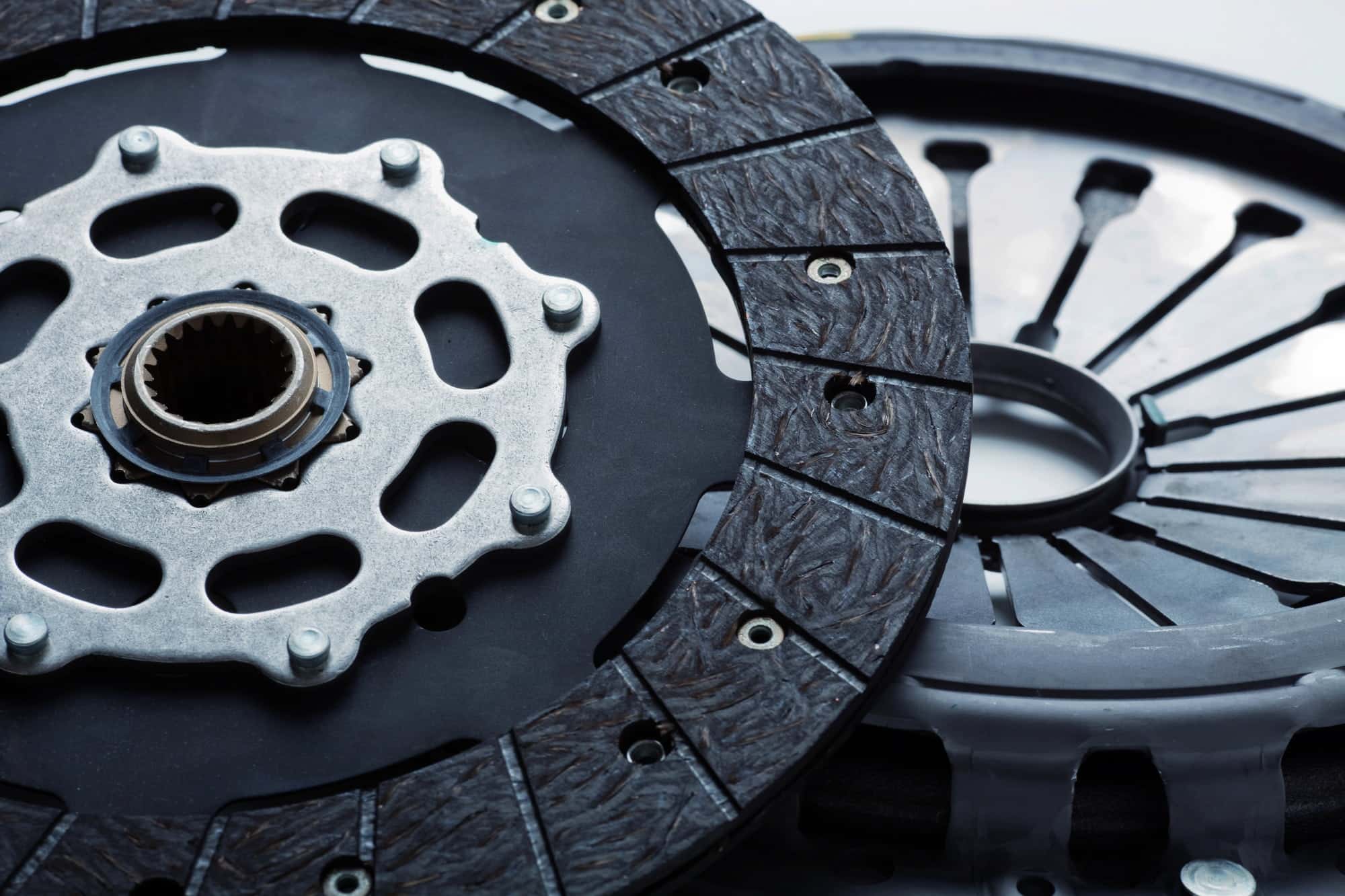
Land Rover manual transmissions use a single-disc dry clutch with hydraulic actuation, but the implementation differs from typical passenger cars. Most modern Land Rovers employ a dual-mass flywheel – two rotating masses connected by internal springs that dampen the diesel engine's torque pulses and reduce drivetrain vibration. The clutch disc sits between this flywheel and a diaphragm-spring pressure plate. When the driver presses the pedal, a hydraulic master cylinder sends fluid to a slave cylinder (either external or integrated into the bell housing), which pushes the release bearing against the pressure plate's diaphragm fingers, releasing clamping force and interrupting power to the transmission.
What makes Land Rover clutch work distinct:
- Transfer case considerations: On four-wheel-drive models, the transmission and transfer case are often removed as a unit. The propeller shafts, transfer case linkage, and in some cases the exhaust system must be disconnected before the transmission can drop far enough to access the clutch assembly.
- Dual-mass flywheel replacement intervals: Land Rover specifies dual-mass flywheel replacement at specific mileage intervals on diesel models, not just when failure occurs. The internal dampening springs fatigue over time, and reusing an old flywheel with a new clutch often results in premature clutch failure or recurring vibration.
- Hydraulic system bleeding procedure: Many Land Rover clutch hydraulic systems require a specific bleeding sequence using a pressure bleeder, not traditional pump-and-hold pedal bleeding. Some models use a clutch delay valve that must be removed or bypassed during bleeding to purge all air from the system.
- Torque-to-yield bolts on the flywheel and pressure plate are single-use. Each one is tightened to a set value and then turned a further angle, and reusing them loses clamping force.
Land Rover's dual-mass flywheels and hydraulic concentric slave cylinders have evolved significantly across platforms, from the LR3/LR4 to the Discovery Sport and Range Rover Evoque. Early TD6 diesel models experienced premature dual-mass flywheel failures, while the 2.0-liter Si4 Ingenium engines introduced in 2015 brought a lighter clutch assembly prone to judder when the flywheel surface wears unevenly. At DART Auto, we've diagnosed hundreds of these systems using Land Rover's approved SDD (Symptom Driven Diagnostics) software and know exactly where each generation fails – and how to fix it right the first time.
How We Diagnose Clutch Repair & Replacement Issues on Land Rover
Accurate diagnosis separates a lasting repair from repeated comebacks. We follow a structured process that combines Land Rover-specific tooling with hands-on inspection:
- Initial interview and symptom documentation. We ask about pedal feel, engagement point changes, slipping under load, noise during engagement, and whether the clutch chatters on takeoff – common on worn dual-mass flywheels.
- Road test under varied conditions. We drive the vehicle through stop-and-go traffic, hill starts, and moderate acceleration to replicate the owner's experience and observe pedal travel, bite point, and any slip or judder.
- Scan with Land Rover SDD. The factory diagnostic suite reads transmission control module fault codes, monitors clutch position sensor data, and checks for hydraulic pressure anomalies that point to concentric slave cylinder failure.
- Visual and mechanical inspection. We inspect the hydraulic reservoir for contamination, check for fluid leaks at the bell housing, and measure pedal free play. On vehicles with external slave cylinders (older Defenders), we verify pushrod travel and bearing condition.
- Transmission removal and component measurement. Once authorized, we drop the transmission and measure flywheel runout, friction disc thickness, pressure plate spring tension, and pilot bearing condition. We inspect the dual-mass flywheel for excessive rotational play – anything beyond 5-7 degrees indicates replacement is due.
This process produces a detailed quote that separates necessary replacements from preventive upgrades, so you understand exactly what failed and why each repair matters.
Clutch Repair & Replacement on Land Rover: Repair vs. Replacement
Not every clutch concern requires a full assembly replacement. The right approach depends on which components have reached their service limit and whether partial replacement introduces new risks.
When Repair Is the Right Call
- Hydraulic system service. If the friction disc and flywheel measure within spec but the pedal feels spongy or won't disengage fully, bleeding the hydraulic circuit or replacing the master cylinder solves the issue without touching the clutch itself.
- Minor adjustments on cable-actuated systems. Older Defenders with mechanical linkage may only need cable tension adjustment or replacement if the clutch components remain serviceable.
When Partial Replacement Makes Sense
- Concentric slave cylinder failure with healthy friction components. On Discovery 4 and Range Rover Sport models, the hydraulic release bearing often fails before the clutch disc wears out. Replacing the slave cylinder and pilot bearing while leaving the friction disc and pressure plate in place is cost-effective if those parts have less than 40% wear.
When Full Replacement Is Necessary
- Dual-mass flywheel wear. Once the DMF shows excessive rotational play or surface heat checking, it must be replaced. Installing a new clutch disc on a worn flywheel guarantees judder and short service life.
- Friction disc below minimum thickness. If the disc measures under spec or shows oil contamination from a rear main seal leak, the entire friction assembly (disc, pressure plate, release bearing) gets replaced as a kit.
- Cascading wear on high-mileage assemblies. When one component fails on a clutch with 80,000+ miles, the remaining parts are near end-of-life. Replacing the full assembly prevents a second teardown six months later.
We walk you through the measurements and explain the trade-offs so you can make an informed decision rather than defaulting to the most expensive option.
How to Make Your Land Rover Clutch Repair & Replacement Last Longer
Clutch longevity on a Land Rover depends as much on driving technique and maintenance habits as it does on parts quality. Here's how to extend service life:
Driving Habits That Reduce Wear
- Avoid riding the clutch pedal. Resting your foot on the pedal while driving partially disengages the pressure plate and accelerates friction disc wear. Keep your foot off the pedal unless shifting.
- Don't slip the clutch to hold on hills. Use the handbrake or footbrake to hold position on inclines rather than balancing on the clutch friction zone, which overheats the disc and flywheel.
- Shift smoothly and match engine speed. Abrupt clutch dumps shock the dual-mass flywheel and pressure plate springs. Smooth engagement reduces peak loads and extends component life.
- Limit towing and heavy loads when possible. Frequent towing or overloading increases clutch slip and heat, especially on the smaller Ingenium engines not designed for sustained high torque.
Maintenance and Monitoring
- Check hydraulic fluid level monthly. Low clutch fluid often signals a leaking slave cylinder. Catching it early prevents a roadside failure.
- Listen for changes in engagement noise. New rattling at idle or grinding during shifts points to dual-mass flywheel wear or pilot bearing failure.
- Follow Land Rover's transmission and transfer case service intervals. Contaminated fluid can migrate into the bell housing and damage the friction disc.
- Use OEM or OE-equivalent hydraulic components. Aftermarket slave cylinders often use inferior seals that fail prematurely under Land Rover's hydraulic pressures.
What to Leave to the Professionals
Clutch hydraulic bleeding and fluid top-ups are safe DIY tasks. Everything else – including clutch replacement, flywheel resurfacing, and pilot bearing service – requires transmission removal, specialized alignment tools, and torque-to-yield fasteners that must be replaced. Attempting these repairs without proper equipment risks misalignment, premature failure, and safety hazards.
What to Expect When You Bring Your Land Rover In
Clutch replacement is a major service, and we treat it that way from the moment you schedule your appointment. Here's how the process unfolds:
- Drop-Off and Initial Consultation: We'll discuss the symptoms you've noticed – slipping under load, hard pedal engagement, grinding during shifts – and review your vehicle's service history. Bring any personal items out of the cabin; we'll need extended access to the vehicle. Loaner vehicles and local shuttle service are available while your Land Rover is with us.
- Comprehensive Inspection: Before any teardown, we perform a full driveline assessment: hydraulic system pressure test, flywheel runout measurement, transmission input-shaft play, and a scan for stored fault codes. On models with electronic clutch actuation (like the Freelander 2), we'll verify actuator function and calibration data.
- Written Estimate and Approval: You'll receive a detailed breakdown of required parts – clutch disc, pressure plate, release bearing, flywheel resurfacing or replacement if needed – along with labor and any additional findings like a leaking clutch master cylinder. We explain what happens if you delay the repair and answer every question before you approve the work.
- Repair and Post-Service Verification: Once completed, we road-test your Land Rover through multiple drive cycles, verify clutch pedal feel and engagement point, and re-scan to confirm all adaptation values are within factory parameters. At pickup, we walk you through the work performed and provide documentation for your records.
If anything feels off in the days following your repair, contact us immediately. We'll schedule a complimentary follow-up inspection to verify clutch break-in is progressing normally and address any concerns.
Our Land Rover Services
- Air Conditioning AC Repair
- Battery Repair Replacement
- Brake Repair & Brake Fluid Change
- Check Engine Light Diagnostics
- Coolant Leak Repair
- Cooling System Repair
- Drive Shaft Repair
- Engine Repair
- Exhaust & Catalytic Converter Repair
- Head Gasket Repair & Replacement
- Oil Change
- Oil Leak Repair
- Scheduled Service Maintenance
- Steering Repair
- Suspension Repair
- Cambelt Timing Belt Replacement
- Transmission Repair
- Tune Up
- Wheel Alignment


