
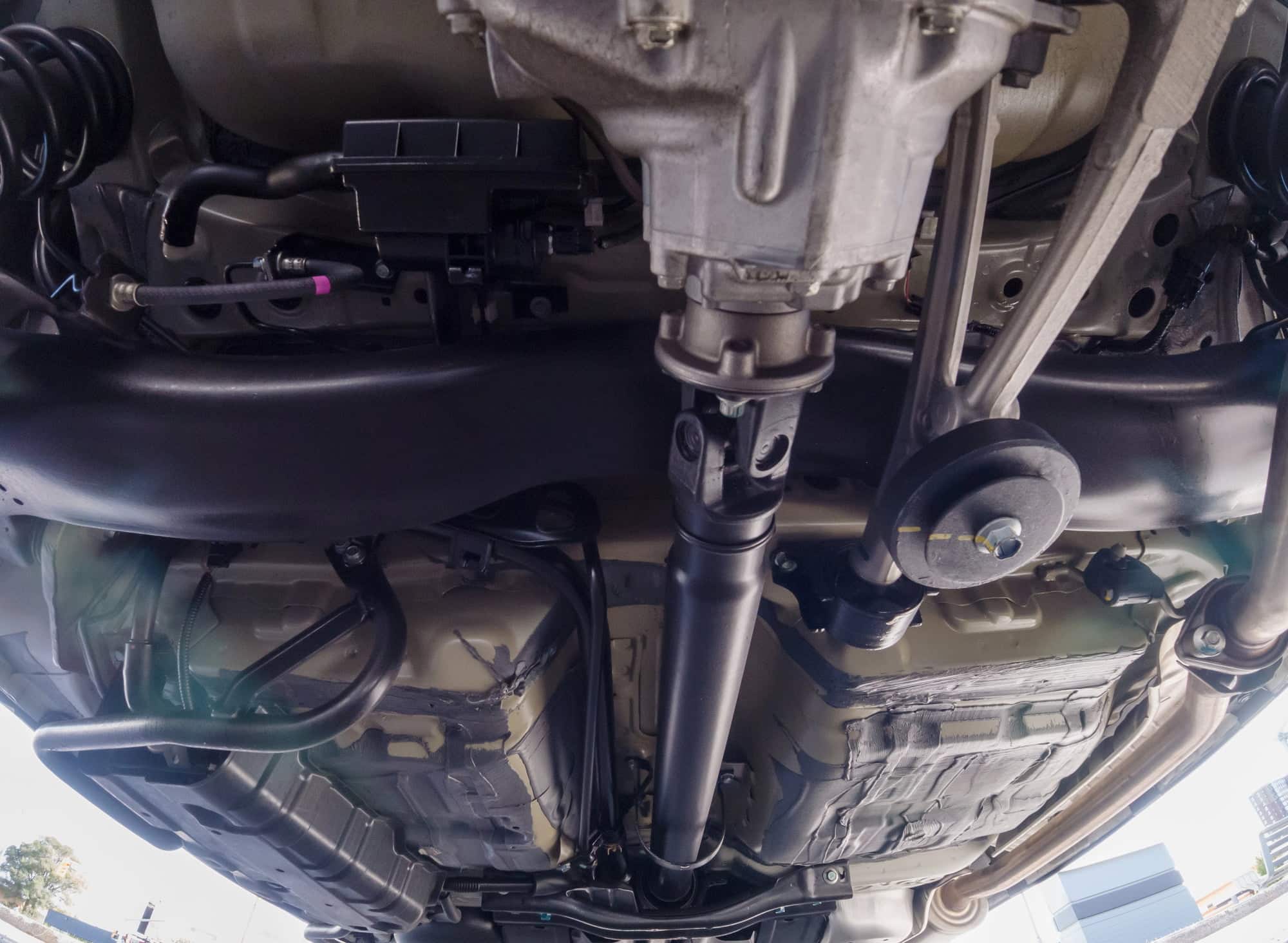
Land Rover Drive Shaft Repair at DART Auto
A customer once drove his 2012 Range Rover Sport into our shop after hearing a rhythmic clunk during acceleration. He'd been told by another shop it was "probably just a U-joint," but when our technicians put it on the lift, they found a cracked aluminum propeller shaft – a known failure point on L320 platforms equipped with the TDV6 diesel. That aluminum shaft, lightweight for fuel economy but prone to stress fractures under the torque loads of Land Rover's Terrain Response system, required OEM replacement and precise alignment to the transfer case output and rear differential pinion flange. Generic driveline shops often miss the software recalibration steps needed after replacing these components on vehicles with adaptive all-wheel-drive systems.
Land Rover drive shafts operate in a demanding environment. Between the transfer case, center differential, and electronically controlled torque distribution, these shafts endure constant speed variation and load changes that would never occur in a two-wheel-drive vehicle. The factory specifies exact phasing angles between the front and rear shafts, torque values for the companion flange bolts, and in some cases, software adaptation procedures to ensure the Terrain Response computer recognizes the new component signatures. We use Land Rover's approved diagnostic platform and maintain the full library of OEM service procedures, so your vehicle leaves with the same driveline balance and NVH characteristics it had from the factory.
When you bring your Land Rover to DART Auto for drive shaft repair, you can expect:
- Complete driveline inspection using factory alignment and runout specifications
- OEM or premium aftermarket shafts sourced to match your vehicle's transfer case and differential ratios
- Proper phasing and torque procedures to eliminate vibration and premature wear
- Software verification to confirm Terrain Response and stability control systems recognize the repair
Common Drive Shaft Repair Issues on Land Rover Vehicles
A customer brought in a 2014 Range Rover Sport with a persistent vibration at highway speeds. The drive shaft center bearing had failed, and what started as a subtle hum had escalated to a noticeable shudder through the cabin. Land Rover's all-wheel-drive architecture places unique demands on the drive shaft system, and when components wear, the symptoms are impossible to ignore.
- Center bearing failure on L494/L405 platforms (2013–2016 Range Rover Sport and Range Rover): The two-piece drive shaft design uses a rubber-isolated center support bearing that degrades over time. Heat cycling and torque load cause the rubber mount to crack and the bearing to seize, producing vibration that worsens with speed. This is especially common on vehicles with the supercharged 5.0L V8, where torque output accelerates wear.
- CV joint wear on Discovery 3/4 (LR3/LR4) front drive shafts: The independent front suspension on these platforms subjects the constant-velocity joints to extreme articulation angles during off-road use. Torn boots allow contaminants in, and the joints click or clunk during tight turns. Left unchecked, the joint binds completely and can separate under load.
- Spline wear on transfer case output shafts (2010–2013 Range Rover Sport with ZF 8-speed): The transfer case output spline can develop play where it mates with the rear drive shaft. This creates a clunk on acceleration or deceleration and eventually damages the transfer case itself, turning a drive shaft repair into a four-figure transfer case replacement.
- Imbalanced drive shafts after off-road exposure (all models): Mud, rocks, and debris accumulate on the drive shaft tube, throwing it out of balance. What begins as a mild vibration at 50 mph becomes a violent shake at 70 mph, accelerating wear on transmission output bearings and differential input seals.
- U-joint failure on older Discovery 2 and Range Rover Classic models: These platforms use traditional Spicer-style universal joints that require periodic greasing. Neglected maintenance causes the needle bearings to dry out and seize, leading to catastrophic failure where the drive shaft separates and can damage the undercarriage, fuel lines, or brake lines.
- Rear drive shaft flex disc deterioration (2006–2009 Range Rover Sport with V8): The rubber flex disc that couples the drive shaft to the rear differential hardens and cracks over time. Chunks of rubber separate, causing clunking noises and eventually allowing the drive shaft to move excessively, damaging the differential pinion seal and causing fluid leaks.
Why Choose DART Auto for Land Rover Drive Shaft Repair
A customer brought in a 2016 Range Rover Sport with a vibration that started subtly at highway speed and grew into a pronounced shudder during acceleration. The dealer quoted a full driveline overhaul. Our technicians isolated the issue to a failing center support bearing on the two-piece propshaft – a known wear point on L494 platforms with the ZF 8HP transmission. We replaced the bearing assembly using OEM-spec components, verified U-joint phasing with a dial indicator, and road-tested under load. The customer left with a smooth drivetrain and saved over forty percent compared to the dealer estimate.
DART Auto has served Denver since 2000, and our master technicians average more than a decade of experience with factory-level training. We use the same diagnostic software Land Rover dealers rely on – including Jaguar Land Rover's SDD platform – to read driveline fault codes, monitor torque distribution in real time on Terrain Response-equipped models, and verify transfer case engagement. Our salaried compensation model means your technician has no incentive to rush or recommend unnecessary work. We diagnose the root cause, explain what failed and why, then fix it right the first time.
- Platform-specific knowledge: familiarity with Discovery 3/4 three-piece propshaft configurations, L320 center bearing failures, and L405/L494 aluminum driveshaft balancing requirements.
- Complete in-house capability: from on-lift inspection and runout measurement to U-joint replacement, CV boot service, and post-repair torque verification.
- Transparent process: written estimates before any work begins, photo documentation of worn components, and a 3-year/36,000-mile warranty on parts and labor.
Symptoms – How to Know You Need This Service
Drive shaft problems on Land Rover vehicles often announce themselves through vibrations and noises that change with vehicle speed or load. You may notice:
- Vibration at highway speeds – a rhythmic shudder through the floor or seats, often between 50 and 70 mph, that worsens under light acceleration
- Clunking during takeoff or gear changes – a metallic thunk when you accelerate from a stop or when the transmission shifts, especially noticeable in Sport mode
- Squeaking or chirping from underneath – high-pitched sounds that vary with wheel speed, indicating worn universal joints or CV joints on the front shaft
- Grinding or rumbling that increases with speed – a low-frequency drone that gets louder as you accelerate, often pointing to failed center support bearings on two-piece shafts
- Dashboard warnings – "HDC Fault," "Terrain Response Not Available," or stability control lights triggered by driveline speed sensor discrepancies
- Visible damage or fluid leaks – grease flung around the undercarriage from torn CV boots, or transmission fluid near the transfer case output seal
- Excessive play when parked – if you can rotate the rear wheels more than an inch with the vehicle in park and transfer case in neutral, you likely have failed U-joints or splined slip-yoke wear
If you hear sudden loud banging or feel the vehicle lurch unexpectedly, stop driving immediately – a complete shaft failure can damage the transfer case, transmission tailhousing, or differential. For vibrations and minor noises, schedule an inspection soon to prevent secondary damage.
Which Land Rover Models We See for Drive Shaft Repair
We regularly service drive shafts across the full Land Rover range, with particular attention to the platform-specific failure modes that affect each generation. The models we see most often include:
- Range Rover (L322, 2003–2012) – two-piece rear shafts with center support bearings that fail around 80k–120k miles; front shafts on supercharged models see higher stress
- Range Rover Sport (L320, 2006–2013) – aluminum propeller shafts on TDV6 and SDV6 diesel variants prone to stress cracks; HSE and Supercharged models with heavier-duty steel shafts
- Range Rover and Range Rover Sport (L405/L494, 2013–present) – lightweight carbon-fiber shafts on select variants require OEM replacement; adaptive systems demand software verification after service
- Discovery 3 and 4 (LR3/LR4, 2005–2016) – shared L319 platform with Range Rover Sport; common U-joint and CV joint wear, especially on vehicles used for towing
- Discovery Sport (L550, 2015–present) – transverse-engine layout with shorter front shaft and electronically managed rear driveline; less common failures but require specific tooling
- LR2/Freelander 2 (2007–2015) – Haldex-based AWD with rear power-take-off unit; different diagnostic approach than full-time 4WD models
- Defender (2020–present) – new D7x platform shares components with L405/L494; early to assess long-term failure patterns but we have factory procedures and parts access
We're equipped to handle both full-time four-wheel-drive systems (with low-range transfer cases) and on-demand all-wheel-drive configurations. If you're working with a classic Defender, Discovery Series I/II, or pre-2003 Range Rover, we're happy to discuss your specific needs – these earlier models use simpler driveline layouts but may require sourcing from specialty suppliers.
Causes & Risks – What Happens if Ignored
Drive shaft problems on Land Rover vehicles stem from a combination of high torque output, all-wheel-drive complexity, and the brand's dual-purpose design philosophy. These vehicles are engineered to handle both highway cruising and serious off-road terrain, which places extraordinary stress on the drive shaft assembly. Heat cycling from stop-and-go city driving degrades rubber components, while sustained highway speeds expose even minor imbalances. Off-road use introduces contamination, impact damage, and articulation angles that exceed what most vehicles ever experience.
Delaying drive shaft repairs sets off a cascade of secondary failures:
- Bearing and seal damage: A worn center bearing transmits vibration directly into the transmission output shaft and rear differential input shaft. Within a few thousand miles, you'll see leaks from the transmission tail housing seal or differential pinion seal, adding fluid replacement and seal work to the bill.
- Transfer case and differential wear: Excessive play in worn U-joints or CV joints hammers the transfer case output shaft and differential pinion. What could have been a drive shaft repair becomes a transfer case rebuild or differential overhaul, multiplying the cost by a factor of five or more.
- Catastrophic separation: A failed U-joint or center bearing can allow the drive shaft to drop and contact the road surface at highway speed. The spinning shaft can wrap around suspension components, sever brake lines, puncture the fuel tank, or cause the vehicle to lose control entirely.
- Transmission and engine mount failure: Chronic vibration from an imbalanced or failing drive shaft fatigues engine and transmission mounts. Replacing these mounts adds labor-intensive work to what should have been a straightforward drive shaft job.
- Wheel bearing and hub damage: Vibration transmitted through the drive shaft accelerates wear on wheel bearings and hub assemblies, particularly on the rear axle. These are expensive, time-consuming repairs that could have been avoided.
Safety Impact – Why Drive Shaft Repair Matters
When a drive shaft fails on a Land Rover, the consequences go far beyond inconvenience. These vehicles often carry families, tow trailers, and navigate challenging terrain where mechanical reliability directly affects occupant safety. A separated drive shaft can pole-vault the rear of the vehicle, cause sudden loss of power in traffic, or create an uncontrollable situation on a steep grade or highway merge.
- Loss of traction control and stability systems: Modern Land Rover models integrate drive shaft speed sensors with traction control, hill descent control, and terrain response systems. A failing drive shaft sends erratic signals to these systems, causing them to intervene inappropriately or fail to engage when needed. You might lose traction control on a wet road or find hill descent control non-functional on a steep trail.
- Sudden loss of drive power: A catastrophic U-joint or CV joint failure instantly disconnects power to the wheels. If this happens while merging onto a highway, climbing a grade, or navigating an intersection, the vehicle becomes a coasting obstacle with no ability to accelerate out of danger.
- Undercarriage damage and fire risk: A dropped drive shaft can sever brake lines, fuel lines, or electrical harnesses. Loss of braking is an immediate emergency, while a punctured fuel line presents a fire hazard, especially if the spinning drive shaft creates sparks against the pavement.
- Increased stopping distances: Vibration from a failing drive shaft can cause uneven brake pad contact and reduce braking efficiency. ABS sensors may receive conflicting wheel speed data, degrading the system's ability to prevent lockup in emergency stops.
When to stop driving immediately: loud clunking or banging from underneath, visible drive shaft wobble, sudden vibration that worsens rapidly, or any grinding noise accompanied by loss of power. Schedule service soon: mild vibration at highway speeds, clicking during turns, or clunking during acceleration and deceleration.
How Land Rover Drive Shaft Repair Actually Works
Land Rover's all-wheel-drive architecture uses a longitudinal engine layout with a transfer case that splits torque between front and rear axles. The rear drive shaft is typically a two-piece design with a center support bearing to manage the length required by the vehicle's wheelbase and ground clearance. Front drive shafts on independent suspension models use plunging CV joints to accommodate suspension travel and steering angles. This design delivers exceptional off-road capability but introduces complexity that affects how repairs must be performed.
Proper drive shaft service on a Land Rover requires more than swapping parts. The transfer case must be placed in neutral using factory diagnostic software to prevent binding during installation. Drive shaft phasing – the angular relationship between U-joints – must be maintained exactly as specified, or vibration will return immediately. Torque specifications for the flange bolts are critical; over-tightening distorts the flanges and causes runout, while under-tightening allows movement that damages the bolts and flanges. On models with electronic parking brakes, the system must be retracted using the scan tool before the drive shaft can be removed, and recalibrated afterward.
- OEM balancing requirements: Land Rover drive shafts are balanced as an assembly with specific bolt locations marked. Reusing the original bolts in the original positions maintains this balance. Aftermarket shafts must be dynamically balanced to OEM tolerances or vibration will persist.
- Transfer case software interaction: The Terrain Response system on 2010-and-newer models monitors drive shaft speed sensors and adjusts torque distribution. After drive shaft replacement, the system may need to relearn baseline values through a drive cycle or forced calibration using the factory tool.
- Spline lubrication and preload: The slip yoke or splined connection at the transfer case requires specific lub
How We Diagnose Drive Shaft Repair Issues on Land Rover
A customer arrived last month with a 2015 Range Rover Sport that shuddered violently during acceleration. The owner had already replaced the transmission mounts elsewhere, but the vibration persisted. Within twenty minutes on our lift, we traced the problem to a failing center support bearing and a propeller shaft that had developed runout from years of trail use. That kind of precision starts with a structured diagnostic process.
- Initial road test and symptom documentation. We drive the vehicle under the conditions that trigger the complaint – highway merge, low-speed turn, reverse – and note the exact speed, load, and steering angle where vibration or noise appears.
- Scan tool interrogation using dealer-level diagnostics. We connect Jaguar Land Rover–approved scan tools (IDS/SDD or equivalent) to pull drivetrain control module codes, transfer case adaptation values, and ABS wheel-speed discrepancies that can point to imbalanced or damaged shafts.
- Lift inspection and physical measurement. With the vehicle raised, we check each CV joint and center bearing for play, inspect boots for tears or grease fling, measure propeller shaft runout with a dial indicator, and verify U-joint tightness. On L320, L405, and L494 platforms, we pay close attention to the aluminum propeller shaft center bearing, which is prone to premature wear under off-road load.
- Transfer case and differential fluid inspection. Metallic debris in the transfer case or rear differential can indicate internal damage that's being transmitted through the driveline. We pull samples and inspect for color, smell, and particulate.
- Dynamic balance check if needed. For high-speed vibrations that don't correlate with obvious damage, we sometimes mark and rotate the shaft to isolate whether the issue is the shaft itself or a related component like a wheel bearing or tire.
Once we've completed the diagnostic sequence, we compile our findings into a clear repair plan with photos and measurements. You'll see exactly what failed, why it matters, and what we recommend – no jargon, no upselling, just the facts and the fix.
Drive Shaft Repair on Land Rover: Repair vs. Replacement
Not every drive shaft problem demands a complete replacement. The right answer depends on what's actually worn and whether the remaining components can deliver safe, reliable service.
When Repair Makes Sense
- Isolated CV boot tears with no joint contamination. If we catch a torn boot early – before dirt and water have compromised the grease – we can replace the boot and repack the joint, restoring full service life.
- Single worn U-joint on a serviceable shaft. On older Discovery and Defender models with replaceable U-joints, swapping the failed joint and inspecting the yoke for wear can be a cost-effective repair.
- Center bearing replacement on aluminum propeller shafts. The L320 Range Rover Sport and L319 Discovery 3/4 use aluminum prop shafts with bolt-on center bearings. Replacing the bearing assembly while keeping the balanced shaft is often the smartest move.
When Full Replacement Is the Right Call
- Runout or imbalance in the shaft tube itself. If the propeller shaft has been bent or shows measurable runout, no amount of component swapping will restore smooth operation. A new or remanufactured shaft is the only safe solution.
- Contaminated CV joints with visible wear. Once a CV joint has run dry and developed pitting or scoring, the damage is irreversible. Replacement is the only option that won't leave you stranded.
- Cascading wear across multiple components. When the center bearing, both CV joints, and the guibo coupling all show wear, the cost and labor of piecemeal repair often approaches or exceeds the cost of a complete shaft assembly.
We walk you through the decision with photos and measurements. If a repair will get you another 100,000 miles, we'll recommend it. If replacement is the smarter investment, we'll explain why – and we'll never push the most expensive option just because we can.
How to Make Your Land Rover Drive Shaft Repair Last Longer
Once we've restored your driveline to smooth, vibration-free operation, a few thoughtful habits will help you protect that investment and avoid premature wear.
Driving Habits That Protect the Driveline
- Avoid aggressive launches on high-traction surfaces. Hard acceleration from a stop – especially with Terrain Response in Rock Crawl or Mud/Ruts – loads the CV joints and center bearing far beyond normal street use. Save the heroics for actual trail conditions.
- Let the drivetrain warm up before heavy load. Cold transmission and transfer case fluid increases internal resistance and shock-loads the driveline. A few minutes of gentle driving before towing or climbing makes a measurable difference.
- Reduce payload and trailer weight where practical. The closer you run to your Land Rover's GVWR, the harder every drivetrain component works. Lighten the load when you can, and your shafts will thank you.
Maintenance You Can Monitor
- Listen for new sounds. A clicking CV joint during tight turns or a rumble that changes with speed are early warnings. Catching them early often means a boot replacement instead of a full joint.
- Watch for grease on the inside of your wheels. A torn CV boot will fling grease onto the wheel and suspension. Spotting it early can save the joint.
- Keep transfer case and differential fluids on schedule. Land Rover specifies fluid changes for the transfer case and differentials. Clean fluid reduces heat and wear transmitted through the driveline.
What to Leave to the Professionals
Visual checks and fluid monitoring are safe DIY tasks. But drive shaft removal, CV joint replacement, and propeller shaft balancing require specialty tools, torque specs, and alignment procedures that aren't practical in a home garage. Safety-critical drivetrain work is best left to a shop with the right equipment and factory repair information. We're here when you need us – and we'll help you understand what you can safely watch for in between visits.
What to Expect When You Bring Your Land Rover In
We start every visit with a conversation about what you've noticed – vibration, clunking during direction changes, or a grinding sound when the transfer case shifts. That context helps our technicians know where to focus during the initial inspection. Drop your Land Rover off at your scheduled time, or call ahead if you need shuttle service to your home or office. If you're staying, our waiting area has Wi-Fi and coffee.
- Initial inspection: Your technician lifts the vehicle, checks propshaft runout with a dial indicator, inspects U-joints and CV boots for play or torn seals, and rotates the driveline by hand to feel for binding or rough spots. On models with electronic transfer cases, we'll connect the scan tool to check for stored fault codes and verify actuator operation.
- Written estimate: Before any repair begins, you'll receive a detailed estimate listing the failed components, the recommended parts (OEM or premium aftermarket), and labor. We explain what happens if you delay the repair – for example, a failing center bearing can damage the transmission tailshaft or transfer case input if the propshaft separates.
- Repair and verification: Once you approve the estimate, we source the parts, perform the replacement following Land Rover service procedures, torque all fasteners to spec, and road-test under varied loads. We re-scan for codes and verify smooth operation across all drive modes.
- Pickup walkthrough: At pickup, we show you the old parts, review what we replaced, and answer any questions. If something feels off in the days after, call us – we'll get you back in promptly to verify the repair at no charge.
We also offer after-hours key drop-off if your schedule requires it, and loaners are available on a first-come basis for longer jobs. Keep valuables and personal items with you; we're not responsible for contents left in the vehicle.
Our Land Rover Services
- Air Conditioning AC Repair
- Battery Repair Replacement
- Brake Repair & Brake Fluid Change
- Check Engine Light Diagnostics
- Clutch Repair & Replacement
- Coolant Leak Repair
- Cooling System Repair
- Engine Repair
- Exhaust & Catalytic Converter Repair
- Head Gasket Repair & Replacement
- Oil Change
- Oil Leak Repair
- Scheduled Service Maintenance
- Steering Repair
- Suspension Repair
- Cambelt Timing Belt Replacement
- Transmission Repair
- Tune Up
- Wheel Alignment