
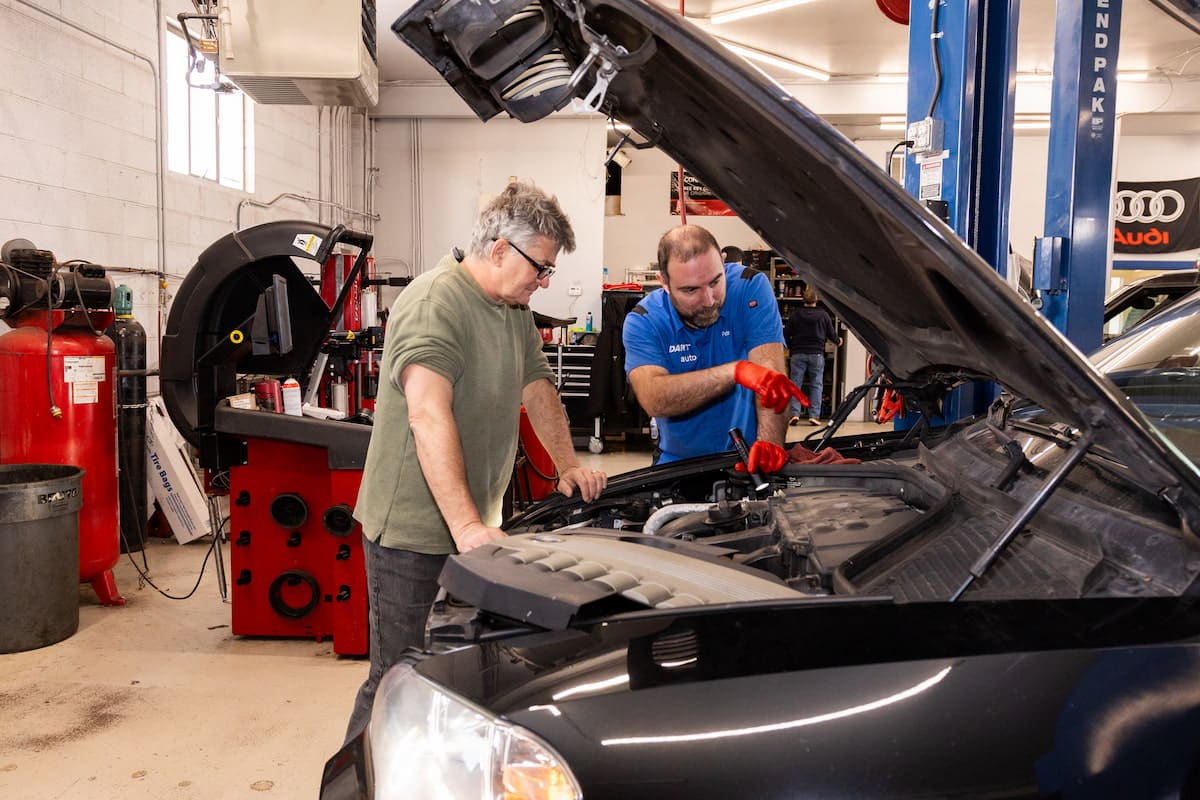
Fiat Scheduled Service Maintenance at DART Auto
Your Fiat's scheduled maintenance intervals aren't just suggestions in the owner's manual – they're the roadmap to protecting your investment and keeping that Italian character alive. Whether you're driving a turbocharged 500 Abarth or a practical 500X crossover, these vehicles demand attention to detail that most quick-lube shops simply can't provide. The MultiAir valve-lift system found across the Fiat lineup since 2010 requires specific oil grades and change intervals to prevent hydraulic actuator failures. Skip or delay these services, and you're looking at carbon buildup, timing system wear, and expensive repairs that could have been avoided.
We follow factory service schedules tailored to your specific model and engine code, using the diagnostic tools and repair information that match what Fiat technicians use. Our master technicians understand the quirks of these platforms – from the known oil consumption issues on early 1.4L MultiAir engines to the dual-clutch transmission fluid service requirements on the 500L. Because our techs are salaried rather than flat-rate, there's zero incentive to recommend services you don't need or rush through the ones you do.
When you bring your Fiat to DART Auto for scheduled maintenance, expect:
- Complete multi-point inspection using factory specifications and torque values
- OEM or premium aftermarket fluids that meet FCA/Stellantis specifications
- Documentation of service history to preserve warranty coverage and resale value
- Transparent communication about what's due now versus what can wait, with no pressure tactics
Common Scheduled Service Maintenance Issues on Fiat Vehicles
Fiat vehicles are known for their spirited driving character and Italian design, but they also come with specific maintenance needs that differ significantly from domestic or Japanese brands. Missing scheduled service intervals on Fiats can lead to accelerated wear on components that were engineered with tight tolerances and specific fluid requirements.
- MultiAir Engine Oil Consumption (2012–2019 500, 500L, 500X with 1.4L Turbo): The electrohydraulic valve actuation system in MultiAir engines relies on clean, fresh oil to operate the intake valve solenoids. Extending oil change intervals beyond 5,000 miles frequently causes sludge buildup in the MultiAir actuators, leading to rough idle, misfires, and expensive actuator replacement. These engines are particularly sensitive to oil quality and contamination.
- Dual-Clutch Transmission Fluid and Adaptation (2012–2020 500, 500X with DDCT): The Dual Dry Clutch Transmission requires fluid changes every 30,000 miles and periodic clutch adaptation relearns using factory scan tools. Skipping these services results in harsh shifts, clutch slippage, and premature clutch pack wear. The DDCT is not a sealed-for-life unit despite some early owner manual ambiguity.
- Timing Belt Replacement (2012–2019 500, 500L 1.4L Non-Turbo): Non-turbo 1.4L engines use an interference-design timing belt that must be replaced at 60,000-mile intervals. Failure to replace on schedule can result in catastrophic valve-to-piston contact, requiring complete engine rebuild or replacement. This is a non-negotiable service interval.
- Brake Fluid Degradation and ABS Module Issues (All Models): Fiat specifies DOT 4 brake fluid replacement every two years. The ABS modules on 2012–2016 models are particularly sensitive to moisture contamination, which leads to internal corrosion and expensive ABS pump failure. Regular fluid exchanges prevent this common failure mode.
- Spark Plug Fouling on Turbo Models (2012–2019 500 Abarth, 500X Turbo): The 1.4L MultiAir turbo engines require iridium spark plugs every 30,000 miles due to high combustion chamber pressures and direct oil exposure from MultiAir actuation. Worn plugs cause misfires that damage ignition coils and catalytic converters, turning a simple maintenance item into a multi-component repair.
- Coolant System Service and Thermostat Housing Leaks (2012–2018 500, 500L): Factory coolant degrades after 50,000 miles, leading to corrosion in the plastic thermostat housing and water pump seals. These components are common failure points that are preventable with scheduled coolant exchanges using OEM-spec coolant and proper bleeding procedures.
Why Choose DART Auto for Fiat Scheduled Service Maintenance
Your Fiat's scheduled service maintenance isn't just about oil changes – it's about protecting your investment and catching platform-specific issues before they escalate. DART Auto has served Denver since 2000, and our master technicians know the quirks of Fiat's platforms inside and out: the MultiAir engine timing system on 500 and 500L models, the dual-clutch transmission service intervals on Abarth variants, and the software updates that address known driveability concerns on 2012-2016 500 and 500X models.
We follow factory service schedules using OEM-spec fluids and filters, but we go further. Our diagnostic equipment reads Fiat-specific fault codes and adaptation values that generic scanners miss. Before you leave, we perform a complete inspection – suspension bushings, brake pad thickness, coolant condition, timing belt condition on older models – so you know exactly where your car stands. Because our technicians are salaried rather than flat-rate, they have zero incentive to rush or recommend unnecessary work. You get honest answers and a 3-year/36,000-mile warranty backing every service.
We use factory repair information and TSBs to address known concerns: throttle body carbon buildup on MultiAir engines, PCM reflashes for transmission shift quality, and the revised service intervals Fiat published for certain model years. You'll pay less than the dealer, but the work meets or exceeds their standards.
Symptoms – How to Know You Need This Service
Scheduled maintenance is preventive by nature, but your Fiat will often signal when services are overdue. You may notice a persistent oil change reminder on the instrument cluster – these systems track not just mileage but driving conditions and engine load. Ignoring it doesn't make the need go away.
Watch for these signs that maintenance is overdue:
- Dashboard maintenance light illuminated or flashing, sometimes accompanied by reduced power mode
- Rough idle or hesitation during acceleration, often caused by dirty throttle bodies or aged spark plugs on the 1.4L turbo
- Transmission that shifts harshly or hesitates, particularly in dual-clutch equipped models needing fluid service
- Increased oil consumption between changes – common on early MultiAir engines but worsens with extended intervals
- Squealing or grinding noises during braking, indicating pad wear that should be caught during routine inspections
- Reduced fuel economy or sluggish throttle response from clogged air filters or aged engine oil
- Coolant leaks or overheating warnings – serious issues that regular inspections help catch early
If you see coolant temperature warnings or smell burning oil, stop driving and have the vehicle towed. Most other symptoms mean schedule service soon, before minor neglect becomes major expense.
Which Fiat Models We See for Scheduled Service Maintenance
We service the full range of modern Fiat vehicles sold in North America, with particular expertise in the turbocharged and MultiAir-equipped models that dominate the lineup. Our technicians have the factory scan tools and service data to properly maintain these Italian-engineered platforms.
Common Fiat models we maintain:
- 500 (2012–2019) – Both naturally aspirated 1.4L and turbocharged Abarth variants; Pop, Lounge, and Sport trims
- 500 Abarth (2012–2019) – 1.4L MultiAir turbo requiring specific oil specs and more frequent service intervals
- 500L (2014–2020) – Larger MPV platform with 1.4L turbo and available dual-clutch transmission needing specialized fluid service
- 500X (2016–2019) – Compact crossover on the Small-Wide platform; 1.4L MultiAir turbo and 2.4L Tigershark engines
- 124 Spider (2017–2020) – Mazda MX-5 based roadster with Fiat's 1.4L MultiAir turbo; shares some Mazda service procedures but requires Fiat-specific engine maintenance
- 500e (2013–2019) – Electric variant with unique maintenance needs including brake fluid, coolant for battery thermal management, and cabin air filtration
We're equipped to handle both manual and automatic transmissions, including the DDCT dual-clutch found in 500L models. If you're driving an older Fiat imported from Europe or a specialty variant, contact us to confirm compatibility – we're honest about the limits of our service capabilities.
Causes & Risks – What Happens if Ignored
Scheduled service maintenance issues on Fiat vehicles stem from a combination of European engineering philosophy and real-world driving conditions. Fiat designs often prioritize performance and packaging efficiency over extended service intervals, meaning components operate closer to their thermal and mechanical limits. Colorado's temperature swings, short urban trips, and extended highway cruising all stress systems differently than the test cycles used to establish service intervals.
When scheduled maintenance is deferred, the progression of damage follows predictable patterns. Oil that stays in a MultiAir engine too long becomes acidic and loses its hydraulic properties, causing the electrohydraulic actuators to stick or fail completely. A dual-clutch transmission that never receives fresh fluid develops clutch glazing and pressure plate warping, eventually requiring a complete clutch pack replacement at five times the cost of routine fluid service. Timing belts don't give warning – they simply snap, and the resulting engine damage can total a vehicle that was otherwise sound.
What escalates when scheduled service is ignored:
- MultiAir actuator failure: Skipping oil changes leads to stuck actuators ($800–$1,500 each), followed by bent valves if the engine continues running with failed actuation.
- Transmission clutch replacement: Deferred DDCT fluid service causes clutch slip, which generates heat and warps pressure plates, turning a $300 fluid service into a $2,500+ clutch pack replacement.
- Timing belt catastrophic failure: A neglected timing belt snaps without warning, causing immediate valve-to-piston contact and requiring engine removal, head machining, and valve replacement – often $4,000+ in repairs.
- ABS module corrosion: Old brake fluid absorbs moisture, corroding the ABS pump internals and requiring module replacement ($1,200–$1,800) instead of a simple $120 fluid flush.
- Catalytic converter damage: Worn spark plugs cause misfires that dump unburned fuel into the exhaust, overheating and destroying the catalytic converter ($1,500–$2,200 with labor).
Safety Impact – Why Scheduled Service Maintenance Matters
Deferred scheduled maintenance on Fiat vehicles directly compromises multiple safety-critical systems. Brake fluid that has absorbed moisture boils under hard braking, creating vapor pockets that cause spongy pedal feel and extended stopping distances – particularly dangerous in mountain driving or emergency stops. The ABS and stability control systems rely on that same fluid to modulate brake pressure; contaminated fluid leads to erratic ABS operation or complete system failure.
MultiAir engine failures present their own hazards. When an actuator sticks, the engine can suddenly lose power or run extremely rough, creating a dangerous situation in traffic or on highway on-ramps. Timing belt failure results in immediate engine shutdown, often without power steering or full brake assist, leaving the driver scrambling to reach the shoulder safely.
Symptoms that require immediate attention:
- Stop driving now: Spongy brake pedal, ABS warning light with brake warning light together, sudden power loss, engine knocking or rattling, transmission stuck in gear.
- Schedule service this week: Check engine light with rough idle, harsh transmission shifts, brake pedal travel increasing, coolant loss without visible leaks.
- Plan service soon: Oil consumption between changes, minor transmission hesitation when cold, slight coolant smell, maintenance reminder lights.
From a liability perspective, neglecting known manufacturer-specified maintenance can complicate insurance claims if a mechanical failure contributes to an accident. Maintenance records demonstrating adherence to factory intervals protect both your safety and your financial interests.
How Fiat Scheduled Service Maintenance Actually Works
Understanding Fiat's engineering approach helps explain why scheduled maintenance is non-negotiable. The MultiAir system replaces traditional camshaft-driven intake valves with electrohydraulic actuators that use engine oil as a hydraulic medium. A high-pressure oil pump feeds solenoid-controlled actuators that open and close intake valves with variable timing and lift. This system allows aggressive valve timing for performance but demands oil that maintains precise viscosity and hydraulic properties – degraded oil causes immediate actuation problems.
The Dual Dry Clutch Transmission uses two independent clutch packs (one for odd gears, one for even) that operate without a wet oil bath. Clutch engagement is controlled by electric motors and a transmission control module that constantly adapts shift points based on clutch wear. The transmission contains its own fluid that lubricates bearings and actuators but doesn't cool the clutches themselves. Regular fluid changes and adaptation relearns using factory scan tools are essential to maintain proper clutch engagement and prevent premature wear.
Fiat-specific service requirements:
- MultiAir engines require oil that meets Fiat 9.55535-S1 or 9.55535-S3 specifications – generic oils lack the hydraulic stability needed for actuator operation
- DDCT transmissions need Tutela Transmission Gearforce or equivalent meeting Fiat 9.55550-MZ6 spec – other fluids cause clutch chatter and premature wear
- Timing belt service requires specific torque sequences for crankshaft and camshaft bolts, plus TDC alignment using factory tools – improper installation causes valve timing errors
- Brake fluid must meet DOT 4 ES
How We Diagnose Scheduled Service Maintenance Issues on Fiat
If your Fiat is due for scheduled service or showing symptoms that suggest neglected maintenance, you're likely wondering what's actually needed versus what can wait. Our diagnostic process cuts through the guesswork and delivers a clear picture of your vehicle's condition.
- Initial scan and fault code retrieval: We connect factory-level diagnostic equipment to your Fiat's OBD-II port and module-specific interfaces. This pulls stored and pending codes from the engine control unit, ABS module, airbag system, and body control modules. On newer 500X and Tipo models with Uconnect systems, we also scan for software update flags and adaptation values that indicate component drift.
- Service history review: We cross-reference your Fiat's VIN against factory service intervals and review any records you bring. This tells us which items are genuinely due – oil and filter, cabin and engine air filters, spark plugs, brake fluid, coolant – versus which might have been skipped or done incorrectly in the past.
- Visual and physical inspection: Our technicians perform a comprehensive underhood and underbody inspection. We check fluid levels and condition, look for oil seeps around the MultiAir valve cover (common on 1.4L turbo engines), inspect serpentine belt wear, examine brake pad thickness and rotor condition, and verify tire tread depth and wear patterns.
- Road test and operational checks: We drive your Fiat to confirm shift quality, clutch engagement (manual models), brake feel, and any drivability concerns. This reveals issues a static scan might miss – hesitation under load, transmission slip, or suspension noise.
- Fluid analysis and measurement: We test brake fluid moisture content with a digital tester, check coolant freeze protection and pH, and inspect transmission fluid color and smell where accessible. On dual-clutch models like the 500 Abarth with TCT transmission, we monitor clutch actuator wear and fluid condition.
Once the inspection is complete, we compile a prioritized list – what's due now per the factory schedule, what's showing early wear and should be addressed soon, and what can safely wait. You receive a transparent quote with explanations, not a generic upsell.
Scheduled Service Maintenance on Fiat: Repair vs. Replacement
Scheduled maintenance on a Fiat isn't always black-and-white. Some services are truly consumable replacements; others offer a choice between repair and replacement depending on wear severity and your plans for the vehicle.
When Maintenance Is a Simple Service
- Oil and filter changes: Straightforward replacement. On 1.4L MultiAir engines, we use the correct 0W-40 or 5W-40 synthetic to protect the electrohydraulic valve actuation system.
- Air filters and cabin filters: Consumable items replaced at fixed intervals. No repair option – just swap and go.
- Spark plugs: On turbo models (500 Abarth, 500X with 1.3L or 1.4L turbo), NGK or Bosch OEM-spec plugs are replaced, not cleaned or re-gapped.
When Partial Replacement Makes Sense
- Brake service: If rotors measure above minimum thickness and show no scoring, we can replace pads only. If rotors are thin or warped, we replace pads and rotors together.
- Serpentine belt and tensioner: Often the belt is due but the tensioner and idler pulleys are still smooth. We replace what's worn and preserve what's sound.
When Full Replacement Is the Right Call
- Timing belt service on 1.4L MultiAir: At the factory interval (typically 60,000–80,000 miles depending on model year), we replace the belt, tensioner, and water pump as an assembly. Skipping the pump invites a second teardown when it fails 10,000 miles later.
- Coolant and brake fluid flush: Complete system flush and fill with OEM-spec fluid. Partial top-offs dilute protection and leave contaminants.
We walk you through the options and explain the trade-offs – repair cost versus longevity, safety implications, and resale value. You decide; we execute.
How to Make Your Fiat Scheduled Service Maintenance Last Longer
Staying ahead of your Fiat's maintenance schedule protects both the car and your wallet. A few smart habits extend service intervals and keep components from degrading prematurely.
Driving Habits That Matter
- Warm up before hard acceleration: MultiAir engines rely on oil pressure for valve actuation. Let the engine reach operating temperature before full-throttle runs, especially in cold weather.
- Avoid short trips in winter: Frequent cold starts without reaching full temperature contaminate oil with fuel and moisture, shortening change intervals.
- Brake gently and progressively: Smooth braking reduces pad glazing and rotor heat cycling, extending pad and rotor life by thousands of miles.
- Shift smoothly on manual and dual-clutch models: Avoid riding the clutch or holding the car on a hill with clutch slip. This preserves clutch life and keeps TCT actuators from overworking.
Owner Maintenance You Can Do
- Check fluid levels monthly: Engine oil, coolant, brake fluid, and washer fluid. Top off as needed with the correct spec.
- Inspect tires for pressure and wear: Proper inflation reduces rolling resistance and uneven wear. Rotate every 5,000–7,500 miles.
- Listen for changes: New noises, vibrations, or warning lights mean something has shifted. Address them early before a minor issue cascades.
What to Leave to the Professionals
Timing belt replacement, brake fluid flush, and coolant system service require specialized tools, torque specs, and bleeding procedures. Attempting these at home on a Fiat risks air locks, improper tension, or contamination. Trust the experts for safety-critical and warranty-preserving work, and handle the simple checks yourself.
What to Expect When You Bring Your Fiat In
We've designed our process to be transparent from the moment you schedule your appointment. Here's how your visit unfolds:
- Drop-off and intake. We'll ask about any concerns you've noticed – unusual noises, dashboard warnings, changes in performance – and note your mileage to confirm which service interval applies. Bring personal items inside; we'll handle the rest.
- Complete inspection. While your Fiat is on the lift, we inspect brakes, suspension, fluid condition, and undercarriage. We scan for stored fault codes and check for open recalls or TSBs. If we find anything beyond the scheduled service, we document it with photos.
- Written estimate and discussion. You'll receive a detailed estimate covering the scheduled service and any additional recommendations. We explain what each item does, what happens if you defer it, and why it matters for your specific model year.
- Service completion and verification. After the work is done, we road-test your Fiat and re-scan to confirm no new codes have appeared. At pickup, we walk you through what we did, show you the old parts if requested, and answer any questions.
If you need a loaner vehicle or shuttle service while we're working, let us know when you schedule. After you drive away, we're available if something doesn't feel right – no question is too small, and we'll make it right if there's any concern about the work.
Our Fiat Services
- Air Conditioning AC Repair
- Battery Repair Replacement
- Brake Repair & Brake Fluid Change
- Check Engine Light Diagnostics
- Clutch Repair & Replacement
- Coolant Leak Repair
- Cooling System Repair
- Drive Shaft Repair
- Engine Repair
- Exhaust & Catalytic Converter Repair
- Head Gasket Repair & Replacement
- Oil Change
- Oil Leak Repair
- Steering Repair
- Suspension Repair
- Cambelt Timing Belt Replacement
- Transmission Repair
- Tune Up
- Wheel Alignment