
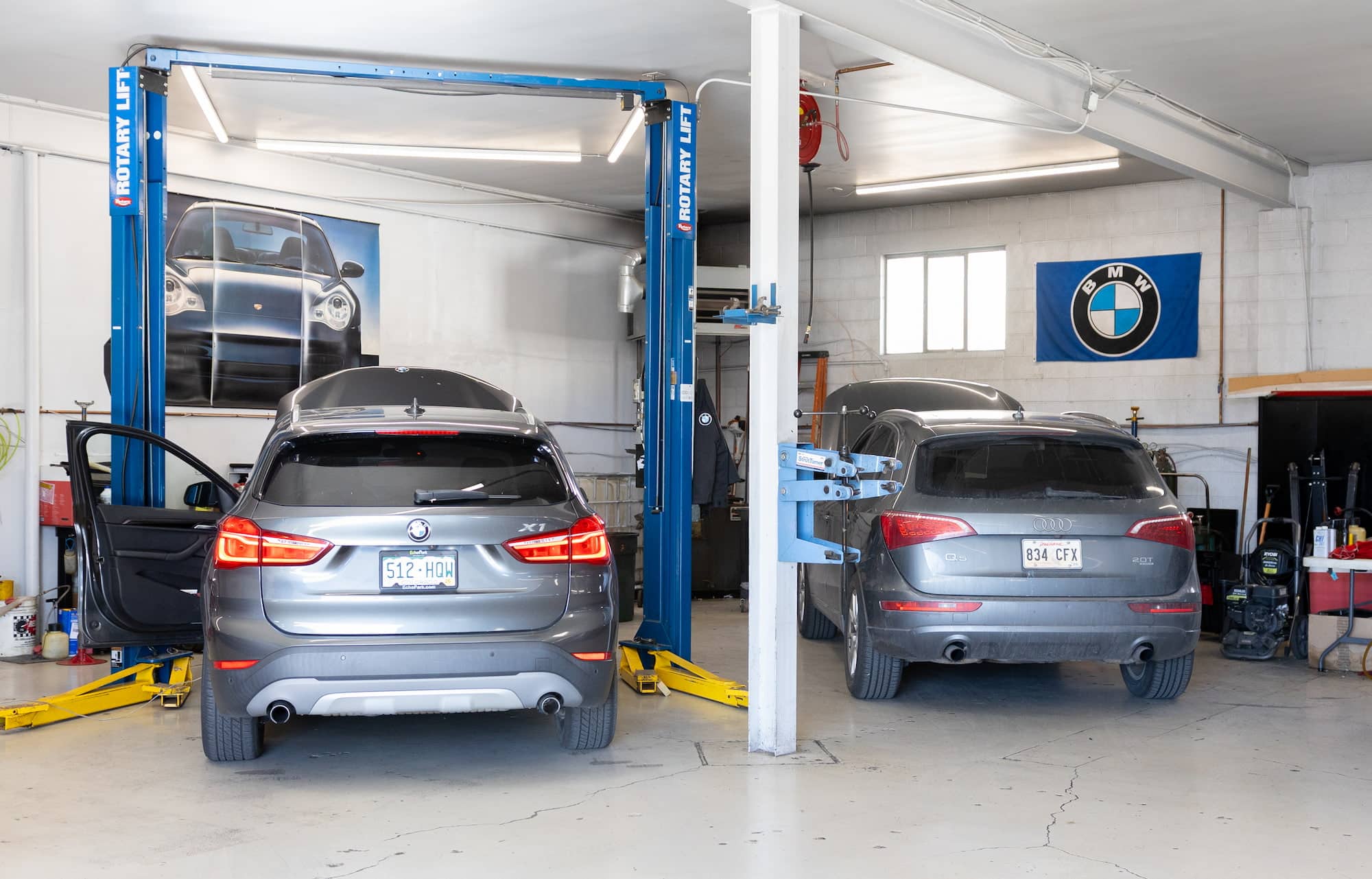
Land Rover Wheel Alignment at DART Auto
When your Land Rover pulls to one side or chews through tires prematurely, the problem is often misalignment – and correcting it requires more than a quick rack adjustment. Land Rover vehicles use sophisticated air suspension systems (on Range Rover L405/L494, Sport L494, and Discovery 5 L462 platforms), adaptive geometry, and multi-link rear setups that demand factory-spec ride heights and calibrated sensors before any alignment measurement is valid. Generic shops often skip the ride-height calibration step or lack the Land Rover-specific software to read suspension sensor data, leading to alignments that look correct on paper but drive poorly in the real world.
At DART Auto, we've aligned Land Rovers since 2000, and our process mirrors what you'd find at a dealer – without the dealer price tag. We use Hunter alignment systems integrated with Land Rover factory specifications, verify air-suspension ride height with IDS or SDD diagnostic software, and inspect suspension bushings, ball joints, and control-arm mounts before touching a single adjustment bolt. Our master technicians know that a Discovery 3/4 (L319/L319 facelift) with worn front lower-control-arm bushings will never hold alignment, so we diagnose the root cause first.
What you can expect from our Land Rover wheel alignment service:
- Pre-alignment suspension inspection to identify worn bushings, ball joints, or tie-rod ends that prevent proper alignment
- Ride-height verification and air-suspension calibration using Land Rover diagnostic software
- Four-wheel alignment to factory specifications, with before-and-after printouts showing camber, caster, toe, and thrust angle
- Road test to confirm straight-line tracking and steering-wheel centering
Common Wheel Alignment Issues on Land Rover Vehicles
When your Land Rover starts pulling to one side or chewing through tires, alignment is often the culprit – and these rigs have a few quirks that make the problem more common than you'd see on a sedan. Here's what we diagnose most often:
- Air suspension sag on 2010–2021 Range Rover (L405) and Range Rover Sport (L494): The air springs settle unevenly over time, especially if one corner has been leaking slowly. This throws camber and ride height out of spec, causing the alignment geometry to drift even when the control arms are still intact. We see this frequently after 60,000 miles.
- Front lower control arm bushing failure on 2005–2013 Range Rover Sport (L320) and LR3/LR4: The forward bushings in the lower control arms wear out, allowing excessive toe change under braking and acceleration. You'll notice wandering at highway speed and uneven inner-edge tire wear. The OEM bushings are softer than most European marques and degrade faster in freeze-thaw cycles.
- Rear upper control arm ball joint wear on Discovery 3/4 (2005–2016): The rear multi-link suspension uses ball joints in the upper arms that develop play, particularly on vehicles used off-road or in snow. This creates camber shift under load and accelerates tire wear on the outer shoulders.
- Subframe mounting point corrosion on 2003–2012 Range Rover (L322): Salt exposure corrodes the subframe mounting points, allowing the entire front cradle to shift slightly. Alignment readings will look acceptable on the rack but won't hold under real-world driving because the reference points have moved.
- Steering rack mount deflection on 2017+ Discovery 5 (L462): The aluminum subframe can flex at the steering rack mounts, especially after a hard impact. The rack shifts laterally under cornering load, causing intermittent pull and steering wander that resets when you let go of the wheel.
- Tie rod end play on all models after 70,000 miles: Land Rover tie rod ends wear faster than their German counterparts due to the higher unsprung weight and articulation demands of the suspension. You'll hear clunking over bumps and see rapid toe changes that destroy tires in under 10,000 miles if left unchecked.
Why Choose DART Auto for Land Rover Wheel Alignment
When your Discovery or Range Rover pulls to one side or chews through tires prematurely, you need more than a quick toe adjustment. Land Rover air suspension platforms – particularly the L320 Range Rover Sport and L405 Range Rover – demand precise ride-height calibration before alignment angles can be accurately set. We use factory-level diagnostic tools to command the air suspension into its measurement mode, ensuring readings reflect true geometry rather than a sagging corner.
Our technicians reference Land Rover's OEM alignment specifications by VIN, accounting for differences between standard and Dynamic handling packages. We've addressed dozens of cases where aftermarket shops skipped the suspension-height verification step, leading to camber and caster readings that looked acceptable on paper but caused rapid inner-edge tire wear within 5,000 miles. Beyond the rack work, we inspect control-arm bushings, ball joints, and tie-rod ends – common wear points on L319 LR3/LR4 and L322 Range Rover models – so you're not paying for an alignment that won't hold because of loose hardware.
- Air-suspension calibration: Command the system into alignment mode using factory procedures, not guesswork ride height.
- VIN-specific specs: Pull exact camber, caster, and toe targets for your trim and wheel package.
- Pre-alignment inspection: Flag worn bushings or ball joints before they waste your alignment investment.
- Post-alignment road test: Verify straight-line tracking and steering-wheel centering under real driving conditions.
Symptoms – How to Know You Need This Service
Land Rover alignment issues announce themselves in ways that are easy to overlook at first, then impossible to ignore. You may notice your steering wheel sits crooked when driving straight, or the vehicle drifts gently toward the lane marker even on flat pavement. Uneven tire wear – especially feathering on the inner or outer tread blocks – is a telltale sign that toe or camber settings have drifted out of spec, often after hitting a pothole or curb.
Common symptoms that point to wheel alignment needs:
- Steering wheel off-center when driving straight on level road
- Vehicle pulls consistently to the left or right, requiring constant steering correction
- Rapid or uneven tire wear, particularly feathering on the inside or outside tread edges
- Steering feels vague or wanders at highway speeds, especially on Range Rover Sport L494 with worn bushings
- Vibration or shimmy through the steering wheel at highway speeds (may also indicate tire balance issues)
- Suspension warning lights on models with air suspension, often accompanied by "Normal Height Only" or "Max Speed 35 MPH" messages – schedule service soon
- Squealing from the front tires during low-speed turns, suggesting severe toe misalignment
If you see suspension fault warnings or the vehicle drops to "access height" and won't raise, stop driving and arrange for towing – continuing to drive risks damaging the air compressor or suspension linkages.
Which Land Rover Models We See for Wheel Alignment
We align the full range of modern Land Rover platforms, from early Discovery Series II models through the latest Range Rover and Defender variants. Each generation brings unique challenges: the L322 Range Rover (2002–2012) is notorious for worn front lower-control-arm bushings that throw alignment out within months, while the L405/L494 air-suspension models require ride-height calibration before any alignment measurement is meaningful. The aluminum-intensive L538 Range Rover (2022+) and L663 Range Rover Sport (2023+) demand updated torque specs and careful handling of suspension fasteners to avoid thread damage.
Land Rover platforms we commonly align:
- Range Rover: L322 (2002–2012), L405 (2013–2021), L538 (2022+) – all trims including Autobiography, SVR, and long-wheelbase variants
- Range Rover Sport: L320 (2006–2013), L494 (2014–2023), L461 (2024+) – including supercharged V8 and diesel models
- Discovery: Series II (1999–2004), Discovery 3/LR3 L319 (2005–2009), Discovery 4/LR4 L319 facelift (2010–2016), Discovery 5 L462 (2017+)
- Defender: L663 (2020+) – both 90 and 110 wheelbases, including P400 and diesel variants
- Range Rover Evoque: L538 (2012–2018), L551 (2020+) – including Convertible and PHEV models
- Range Rover Velar: L560 (2018+) – all engine options including P400e plug-in hybrid
- LR2/Freelander 2: L359 (2008–2015) – less common but we service them when needed
We do not typically service pre-2000 Discovery Series I or classic Range Rover models, as parts availability and alignment specifications become difficult to verify. If you own an earlier Land Rover, call us – we'll let you know honestly whether we're the right shop for your vehicle.
Causes & Risks – What Happens if Ignored
Alignment problems on a Land Rover usually start with Colorado's road conditions – potholes, freeze-thaw heaves, and the occasional curb strike during winter parking. The air suspension and long-travel geometry amplify small impacts that a conventional coil-spring car would shrug off. Add in the age of many vehicles on the road (L322 and L320 platforms are now 10–20 years old) and you have bushings, ball joints, and subframe mounts that have been cycled through thousands of compression events. When one component starts to give, the alignment drifts out of spec and the tires start scrubbing.
Here's what escalates when you delay the fix:
- Tire replacement every 15,000–20,000 miles instead of 40,000+: Misalignment accelerates tread wear exponentially. A half-degree of toe error will destroy the inner or outer edge of a tire in under six months of daily driving.
- Steering rack and tie rod damage: When the suspension geometry is wrong, the steering components work against constant side-load. Tie rods develop play, and the rack itself can start leaking from seal wear. A $400 alignment and control arm job becomes a $2,200 rack replacement.
- Wheel bearing failure: Misalignment puts uneven radial load on the wheel bearings. We've seen rear hub assemblies fail on L320 platforms within 10,000 miles of ignoring a camber issue caused by a worn upper arm.
- Air suspension compressor burnout: If one corner is sagging due to a worn bushing or ball joint, the air suspension compressor runs more frequently to try to level the vehicle. This shortens compressor life from 100,000+ miles to under 60,000.
- Stability control and ABS faults: Modern Land Rovers use wheel speed sensors and yaw rate data to manage traction. When alignment is off, the system sees unexpected slip angles and may throw fault codes or enter limp mode, especially during aggressive maneuvers or on wet pavement.
Safety Impact – Why Wheel Alignment Matters
A Land Rover with bad alignment doesn't just cost you in tires – it compromises the electronic safety systems that keep a tall, heavy SUV stable in emergency maneuvers. The traction control, stability control, and ABS all rely on predictable contact-patch behavior. When camber, caster, or toe are out of spec, the system's assumptions break down. You'll feel it as delayed ABS response on hard braking, unexpected understeer in fast sweepers, or a vehicle that won't track straight when you lift off the throttle on a wet highway.
Here's when alignment becomes a safety-critical issue:
- Stop driving now: Steering pulls hard to one side under braking, clunking or popping from the front suspension over bumps, or the steering wheel is off-center by more than 45 degrees when driving straight. These indicate a failed suspension component that can separate.
- Schedule within the week: Uneven tire wear visible across the tread (more than 3/32" difference inner to outer), vibration at highway speed that wasn't there before, or the vehicle drifts out of lane on flat, straight road with no wind.
- Plan for your next service interval: Steering wheel is slightly off-center (under 20 degrees), tires are wearing evenly but faster than expected, or you've recently replaced suspension components and haven't had an alignment since.
Insurance and liability matter, too. If you're aware of a suspension defect – documented by a prior inspection or obvious symptoms – and you're involved in an incident, your insurer may question whether the known defect contributed. We document findings and provide clear recommendations so you have a record of what was disclosed and when.
How Land Rover Wheel Alignment Actually Works
Land Rover suspension geometry is more complex than a typical crossover because it's designed to handle both on-road dynamics and significant suspension articulation off-road. Most modern Land Rovers use a multi-link independent rear suspension and a double-wishbone or multi-link front, with air springs at all four corners on higher trims. The air suspension adds a variable: ride height directly affects camber and toe, so alignment must be performed at the factory-specified ride height, which requires the vehicle to be in "normal" mode and the suspension fully settled. We use a four-wheel alignment rack with live ride-height monitoring and OEM-spec targets pulled directly from Land Rover's technical data.
What makes Land Rover alignment different from a generic procedure:
- Air suspension calibration: After any suspension work, the air system must be recalibrated using the factory IDS or approved aftermarket equivalent (we use both). The system needs to relearn corner weights and ride-height sensors, or the alignment will drift within days.
- Subframe positioning: On L322 and L320 platforms, the front subframe has slotted mounting points that allow lateral and fore-aft adjustment. If the subframe has shifted due to an impact or corrosion, we measure and reposition it to OEM centerline specs before setting camber and caster.
- Eccentric bolts and shims: Camber and caster are adjusted using eccentric cam bolts or shims, depending on the model year. These require specific torque sequences (typically 120–180 Nm) and must be tightened with the suspension loaded to avoid bind.
- Steering angle sensor reset: After a toe adjustment, the steering angle sensor must be recalibrated through the OBD-II port. If this step is skipped, the stability control and lane-keeping systems will malfunction because the ECU thinks the wheels are pointed in a different direction than they actually are.
We perform a full suspension inspection before alignment – worn bushings, ball joints, or tie rods will prevent the alignment from holding, and we won't charge you twice to do the same job after parts are replaced. The process takes 90–120 minutes when done correctly, including the pre-alignment inspection, the alignment itself, the sensor
How We Diagnose Wheel Alignment Issues on Land Rover
When your Land Rover pulls to one side, chews through tires unevenly, or the steering wheel sits off-center, we start with a methodical diagnostic process designed for the specific suspension architecture of your vehicle. Land Rover's air suspension systems, multi-link rear setups, and adjustable ride-height platforms require precision measurement and OEM-aligned procedures to get alignment right.
- Visual and road-test evaluation. Before touching the alignment rack, we inspect tire wear patterns, check for bent control arms or subframe damage, and verify ride-height calibration on air-suspended models. A test drive reveals steering pull, wander, and whether the vehicle tracks straight under acceleration and braking.
- Suspension component inspection. We lift the vehicle and check ball joints, tie rod ends, control arm bushings, and subframe mounts for play or damage. Discovery 3/4 and Range Rover Sport models (2005–2013) are notorious for worn front lower control arm bushings that throw off camber readings. Replacing those bushings before alignment prevents wasted labor.
- Precision alignment measurement. Using a four-wheel alignment system with OEM-spec targets for your specific Land Rover model and year, we measure camber, caster, toe, and thrust angle. We compare live readings against factory specifications and note whether the vehicle is within adjustable range or requires new parts to bring alignment back into spec.
- Air suspension calibration check. On models with Terrain Response and air suspension (Range Rover, Discovery, Sport), we verify ride-height sensors are reading correctly and that the system settles to the correct height before finalizing alignment angles. Mismatched ride height skews every alignment measurement.
- Clear repair plan and quote. We explain which angles are out of spec, what parts (if any) need replacement to restore adjustability, and provide a detailed estimate before proceeding. You'll know exactly what's required to get your Land Rover tracking straight and wearing tires evenly.
Wheel Alignment on Land Rover: Repair vs. Replacement
Alignment work on a Land Rover isn't always a simple adjust-and-go procedure. The decision between adjustment, targeted part replacement, or full assembly replacement depends on what the diagnostic process reveals.
When Adjustment Alone Works
If suspension components are still in good condition and alignment angles are out of spec but within adjustable range, we perform a four-wheel alignment using OEM targets. This is the ideal scenario – no parts needed, just precision adjustment of toe, camber, and caster to factory specifications.
When Targeted Replacement Makes Sense
- Worn bushings or ball joints. Discovery 3/4 and Range Rover Sport (L320 platform, 2005–2013) commonly develop worn front lower control arm bushings that allow excessive camber movement. Replacing those bushings restores proper geometry and allows accurate alignment.
- Bent or damaged tie rods. If a pothole or curb strike bent a tie rod end, replacing that single component and re-aligning is far more cost-effective than ignoring it and burning through tires.
- Failed air suspension height sensors. On air-suspended models, a faulty ride-height sensor can cause the vehicle to sit unevenly, skewing alignment. Replacing the sensor and recalibrating the system restores proper ride height and alignment baseline.
When Full Replacement Is the Right Call
If multiple suspension components are worn, the subframe is damaged, or crash damage has compromised structural mounting points, piecemeal repairs don't make sense. We walk you through the findings, explain why partial fixes won't hold alignment, and provide a comprehensive estimate for the work required to restore safe, predictable handling.
How to Make Your Land Rover Wheel Alignment Last Longer
Proper alignment on a Land Rover depends on maintaining the suspension components that hold those angles in place. A few proactive habits go a long way toward keeping your vehicle tracking straight between service intervals.
Driving Habits That Protect Alignment
- Avoid potholes and curbs. Even minor impacts can bend control arms, knock alignment out of spec, or damage air suspension components on models with adaptive ride systems.
- Don't overload the vehicle. Exceeding payload ratings stresses suspension bushings and can cause premature wear, especially on the rear multi-link setup common to Discovery and Range Rover models.
- Use Terrain Response appropriately. On models with selectable terrain modes, using the correct setting for the surface reduces suspension stress and helps maintain ride-height calibration on air-suspended platforms.
Maintenance You Can Monitor
- Check tire wear monthly. Uneven wear across the tread or feathering on the inner/outer edges signals alignment drift. Catching it early prevents costly tire replacement.
- Listen for new clunks or rattles. Worn ball joints, tie rod ends, or control arm bushings announce themselves with noise over bumps. Address them before they throw alignment out of spec.
- Keep an eye on steering feel. If the steering wheel starts pulling to one side or sits off-center when driving straight, schedule an alignment check rather than waiting for the next service interval.
What to Leave to the Shop
Alignment adjustment, suspension component replacement, and air suspension calibration require specialized equipment and OEM procedures. Attempting DIY alignment or suspension work without the right tools and training risks safety and creates expensive comebacks. We handle the technical work; you handle the proactive monitoring that keeps small issues from becoming big bills.
What to Expect When You Bring Your Land Rover In
Schedule your appointment online or by phone. When you arrive, we'll ask about symptoms – steering pull, uneven tire wear, or a crooked wheel after suspension work – and note any recent collisions or curb impacts. You're welcome to use our complimentary shuttle service within the Denver metro area, or we can arrange a loaner vehicle if the work extends beyond a few hours.
- Initial inspection and estimate: We lift the vehicle, check suspension components for play or damage, measure current alignment angles, and photograph any tire-wear patterns. You'll receive a written estimate covering alignment labor and any parts needed to make the alignment hold – no surprises mid-job.
- Air-suspension setup: For models equipped with air suspension, we connect our diagnostic tool to command the system into its alignment measurement height, then verify each corner has settled to spec before touching an adjustment bolt.
- Alignment and verification: We adjust camber, caster, and toe to Land Rover's published tolerances, print a before-and-after report, and road-test the vehicle to confirm straight tracking and centered steering.
- Pickup walkthrough: At pickup, we review the alignment printout, show you the tire-wear photos, and explain any deferred items – like a control-arm bushing that's serviceable now but will need replacement within the next year.
If your Land Rover drifts or the steering wheel sits off-center after you leave, call us immediately. We'll bring it back in, recheck the settings, and make any needed corrections at no charge. Every alignment is backed by our 3-year/36,000-mile warranty on parts and labor, so you drive with confidence long after the rack comes down.
Our Land Rover Services
- Air Conditioning AC Repair
- Battery Repair Replacement
- Brake Repair & Brake Fluid Change
- Check Engine Light Diagnostics
- Clutch Repair & Replacement
- Coolant Leak Repair
- Cooling System Repair
- Drive Shaft Repair
- Engine Repair
- Exhaust & Catalytic Converter Repair
- Head Gasket Repair & Replacement
- Oil Change
- Oil Leak Repair
- Scheduled Service Maintenance
- Steering Repair
- Suspension Repair
- Cambelt Timing Belt Replacement
- Transmission Repair
- Tune Up