
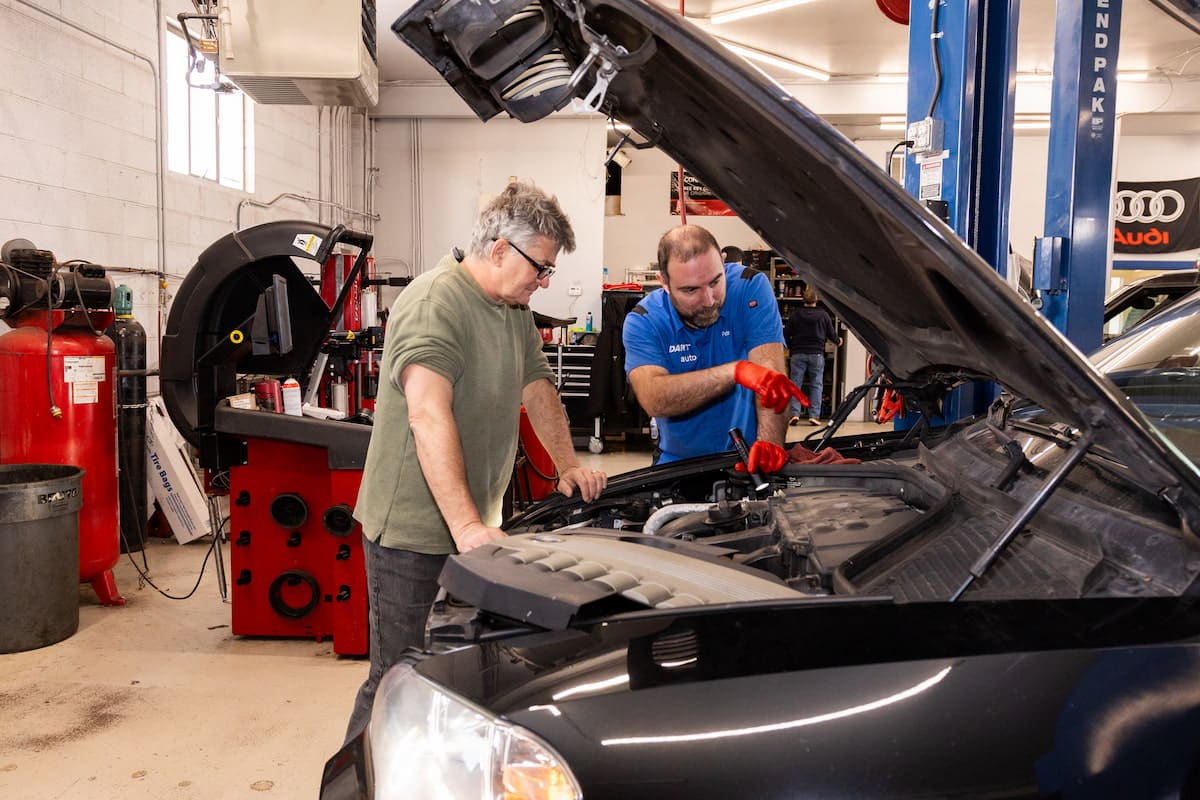
BMW Scheduled Service Maintenance at DART Auto
Your BMW's dashboard just reminded you that service is due, and you're wondering whether to trust a local shop or pay dealer prices. Here's what most BMW owners don't realize: scheduled maintenance on a modern BMW isn't just an oil change and tire rotation. It's a precisely timed sequence of inspections, fluid exchanges, and software-driven service resets that directly affect your car's long-term reliability and resale value.
DART Auto has specialized in European vehicles since 2000, and our master technicians understand the platform-specific requirements that separate proper BMW maintenance from generic service. We use factory repair information, OEM-spec fluids, and the same diagnostic tools dealerships rely on – but without the markup. Whether you're maintaining a B58-powered X3, an N55 3-series, or an S63-equipped M5, we follow BMW's exact service intervals and procedures, then go further with comprehensive multi-point inspections that catch developing issues before they become expensive repairs.
Our salaried technicians have no incentive to rush your service or recommend unnecessary work. We explain what's due now, what can wait, and what the consequences are of delaying specific items. Every scheduled service at DART includes:
- Oil and filter service using BMW LL-01 or LL-04 approved synthetic lubricants matched to your engine type
- Complete brake, suspension, and drivetrain inspection with detailed reporting
- Service indicator reset using factory-level diagnostic equipment
- 3-year/36,000-mile warranty on parts and labor – better coverage than most dealers offer
Common Scheduled Service Maintenance Issues on BMW Vehicles
Your BMW's scheduled maintenance isn't just about oil changes. Modern BMWs rely on precise intervals for dozens of wear items, and skipping or delaying the factory schedule creates predictable failure patterns. Here's what Denver BMW owners typically face when maintenance lapses:
- Valve cover gasket leaks on N52/N54/N55 engines (2006–2015 E90, E92, F30): These inline-six engines develop brittle valve cover gaskets around 60,000–80,000 miles. Oil seeps onto the exhaust manifold, creating smoke and a burning smell. Left unaddressed, oil saturates ignition coils and spark plug wells, causing misfires and expensive coil replacements.
- VANOS solenoid failures on N20/N26 turbocharged four-cylinders (2012–2016 F30, F32): Variable valve timing solenoids clog with carbon and varnish when oil changes are stretched past BMW's 10,000-mile interval. You'll notice rough cold starts, hesitation under load, and Check Engine lights for cam correlation faults. Delayed replacement damages the timing chain tensioner.
- Transmission fluid "lifetime fill" degradation (ZF 8HP, GA 6HP): Despite BMW's early "lifetime" claims, ZF automatics in F-chassis and G-chassis models need fluid service by 60,000–80,000 miles. Ignored, you'll feel harsh shifts, delayed engagement from Park, and limp-mode events. Internal clutch packs wear rapidly once fluid breaks down.
- Brake fluid moisture absorption (all models, 2-year interval): DOT 4 fluid is hygroscopic – it pulls moisture from the air. After two years, water content drops the boiling point, causing spongy pedal feel and reduced ABS effectiveness. On performance models with compound braking systems, moisture triggers expensive ABS module corrosion.
- Spark plug fouling on direct-injection engines (N20, N55, B58): Carbon buildup on intake valves migrates to plug tips when plugs aren't replaced at BMW's 60,000-mile interval. Misfires develop, damaging catalytic converters that cost thousands to replace. Turbocharged models are especially sensitive to ignition timing precision.
- Differential fluid breakdown on xDrive models (2010–present): All-wheel-drive BMWs have front, center, and rear differentials. Fluid oxidizes and loses its friction-modifier properties by 50,000 miles, causing clunking on tight turns and premature bearing wear. Rear-drive M models with limited-slip differentials show the same pattern.
Why Choose DART Auto for BMW Scheduled Service Maintenance
Your BMW was engineered with precision, and its scheduled service intervals reflect that. DART Auto uses the same factory repair information and diagnostic protocols dealerships rely on – but without the overhead markup. Our technicians follow BMW's Condition Based Service (CBS) system to the letter, resetting service indicators only after completing every required inspection, fluid exchange, and adjustment.
We address platform-specific maintenance needs that generic shops often miss. On N20 and N26 turbocharged four-cylinders (2012–2016 3-series, 4-series, X3), we inspect timing chain stretch during oil services because early intervention prevents catastrophic engine damage. For N52 and N54 engines, we check valve cover gaskets and oil filter housing seals – common leak points that contaminate ignition coils if left unchecked. Our factory-level scan tools pull stored adaptation values and flag software updates released since your last visit, keeping your BMW's control modules current.
Because our technicians are salaried rather than flat-rate, there's no incentive to upsell or rush through your service checklist. You receive a complete digital inspection with photos, a transparent estimate for any additional work, and a clear explanation of what happens if you defer certain repairs. Every service is backed by our 3-year/36,000-mile warranty – coverage that reflects our commitment to doing the job right the first time.
Symptoms – How to Know You Need This Service
BMW's Condition Based Service system tracks time, mileage, and driving conditions to determine when maintenance is due. You'll know it's time when you notice:
- Service reminder in the instrument cluster or iDrive screen – typically appears 4-6 weeks before the service is due, displaying remaining miles or time
- Oil level warning or "Check Engine Oil Level" message – common on N52, N54, N55, and B58 engines as consumption increases between services
- Reduced throttle response or sluggish acceleration – degraded oil loses its ability to protect high-performance turbo engines under load
- Increased engine noise, especially on cold starts – worn oil no longer cushions timing chain components and valve train properly
- Brake dust accumulation or squealing – indicates pads are wearing and inspection is overdue
- Visible fluid leaks under the vehicle – oil filter housing gaskets, valve cover gaskets, and oil pan seals often weep as service intervals stretch
- Dashboard warning lights for brake fluid or coolant level – both fluids degrade over time and require scheduled replacement
If you see oil pressure warnings or hear knocking from the engine, stop driving immediately and have the vehicle towed. Continuing to operate a BMW with compromised lubrication can destroy bearings, turbos, and VANOS components in minutes.
Which BMW Models We See for Scheduled Service Maintenance
We service the full range of BMW platforms, from naturally aspirated inline-sixes to twin-turbo V8s and diesel models. The cars we maintain most frequently include:
- 3-Series (E90/E91/E92/E93, F30/F31/F34, G20/G21) – 2006-present, including 328i, 330i, 335i, 340i, and M340i variants with N52, N54, N55, B58 engines
- 5-Series (E60/E61, F10/F11, G30/G31) – 2004-present, covering 528i, 535i, 550i, M550i models and xDrive all-wheel-drive versions
- X3 and X5 (E83, F25, G01, E70, F15, G05) – 2004-present SAVs with inline-six and V8 powertrains
- M models (E90/E92 M3, F80 M3, F10 M5, F90 M5) – S65, S55, S63 high-performance engines requiring specialized service intervals and M-specific fluids
- Z4 and older 6-Series (E85/E86, E89, E63/E64) – roadsters and coupes with unique maintenance access points
- 1-Series and 2-Series (E82/E88, F22/F23) – compact models sharing drivetrains with 3-Series platforms
We handle both rear-wheel-drive and xDrive all-wheel-drive configurations, manual and automatic transmissions, and diesel models (328d, 535d). Our equipment and training cover vehicles from the mid-2000s forward. If you're maintaining a classic E30, E36, or E46, call us to discuss – we focus on modern BMWs where software integration and advanced diagnostics are essential.
Causes & Risks – What Happens if Ignored
BMW's scheduled maintenance exists because German engineering pushes tolerances tight. High-compression engines, turbochargers running 15+ psi of boost, and electronically controlled transmissions all generate heat, friction, and byproducts that degrade fluids and wear components on predictable timelines. Denver's temperature swings – freezing mornings and 90-degree afternoons – accelerate seal degradation and fluid breakdown. Short trips around town prevent engines from reaching full operating temperature, allowing moisture and fuel dilution to contaminate oil.
When you delay the factory schedule, small issues compound into expensive failures:
- Skipped oil changes: Sludge forms in the valve train and oil pickup screen. Turbocharger bearings starve for lubrication, leading to shaft play and eventual turbo failure costing $2,500–$4,000 in parts alone.
- Ignored coolant service: Coolant becomes acidic after five years, corroding aluminum water pumps, thermostats, and radiator end tanks. A $400 coolant flush becomes a $1,800 cooling system overhaul when the water pump seizes and overheats the engine.
- Delayed brake fluid replacement: Moisture-laden fluid boils under hard braking, creating vapor pockets that make the pedal sink to the floor. ABS hydraulic units on F-chassis and newer models corrode internally, requiring $2,000+ module replacement instead of a $180 fluid service.
- Stretched transmission service intervals: Worn fluid loses its ability to transfer heat and maintain hydraulic pressure. Mechatronic sleeves in the valve body score and leak, necessitating a $3,500 rebuild instead of a $500 fluid and filter service.
- Overdue spark plugs: Misfires dump unburned fuel into the exhaust, melting catalytic converter substrates. A $300 plug replacement becomes a $2,200 catalytic converter job, plus the original plug cost.
The pattern is consistent: every deferred service creates secondary damage that costs five to ten times the original maintenance item. We see it weekly – customers who saved $400 skipping a differential service now facing a $3,000 differential replacement because the bearings ran dry and grenaded.
Safety Impact – Why Scheduled Service Maintenance Matters
Deferred maintenance doesn't just cost money – it creates real safety risks. BMW's braking, stability, and traction systems depend on fluids, sensors, and wear components functioning within spec. When maintenance lapses, these systems degrade in ways that put you and other drivers at risk.
Brake fluid moisture reduces boiling point from 500°F to under 300°F. During a panic stop from highway speed, the fluid boils, creating vapor. Your pedal sinks, braking force drops by half, and stopping distance doubles. On mountain descents west of Denver, we've seen complete brake fade from neglected fluid – the driver had to use guardrails to scrub off speed.
Worn differential fluid causes xDrive torque-split errors. The system can't predict traction accurately, leading to unexpected power delivery in snow or rain. Stability control intervenes late or incorrectly, increasing the chance of a skid. Old transmission fluid triggers limp mode without warning – suddenly you're stuck in third gear merging onto I-25 in heavy traffic.
Know when to stop driving versus schedule soon:
- Stop driving now: Brake pedal sinks to the floor, grinding noise from wheels, smoke from under the hood, transmission stuck in gear, steering feels loose or unresponsive, oil pressure warning light stays on.
- Schedule this week: Spongy brake pedal, delayed shift engagement, rough idle, coolant level dropping, any fluid leak visible on your driveway, Check Engine light for misfire codes.
- Schedule within the month: Service reminder on iDrive, minor oil seepage, aging brake fluid past two years, approaching mileage interval for spark plugs or differential service.
Insurance adjusters scrutinize maintenance records after accidents. If a crash involved brake failure and your fluid was four years old, you may face liability questions. Keeping to BMW's schedule protects you legally and physically.
How BMW Scheduled Service Maintenance Actually Works
BMW's Condition Based Service (CBS) system monitors dozens of inputs – mileage, engine starts, fuel consumption, temperature cycles, brake applications – to calculate when each component needs attention. Unlike older fixed-interval schedules, CBS adjusts for your driving style. Frequent cold starts and short trips accelerate oil degradation, so the system calls for service sooner. Highway commutes extend intervals slightly. The iDrive display shows countdowns for engine oil, brake fluid, spark plugs, and other items, each tracked independently.
What makes BMW maintenance different from generic service:
- Electronic service reset requires factory tooling: After completing maintenance, techs must connect ISTA+ or equivalent BMW diagnostic software to reset CBS counters. Generic OBD scanners can't access these modules. Skipping the reset leaves the system out of sync, triggering premature warnings or missing actual service needs.
- Transmission adaptations must be cleared and relearned: ZF 8-speed and 6-speed automatics store shift maps in the Mechatronic unit. After fluid service, these maps must be reset so the transmission relearns clutch pack wear with fresh fluid. Without this step, shifts stay harsh because the computer compensates for old fluid properties.
- Brake fluid service involves electronic parking brake retraction: Most BMWs since 2009 use electronic parking brakes with caliper-mounted motors. You can't simply compress the pistons – the system must be put into
How We Diagnose Scheduled Service Maintenance Issues on BMW
Your BMW's dash just lit up with a service reminder, or maybe you're past the mileage interval and wondering what actually needs attention. Either way, you want to know the car will be sorted properly without guessing or overpaying. Here's how we turn that service light into a clear plan.
- Factory-level scan and fault-code retrieval. We connect BMW-specific diagnostic tools – not generic OBD scanners – to pull stored codes, live data streams, and adaptation values from every control module. On F-series and G-series platforms, this reveals everything from oil quality sensors to brake-pad wear counters that trigger CBS (Condition Based Service) alerts.
- Service history review and interval verification. We check what's actually due based on your VIN, model year, and engine code. A 2015 F30 328i with the N20 engine has different oil-change chemistry and spark-plug intervals than a 2018 G20 330i with the B48. We cross-reference CBS data against factory schedules to confirm what the car is asking for versus what it genuinely needs.
- Visual inspection of wear items and fluid condition. We pull the wheels to measure brake-pad thickness, inspect rotors for heat cracks or scoring, check suspension bushings and ball joints for play. Under the hood, we assess coolant color, brake-fluid moisture content with a tester, and look for oil seeps at common failure points like valve-cover gaskets or oil-filter housing seals.
- Road test for drivability and NVH (noise, vibration, harshness). We take the car out to verify shift quality, steering response, and braking feel. On models with adaptive dampers or active steering, we confirm those systems respond correctly under load.
- Comprehensive quote with prioritization. You receive a detailed estimate that separates what's due now, what's approaching, and what can wait. Every line item includes the why – not just "replace air filter," but "cabin filter is saturated; restricting HVAC airflow and trapping allergens."
This process ensures nothing gets missed and nothing gets sold that you don't need. You'll know exactly what the service interval requires, what wear items are on borrowed time, and how to budget for upcoming maintenance.
Scheduled Service Maintenance on BMW: Repair vs. Replacement
Scheduled maintenance on a BMW often sits at the intersection of service and repair. Sometimes you're just resetting the clock with fresh fluids; other times you're addressing wear that's crept up since the last interval. Here's how we decide what gets serviced, what gets repaired, and what gets replaced outright.
When Repair or Service Is the Right Call
- Fluid exchanges and filter replacements. Oil, coolant, brake fluid, and transmission fluid are consumables. Changing them on schedule – or slightly early if contaminated – restores protection without replacing hardware.
- Cleaning and adjustment. Throttle-body carbon buildup on N55 or B58 engines responds well to walnut-blasting the intake valves. Brake calipers can often be cleaned, lubricated, and fitted with new slider pins rather than replaced if the piston and bore are still smooth.
- Minor component refresh. Replacing a cracked PCV valve diaphragm, a leaking oil-filter housing gasket, or worn engine mounts during a service interval addresses the root cause without tearing into major assemblies.
When Partial or Full Replacement Makes Sense
- Wear items at end of life. Brake pads, rotors, wiper blades, and cabin filters are designed to be replaced. Trying to "repair" a brake rotor below minimum thickness is unsafe and false economy.
- Cascading wear or safety-critical parts. If a water pump is seeping on an N52 or N55, replacing just the seal often buys six months before the bearing fails. A complete pump with thermostat and hoses is the durable fix. Same logic applies to timing components on the N20 – if the chain has stretched, replacing guides and tensioners alone leaves the root problem in place.
- Cost and labor overlap. When labor to access a part exceeds half the cost of replacement, and the part is already halfway through its service life, replacement wins. Example: if we're draining coolant to replace a thermostat on an E90, swapping the aging expansion tank and hoses at the same time saves you a second trip when they fail three months later.
We walk you through the trade-offs honestly. You'll understand why one approach saves money in the short term and another saves headaches over the next 50,000 miles.
How to Make Your BMW Scheduled Service Maintenance Last Longer
Scheduled maintenance is non-negotiable, but how you drive and care for your BMW between services determines whether components reach their design life or fail early. Small habits compound into big savings.
Driving Habits That Extend Component Life
- Warm up before hard acceleration. Turbocharged engines like the N20, N55, and B58 need oil circulating and up to temperature before you ask for boost. Cold-start full throttle accelerates turbo bearing wear and oil coking in the VANOS solenoids.
- Brake progressively rather than aggressively. Smooth, early braking keeps pad temperatures lower and reduces rotor warping. Hard stops from speed generate heat that glazes pads and can crack rotors, especially on performance models with larger brakes.
- Avoid short trips in cold weather. Frequent cold starts without reaching full operating temperature leave moisture in the oil, accelerate sludge formation, and prevent the catalytic converters from reaching light-off temperature. Combine errands into one longer drive when possible.
Maintenance Habits You Can Handle
- Check fluid levels monthly. Pop the hood and verify engine oil, coolant, brake fluid, and washer fluid. Low coolant can signal a slow leak; low brake fluid often means worn pads.
- Listen for changes. New squeaks, rattles, or grinding sounds are early warnings. Catching a failing wheel bearing or worn control-arm bushing before it damages the hub or subframe saves serious money.
- Monitor tire pressures and tread depth. Underinflated tires increase rolling resistance, hurt fuel economy, and wear unevenly. Rotate tires every 5,000–7,500 miles to maximize tread life.
What to Leave to the Professionals
- Brake bleeding and ABS module service. Modern BMWs require scan-tool activation to cycle ABS pump motors during fluid changes. DIY brake bleeding without this step leaves old fluid trapped in the module.
- Software updates and adaptations. BMW releases service campaigns and software patches that address drivability, fuel economy, and component longevity. These require factory tooling and can't be skipped.
- Timing components, turbos, and VANOS systems. These are safety-critical or require specialty tools and precise torque specs. Mistakes here lead to catastrophic engine damage.
Stick to OEM-spec fluids – Castrol TWS 10W-60 for S65 V8s, BMW LL-01 or LL-04 oils for turbocharged inline-sixes – and follow the Condition Based Service intervals in your iDrive. Cutting corners with bargain fluids or stretching intervals beyond CBS recommendations undoes everything else you do right.
What to Expect When You Bring Your BMW In
We've designed our process to keep you informed at every step, so there are no surprises when you pick up your keys.
- Appointment and drop-off. Schedule online or by phone. If you need a loaner vehicle or shuttle service, let us know when booking. During drop-off, we'll note any concerns you've noticed – unusual sounds, warning lights, or handling changes – so the technician can address them during the multi-point inspection.
- Complete inspection and diagnostics. Your BMW goes on the lift for a thorough undercarriage check, fluid-level verification, brake measurement, and tire-tread assessment. We scan all control modules for fault codes and pending updates, then document findings with photos and notes in your digital report.
- Written estimate and approval. You'll receive a detailed estimate covering the scheduled service items your CBS system requires, plus any additional recommendations from the inspection. We explain what each repair addresses and what happens if you wait. Nothing gets done without your go-ahead.
- Service completion and verification. Once approved, we perform the work using OEM or premium aftermarket parts, reset service indicators, and road-test your BMW to confirm smooth operation. A final scan verifies no new fault codes have appeared.
- Pickup walkthrough. At pickup, we review what was completed, show you the old parts if requested, and answer any questions about the next service interval. If something feels off in the days following your visit, call us – we'll get you back in to make it right.
After-hours key drop and pickup are available by arrangement. Remove valuables and personal items before your appointment; we're not responsible for items left in the vehicle.
Our BMW Services
- Air Conditioning AC Repair
- Battery Repair Replacement
- Brake Repair & Brake Fluid Change
- Check Engine Light Diagnostics
- Clutch Repair & Replacement
- Coolant Leak Repair
- Cooling System Repair
- Drive Shaft Repair
- Engine Repair
- Exhaust & Catalytic Converter Repair
- Head Gasket Repair & Replacement
- Oil Change
- Oil Leak Repair
- Steering Repair
- Suspension Repair
- Cambelt Timing Belt Replacement
- Transmission Repair
- Tune Up
- Wheel Alignment