
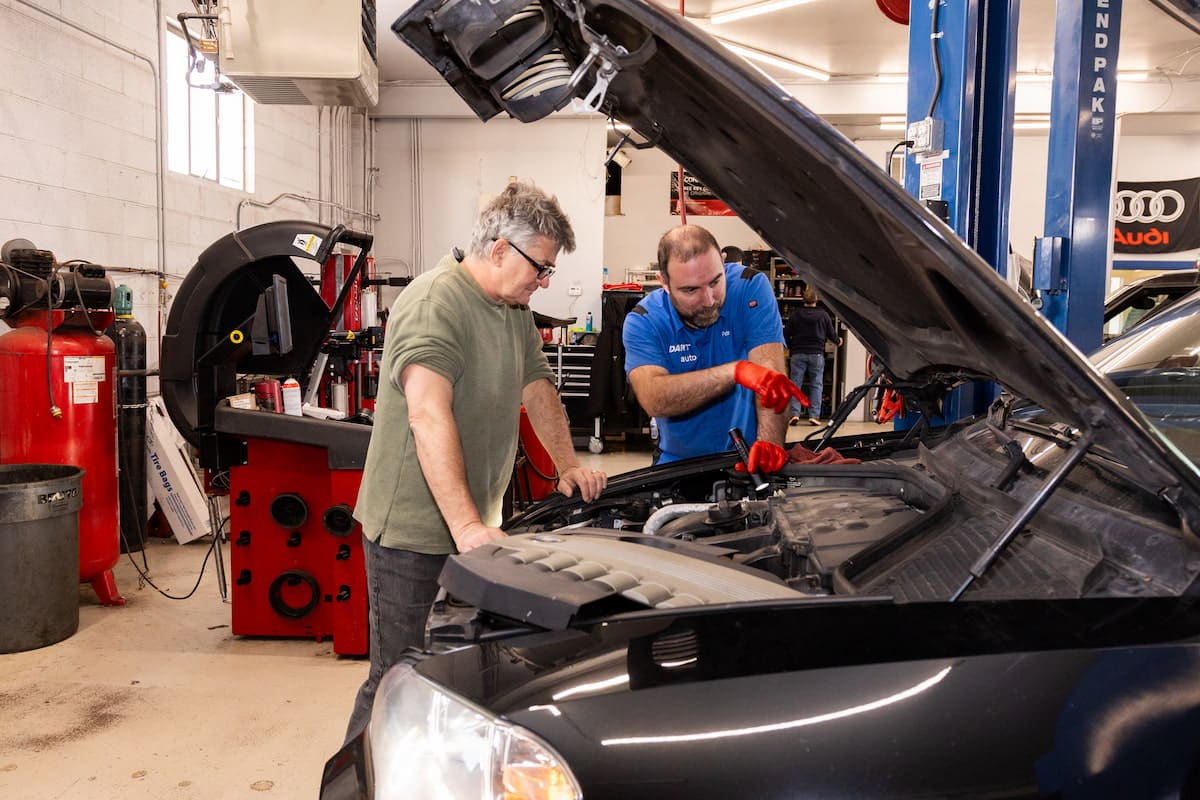
Lamborghini Scheduled Service Maintenance at DART Auto
Lamborghini's naturally aspirated V10 and V12 engines – along with the newer twin-turbo V8 platforms – demand precision maintenance that goes far beyond oil and filters. The Gallardo's 5.0L and 5.2L E-gear transmissions require specific Pentosin fluid at exact intervals to prevent clutch degradation. The Huracán's dual-clutch transmission relies on software-monitored clutch wear parameters that only factory-level diagnostic tools can read accurately. Aventador V12 platforms use dry-sump oiling systems with multiple pickup points and reservoir capacity specs that generic shops routinely misinterpret. Missing a scheduled valve clearance check on early Gallardo models can lead to bent valves under high-RPM operation. Since 2000, we've maintained these machines using factory repair information, Leonardo diagnostic software, and the specialty tooling required to meet Lamborghini's exacting torque specifications and fluid standards.
Our scheduled service maintenance process ensures your Lamborghini receives the attention its engineering demands:
- Complete fluid analysis and replacement using OEM-spec Pentosin, Motul, or Shell formulations matched to your platform and operating environment
- Diagnostic health scans covering engine management, transmission adaptation values, suspension calibration, and brake system telemetry
- Inspection of known wear points – exhaust manifold studs on Gallardo, carbon ceramic brake rotor thickness on Aventador, coolant hose routing on Huracán
- Documentation and interval tracking aligned to Lamborghini's service book, with adjustments for track use or high-performance driving
Common Scheduled Service Maintenance Issues on Lamborghini Vehicles
Lamborghini scheduled maintenance intervals reveal platform-specific wear patterns that separate these supercars from ordinary performance vehicles. The Gallardo platform (2003–2013) frequently shows clutch wear accelerated by the e-gear automated manual transmission's aggressive engagement strategy, with hydraulic actuator failures appearing around 15,000–20,000 miles in spirited driving conditions. Aventador models (2011–present) using the ISR single-clutch automated manual exhibit similar clutch disc wear, compounded by the carbon-ceramic brake system's need for rotor thickness measurement and pad compound inspection at each service – rotors that cost five figures when replacement becomes necessary.
- Gallardo (2003–2013) e-gear clutch and hydraulic actuator degradation: The automated manual transmission relies on a complex hydraulic pump and accumulator system that loses pressure over time, causing delayed shifts and eventual clutch slippage. Factory service intervals call for fluid replacement and actuator inspection every 9,000 miles, yet many owners skip this until shift quality deteriorates noticeably.
- Aventador ISR transmission clutch wear and adaptive learning reset: The single-clutch ISR system requires periodic clutch position sensor recalibration using factory diagnostic software. Skipping the prescribed 9,000-mile service means the ECU cannot accurately track clutch wear, leading to abrupt engagement and premature disc failure.
- Huracán (2014–present) dual-clutch transmission fluid degradation: The LDF (Lamborghini Doppia Frizione) seven-speed dual-clutch demands synthetic transmission fluid replacement every 18,000 miles. Heat cycling in stop-and-go traffic or track use breaks down additives, causing clutch pack shudder and eventual mechatronic control unit failure.
- Carbon-ceramic brake rotor thickness monitoring across all platforms: Lamborghini specifies minimum rotor thickness measurements at every service. These rotors wear slowly but unpredictably, and once below the minimum spec, catastrophic failure during high-speed braking becomes a real risk.
- V10 and V12 engine oil consumption and valve train inspection: Both the Gallardo/Huracán V10 and Aventador V12 are known for elevated oil consumption when driven hard. Factory service includes valve clearance inspection and oil analysis to detect bearing wear before metal contamination circulates through the lubrication system.
- Magneto-rheological damper fluid service on Aventador: The pushrod suspension uses magneto-rheological dampers that require fluid replacement and system recalibration every 24,000 miles. Neglecting this service results in ride quality degradation and eventual damper seal failure.
Why Choose DART Auto for Lamborghini Scheduled Service Maintenance
Lamborghini factory intervals demand more than an oil change and tire rotation. The Aventador's ISR gearbox requires precise fluid service schedules to prevent harsh shifts and actuator wear. Huracán LP 610-4 models with the Lamborghini Dinamica Veicolo Integrata (LDVI) system need software validation at every major service to catch calibration drift before it affects torque vectoring. DART Auto's master technicians bring dealer-level training and over a decade of experience with these platforms, using the same factory repair information and diagnostic protocols Lamborghini Corporate mandates – without the dealer markup.
We invest in the tools that matter: genuine VAG diagnostic interfaces for live data logging, factory torque specifications for every fastener on the carbon-ceramic brake calipers, and OEM fluid specs down to the exact viscosity grade for the E-gear hydraulic actuator on pre-2014 Gallardo models. Our salaried compensation structure removes the flat-rate incentive to rush through a 15,000-mile service, so your technician takes the time to inspect valve-cover gasket seepage on early V10 engines and document oil consumption trends that predict future work. Since 2000, we've built our reputation on fixing European exotics right the first time, backed by a 3-year/36,000-mile warranty on parts and labor that exceeds most dealer coverage.
Symptoms – How to Know You Need This Service
Lamborghini service intervals are time- and mileage-based, but certain symptoms indicate you've pushed past due:
- E-gear or LDF transmission hesitation during shifts – delayed engagement or harsh downshifts often signal degraded hydraulic fluid or clutch wear nearing adaptation limits
- Oil pressure fluctuation at idle or under hard acceleration – dry-sump systems on Aventador and Murciélago platforms show this when scavenge pump screens clog or oil level drops below the reservoir's operational range
- Dashboard service interval warning or wrench icon – Lamborghini's onboard computer tracks oil quality, brake fluid moisture content, and operating hours; ignoring these warnings voids certain warranty coverage
- Rough idle or misfires after cold start – carbon buildup on direct-injection platforms (Huracán 5.2L V10) or fouled spark plugs from short-trip driving cycles
- Brake pedal travel increase or spongy feel – brake fluid absorbs moisture aggressively in performance applications; Lamborghini specifies annual replacement regardless of mileage
- Coolant odor in the cabin or visible seepage around hose clamps – early Gallardo models suffer hose degradation at the firewall; stop driving immediately if coolant level drops
- Metallic noise during throttle blips in neutral – potential valve train wear on engines nearing valve clearance inspection intervals (typically 15,000 miles on Gallardo)
Which Lamborghini Models We See for Scheduled Service Maintenance
We service the full range of modern Lamborghini platforms, each with distinct maintenance requirements driven by engine architecture, transmission type, and model-year updates:
- Huracán (2014–present) – LP 580-2, LP 610-4, Performante, EVO; 5.2L V10 direct injection with LDF dual-clutch transmission requiring software-monitored clutch adaptation and annual brake fluid service
- Gallardo (2003–2013) – all variants including LP 550-2, LP 560-4, Superleggera; 5.0L and 5.2L V10 with E-gear or manual transmission; valve clearance checks critical on pre-2008 models
- Aventador (2011–2022) – LP 700-4, LP 750-4 SV, SVJ, Ultimae; 6.5L V12 with ISR single-clutch transmission and carbon ceramic brakes requiring rotor thickness measurement at each service
- Murciélago (2001–2010) – 6.2L and 6.5L V12 platforms with E-gear or manual; dry-sump oil system demands precise fill procedures and scavenge pump inspection
- Urus (2018–present) – 4.0L twin-turbo V8 shares platform components with Audi RSQ8 but uses Lamborghini-specific calibration and service intervals
We maintain full diagnostic capability for all models from 2001 forward. Earlier Diablo-era vehicles require case-by-case evaluation for parts availability and tooling compatibility.
Causes & Risks – What Happens if Ignored
Lamborghini scheduled maintenance demands stem from the extreme operating conditions these vehicles endure – high-revving naturally aspirated engines, carbon-ceramic brakes generating immense heat, and transmission systems operating at the edge of material science. Denver's altitude compounds these stresses: thinner air reduces cooling efficiency, and temperature swings from mountain drives to summer heat accelerate fluid breakdown. The factory intervals aren't arbitrary; they're calibrated to catch wear before it cascades into catastrophic failure.
When owners defer scheduled service, the progression is predictable and expensive:
- Transmission fluid degradation leads to clutch pack failure: On dual-clutch systems like the Huracán's LDF, old fluid loses its friction-modifying properties within 2,000–3,000 miles past the service interval. Clutch packs begin to slip under load, generating heat that warps the pressure plates. What starts as a $1,200 fluid service becomes a $15,000+ clutch replacement plus mechatronic unit repair.
- E-gear hydraulic actuator wear progresses to complete system failure: Gallardo owners who ignore actuator inspection often face total transmission lockout – the car stuck in gear, undriveable. The actuator pump wears internally, contaminating the hydraulic fluid with metal particles that then damage the clutch position sensors and solenoid valves.
- Carbon-ceramic brake rotors crack when driven below minimum thickness: These rotors don't give gradual warning like steel. Once below spec, thermal shock from a single hard stop can cause radial cracking, and replacement cost exceeds $10,000 per axle.
- Deferred valve clearance inspection allows cam lobe wear: High-revving V10 and V12 engines develop tight valve clearances over time. Ignoring the inspection interval means valves eventually contact pistons at redline, causing catastrophic engine damage – bent valves, damaged pistons, and potential crankshaft failure requiring complete engine replacement.
- Oil analysis skipped means bearing wear goes undetected: Lamborghini engines consume oil by design, but excessive consumption indicates ring or bearing wear. Without oil analysis at each service, owners don't know contamination levels until a spun bearing destroys the crankshaft.
Safety Impact – Why Scheduled Service Maintenance Matters
Lamborghini scheduled maintenance directly affects the systems that keep a 200+ mph supercar controllable and safe. Carbon-ceramic brakes operating below minimum thickness can fracture under heavy braking, causing sudden loss of stopping power with no warning. Transmission failures on automated manual systems can lock the drivetrain mid-corner, breaking rear-wheel traction and triggering a spin. Magneto-rheological damper degradation reduces the suspension's ability to adapt to road conditions, compromising high-speed stability and increasing the risk of loss of control during emergency maneuvers.
The safety timeline breaks down as follows:
- Stop driving immediately: Any grinding noise from carbon-ceramic brakes, transmission stuck in gear, or oil pressure warning light illuminated. These indicate imminent mechanical failure that puts you and others at serious risk.
- Schedule service within 500 miles: Clutch slippage under acceleration, delayed shift response on e-gear or ISR transmissions, or suspension ride quality suddenly degraded. These symptoms indicate wear approaching the failure threshold.
- Schedule at next convenient interval (within 1,000 miles): Service interval reminder on the dashboard, minor oil consumption increase, or brake pedal feel slightly softer than normal. These are early warnings before safety margins erode.
Insurance and liability considerations also matter. If a known maintenance deficiency contributes to an incident, coverage disputes become likely. Lamborghini's service records are scrutinized during any claim involving mechanical failure, and deferred scheduled maintenance provides clear evidence of owner negligence.
How Lamborghini Scheduled Service Maintenance Actually Works
Lamborghini scheduled service goes far beyond oil changes and tire rotations. The factory service procedures require proprietary diagnostic software that communicates with each vehicle's multiple control units – engine, transmission, ABS, traction control, magneto-rheological suspension, and more. Each service interval includes software-driven adaptive value resets: the transmission ECU must relearn clutch bite points after fluid replacement, the brake system requires rotor thickness measurements uploaded to the ABS module, and the suspension dampers need recalibration after fluid service. This isn't work a generic scan tool can handle; it demands the same Leonardo diagnostic platform Lamborghini dealers use, along with factory repair procedures that specify torque sequences, fluid capacities, and calibration steps unique to each model year and VIN range.
Key design elements that distinguish Lamborghini scheduled maintenance:
- Carbon-ceramic brake rotor measurement and data logging: Rotors must be measured at six points per disc, with values recorded in the vehicle's ABS module. The system uses this data to adjust brake bias and ABS intervention thresholds as rotors wear.
- Transmission adaptive learning reset procedures: After clutch or fluid service, the ECU must relearn clutch engagement points through a specific drive cycle. Skipping this step causes harsh shifts and accelerated clutch wear.
- Magneto-rheological damper fluid replacement and magnetic particle alignment: The damper fluid contains suspended iron particles that align in magnetic fields. Service requires fluid replacement, system purging, and a recalibration sequence that cycles the dampers through their full range while the diagnostic tool monitors response times.
- Engine oil analysis and consumption tracking: Factory service includes sending oil samples to a lab for spectroscopic analysis, detecting bearing material, fuel dilution, and coolant contamination at levels invisible to the naked eye.
- VIN-specific torque specifications and fastener replacement: Many Lamborghini fasteners are torque-to-yield, meaning they must be replaced rather than reused. The
How We Diagnose Scheduled Service Maintenance Issues on Lamborghini
Lamborghini scheduled service maintenance isn't a simple oil change and tire rotation. These mid-engine supercars demand factory-level diagnostics to track service intervals, monitor fluid condition, and verify that every safety-critical system performs as Sant'Agata intended. Our process mirrors what you'd see at the dealer, but without the markup or the rush.
- Factory scan and service history pull. We connect the Lamborghini Diagnostic System (LDS) or equivalent aftermarket diagnostic interface to read all control modules – engine, transmission, ABS, airbag, instrument cluster – and retrieve the stored service counters. On Gallardo and Murciélago platforms, we check for stored fault codes related to E-Gear actuator wear or hydraulic clutch pressure irregularities. On Aventador and Huracán models, we verify ISR (Independent Shifting Rod) clutch engagement data and engine oil quality sensor readings.
- Fluid analysis and visual inspection. We pull samples of engine oil, transmission fluid, and differential fluid (or transaxle fluid on AWD models) to check for metallic contamination, color, and viscosity. We inspect brake fluid moisture content with a digital tester – especially important given the carbon-ceramic brake systems on many Lamborghinis. Coolant is checked for glycol breakdown and pH, as V10 and V12 engines run hot and degrade coolant faster than most street cars.
- Undercarriage and exhaust inspection. With the car on the lift, we inspect exhaust manifold studs (a known failure point on early Gallardo V10s), check for oil seepage at valve cover gaskets and cam tower seals, and verify that all undertray fasteners and aerodynamic panels are secure. We also inspect suspension bushings, ball joints, and tie rod ends – high-performance driving accelerates wear.
- Road test and performance verification. We take the car through a controlled drive cycle to confirm throttle response, transmission shift quality, and brake feel. Any hesitation, rough shifts, or abnormal noises are documented and cross-referenced with the scan data.
Once diagnostics are complete, we compile a detailed report that separates immediate service needs from upcoming maintenance items, giving you a clear roadmap and a transparent quote before any work begins.
Scheduled Service Maintenance on Lamborghini: Repair vs. Replacement
Scheduled service on a Lamborghini often sits at the intersection of maintenance and repair, and knowing when to service versus replace saves both money and future headaches.
When Service Alone Is Sufficient
- Fluid exchanges and filter replacement. Engine oil, transmission fluid, differential fluid, brake fluid, and coolant are all serviceable items. On Huracán and Aventador models, we follow Lamborghini's strict fluid specifications – using anything other than factory-approved synthetic can void warranty claims and degrade performance.
- Spark plug replacement and ignition coil inspection. V10 and V12 engines use individual coil-on-plug ignition, and spark plugs are replaced at prescribed intervals. If coils test within spec, they stay; if resistance or spark energy is weak, we replace only the failed units.
- Brake pad replacement with rotor machining. Carbon-ceramic rotors (CCB) on Aventador, Huracán, and higher-trim Gallardo models do not wear like steel rotors – they last the life of the car under normal use. Steel rotors on base Gallardo models can be machined if thickness is within spec; otherwise, replacement is the only safe option.
When Partial or Full Replacement Makes Sense
- Clutch wear on E-Gear and ISR transmissions. Gallardo E-Gear and Murciélago E-Gear use hydraulic actuators and clutch packs that wear with use. If clutch material is below minimum thickness or actuator seals are leaking, replacement is the only option – there is no "repair" for a worn friction disc.
- Timing belt and accessory drive service. Early Gallardo and Murciélago V10/V12 engines use timing belts that must be replaced at five-year or mileage intervals, along with tensioners, idler pulleys, and water pump. Skipping this service risks catastrophic engine damage.
We walk you through the decision with photos, measurements, and a clear explanation of what happens if you delay – no pressure, just the facts you need to choose wisely.
How to Make Your Lamborghini Scheduled Service Maintenance Last Longer
Lamborghinis are built for performance, not neglect. A few smart habits extend service intervals and keep your supercar running as intended.
Driving Habits That Protect Components
- Warm up before hard acceleration. V10 and V12 engines need oil and coolant at operating temperature before full throttle. Cold starts followed by immediate high RPM accelerate cam tower wear and piston ring scuffing.
- Use CORSA or SPORT mode selectively. Aggressive throttle maps and transmission shift logic increase clutch wear on E-Gear and ISR systems. Save the hardest modes for the track or spirited drives, not daily commuting.
- Brake progressively, not abruptly. Carbon-ceramic brakes perform best with gradual, firm pressure rather than panic stops. Sudden high-heat cycles can glaze the pads and reduce bite.
Maintenance You Can Monitor Yourself
- Check fluid levels monthly. Engine oil, coolant, and brake fluid reservoirs are accessible on most models. Low levels between services can indicate a leak or consumption issue that needs attention.
- Listen for new sounds. Rattles from the engine bay, grinding from the transmission, or squealing from the brakes are early warning signs. Catching them early prevents expensive cascading damage.
- Keep tires properly inflated. Low tire pressure increases rolling resistance, stresses suspension components, and reduces fuel economy. Check pressures cold, before driving.
What to Leave to the Professionals
Lamborghini service intervals are strict for a reason. Timing belt replacement, clutch inspection, and brake fluid flushing require factory tooling, torque specs, and bleeding procedures that are not safe to DIY. Use OEM-spec fluids and follow the factory schedule – shortcuts cost more in the long run.
What to Expect When You Bring Your Lamborghini In
Scheduled service on a Lamborghini follows a methodical process designed to catch small issues before they become expensive failures. Here's how your visit unfolds:
- Appointment and Drop-Off: Schedule your service around your Lamborghini's mileage interval or calendar date – whichever comes first. Bring your service booklet if you have one; we'll document the work to maintain resale value. Remove personal items from the cabin and frunk; we'll need full access for the multi-point inspection.
- Pre-Service Inspection: Before we drain a single liter of oil, a master technician connects factory-grade scan tools to pull fault codes, check adaptation values in the transmission control module, and log live sensor data. We inspect brake pad thickness, measure rotor runout, and photograph any fluid seepage or wear patterns you should know about.
- Written Estimate and Authorization: You'll receive a detailed estimate covering the factory-scheduled items plus any additional needs we found during inspection. We explain what each service accomplishes and what happens if you defer it – no pressure, just facts. Once you authorize the work, we order OEM or premium aftermarket parts from our trusted European suppliers.
- Service Execution: Your technician follows Lamborghini's torque sequences for oil pan bolts, uses the correct fill procedure for the dual-clutch transmission, and replaces crush washers and sealing rings that other shops reuse. We reset service indicators through the diagnostic interface and perform a post-service road test to verify shift quality, throttle response, and brake feel.
- Pickup and Follow-Up: At pickup, we walk you through the completed work and show you photos of any deferred items. If something feels different after you drive it, call us immediately – we'll re-check our work at no charge and make it right.
Loaner vehicles and local shuttle service are available by request; ask when you schedule. After-hours key drop and pickup can be arranged for clients with conflicting schedules.
Our Lamborghini Services
- Air Conditioning AC Repair
- Battery Repair Replacement
- Brake Repair & Brake Fluid Change
- Check Engine Light Diagnostics
- Clutch Repair & Replacement
- Coolant Leak Repair
- Cooling System Repair
- Drive Shaft Repair
- Engine Repair
- Exhaust & Catalytic Converter Repair
- Head Gasket Repair & Replacement
- Oil Change
- Oil Leak Repair
- Steering Repair
- Suspension Repair
- Cambelt Timing Belt Replacement
- Transmission Repair
- Tune Up
- Wheel Alignment