
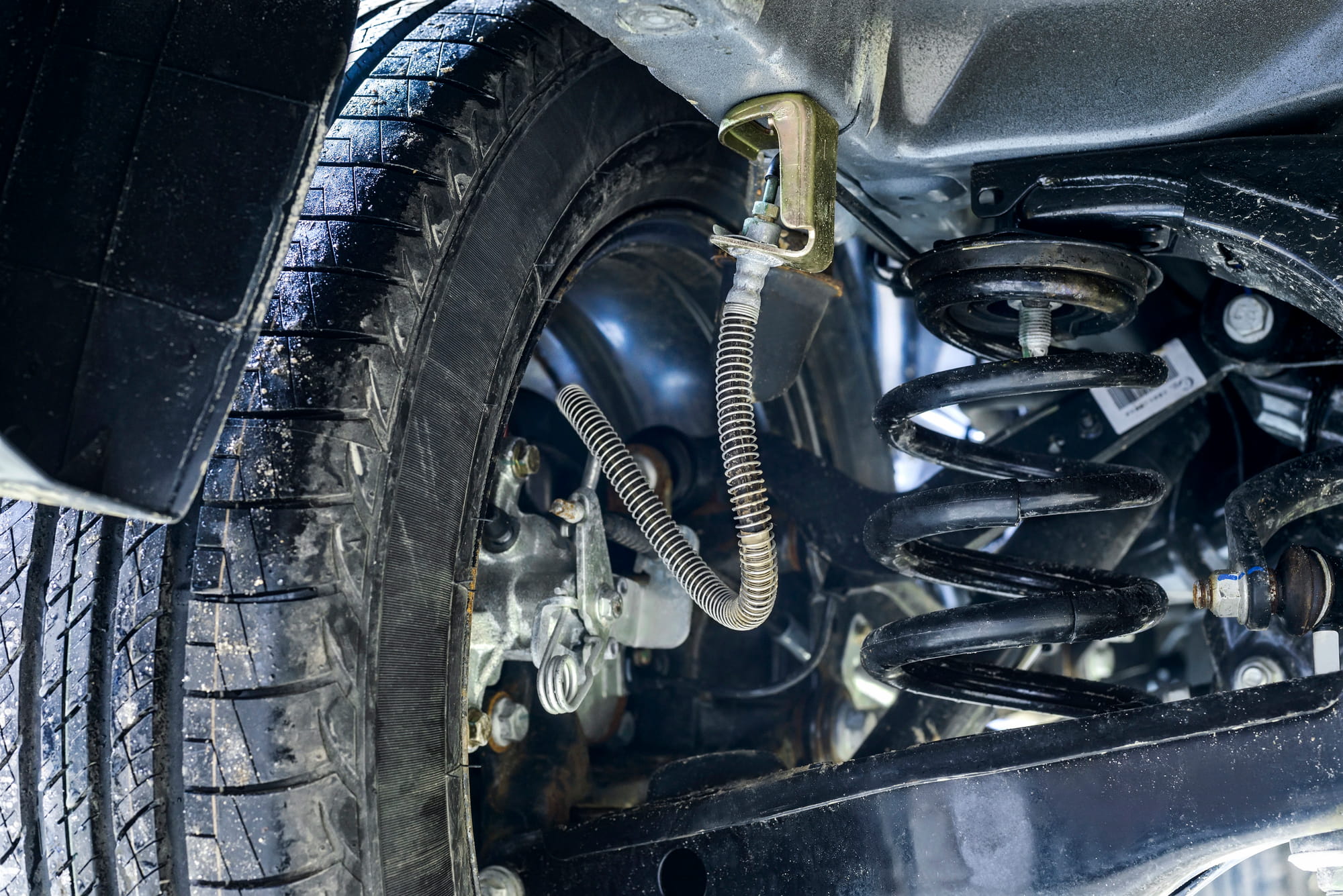
BMW Suspension Repair at DART Auto
BMW suspensions are engineered for precision handling and driver feedback – qualities that disappear the moment a worn control arm bushing or failing strut introduces unwanted play. Since 2000, DART Auto has specialized in restoring that factory-engineered balance on everything from E46 3-series to the latest G-chassis platforms. Unlike generic shops that treat every suspension like a bolt-on affair, we address the platform-specific challenges that define BMW repair: adaptive dampers that require ISTA/D coding after replacement, xDrive models where toe alignment must account for all-wheel-drive geometry, and M-sport suspensions with staggered wheel setups and tighter tolerances.
BMW suspensions rely on rubber-mounted subframes, hydraulic engine mounts that affect handling, and electronic damping systems (EDC, Adaptive M) that communicate with the vehicle's CAN bus. Replacing a strut on a 2015 F30 isn't just swapping hardware – it often means recalibrating ride-height sensors and clearing adaptation values so the system relearns damping curves. We use factory repair procedures, OEM torque specifications, and the same diagnostic platforms dealers rely on to confirm proper operation after every repair.
When you bring your BMW to DART Auto for suspension work, you can expect:
- Complete inspection – we measure ball-joint play, bushing condition, and alignment specs before recommending parts, so you're not replacing components that still have service life
- OEM and premium aftermarket parts sourced from Lemförder, Meyle HD, and other suppliers who meet or exceed BMW factory standards
- Post-repair alignment on our precision rack, with printouts showing before-and-after specs to document the correction
- 3-year/36,000-mile warranty on parts and labor, backing every strut, control arm, and link we install
Common Suspension Repair Issues on BMW Vehicles
BMW engineers suspension systems for precise handling and driver feedback, but that performance focus creates specific wear patterns. F-chassis platforms (F30, F32, F10) built between 2012 and 2019 show a predictable pattern of front control arm bushing failure around 60,000 miles, often accompanied by a distinctive clunk over bumps and steering wander under braking. The rubber compound BMW uses for these bushings prioritizes response over longevity, and Colorado's temperature swings accelerate degradation.
- Thrust arm bushing failure on E90/E92 (2006–2013): The rear trailing arm bushings tear internally, causing a vague, floating sensation during lane changes and uneven rear tire wear. This is one of the most common suspension complaints on the E-chassis 3 Series, and replacement requires pressing new bushings into the OEM arms or installing complete assemblies.
- Front strut mount bearing wear on E46 and E39 platforms: The top bearing plate wears unevenly, creating a grinding or popping noise when turning at low speed. Left unaddressed, the strut rod can contact the mount plate directly, damaging the tower and requiring far more extensive metalwork.
- Electronic damper failure on Adaptive M Suspension (F-chassis and G-chassis): The electronically controlled dampers lose their ability to adjust firmness, often throwing a suspension malfunction warning. One failed damper typically means replacing all four to maintain balance, and coding is required after installation.
- Rear subframe mount tearing on E46 (especially 330i and M3): The sheet metal around the rear subframe mounting points cracks due to stress, creating a clunking sound and misalignment. This is a known weak point on higher-mileage E46 platforms and requires reinforcement plates during repair.
- Front lower control arm ball joint separation on X5/X6 (E70/E71): The ball joint press-fit loosens over time, allowing play that shows up as a knocking sound over rough pavement and erratic steering feel. These SUV platforms place higher loads on the joints, accelerating wear beyond what sedan owners typically see.
- Air suspension compressor and valve block failure on 7 Series (F01/F02) and 5 Series GT: The air ride system develops leaks at the valve block or the compressor runs continuously, draining the battery overnight. These systems require BMW-specific diagnostic software to identify which corner is leaking and to calibrate ride height after component replacement.
Why Choose DART Auto for BMW Suspension Repair
BMW suspension systems demand specialized knowledge that goes beyond generic strut-and-spring replacement. From the adaptive damping faults in F-chassis EDC (Electronic Damper Control) systems to the notorious rear subframe cracking on E46 and E90 platforms, each generation brings its own failure modes. DART's technicians rely on factory ISTA diagnostic software and BMW-specific tooling to isolate faults in the Vertical Dynamics Management modules, air-suspension compressors on F01/F02 7-series, and self-leveling systems on X5/X6 models.
Our salaried master technicians – each with dealer training and over a decade of BMW-specific experience – follow OEM torque specifications and alignment procedures to the letter. We stock OEM and premium aftermarket control arms, bushings, and dampers from suppliers who meet BMW's original specifications. Because we're not paid flat-rate, there's no incentive to skip the pre-alignment subframe inspection or the post-repair road test that reveals residual noise or pull. Every repair is backed by a 3-year/36,000-mile warranty, and we verify suspension geometry with precision alignment equipment calibrated for BMW's tight tolerances.
- Platform expertise: familiarity with TSBs covering F30 control-arm failures, E60 thrust-arm bushings, and G-chassis air-spring leaks
- Diagnostic depth: ISTA scan capability to read fault codes in EDC modules, air-suspension controllers, and ride-height sensors
- End-to-end ownership: same technician diagnoses, repairs, and road-tests your BMW – no handoffs between departments
Symptoms – How to Know You Need This Service
BMW suspension wear often announces itself through steering feel and ride quality changes before you see dashboard warnings. You may notice:
- Clunking over bumps – especially at low speeds over speed bumps or potholes, often caused by worn strut mounts, sway bar end links, or control arm bushings that have torn and allow metal-on-metal contact
- Steering wander or vague center feel – the car requires constant correction on the highway, typically indicating worn tie rod ends, thrust arm bushings (common on E90/E92 and F30 platforms), or failing steering rack mounts
- Uneven tire wear – inner or outer edge scalloping, feathering, or cupping that persists even after alignment, pointing to camber arms, toe links, or struts that can no longer hold geometry
- Nose dive during braking or squat under acceleration – excessive body motion suggests worn struts or shocks that have lost damping force
- Pulling to one side – can indicate a collapsed control arm bushing, seized caliper, or bent suspension component from pothole impact
- "Chassis Stabilization" or "Suspension Malfunction" warnings on models with adaptive damping – the system detects a sensor fault, air leak (on F07 5GT or F11 with air suspension), or damper failure
- Vibration through the steering wheel at highway speeds – may point to a separated control arm bushing or out-of-balance wheel, but also worn wheel bearings that affect hub runout
If you see a suspension warning light or experience sudden loss of ride height, schedule service immediately. Clunking and tire wear issues should be addressed soon to prevent further damage and maintain safe handling.
Which BMW Models We See for Suspension Repair
We service suspension systems across the full BMW lineup, with deep familiarity in the platforms that make up the majority of Denver's European car population. Common chassis codes and generations include:
- E46 3-series (1999–2006) – known for front control arm bushing failures and rear subframe mounting point tears on pre-2002 models; we reinforce subframes and replace arms with upgraded bushings
- E90/E91/E92/E93 3-series (2006–2013) – thrust arm bushings, front control arms, and strut mounts are high-wear items; xDrive variants require careful attention to driveline alignment
- F30/F31/F34 3-series and 4-series (2012–2019) – adaptive M suspension models need ISTA coding after strut replacement; we see frequent front control arm and sway bar link wear
- E39 5-series (1997–2003) – thrust arms, front lower control arms, and rear trailing arm bushings; self-leveling rear suspension on some models requires hydraulic system diagnosis
- E60/E61 5-series (2004–2010) – active roll stabilization and adaptive drive systems add complexity; we address hydraulic leaks, sensor faults, and conventional wear items
- F10/F11 5-series (2011–2016) – air suspension on some models, adaptive dampers on M Sport; common front control arm and wheel bearing issues
- E53 X5 (2000–2006) and E70 X5 (2007–2013) – heavier loads accelerate control arm and strut wear; air suspension on later models requires compressor and air spring service
- F15/F16 X5 and X6 (2014–2018) – adaptive air suspension, electronic dampers, and xDrive all-wheel-drive geometry
- E83 X3 (2004–2010) and F25 X3 (2011–2017) – front lower control arms, strut mounts, and rear trailing arm bushings are typical wear points
- M models (E46 M3, E90/E92 M3, F80 M3, F10 M5) – stiffer bushings, unique control arm designs, and adaptive dampers that require factory-level diagnostics and coding
We also service 1-series, 2-series, Z4, and X1/X2 platforms. If you drive a classic E30 or E28, or a very recent G20/G29 model, call us to confirm parts availability and tooling – we'll let you know up front if your chassis falls outside our typical service range.
Causes & Risks – What Happens if Ignored
Suspension wear on BMW vehicles accelerates due to the performance-tuned geometry and stiffer bushings that prioritize handling precision. Denver's freeze-thaw cycles cause rubber components to harden and crack faster than in temperate climates, while road salt infiltrates sealed joints and corrodes the steel subframes common on E-chassis and older platforms. High-performance models with sport suspension packages experience even faster wear because the firmer bushings and springs transmit more road shock directly into mounting points.
Delaying suspension repairs creates a cascade of secondary damage. A worn thrust arm bushing allows the wheel to move out of alignment under load, which scrubs the inside edge of the rear tire down to the cords within a few thousand miles. That same misalignment changes the load path through adjacent components – the trailing arm, the differential mounts, even the driveshaft carrier bearing on rear-wheel-drive models. What begins as a $400 bushing replacement can escalate into a $2,000 repair once multiple arms, an alignment, and a set of rear tires enter the equation.
Safety risks appear before the cost spiral. Here's what deteriorates when you wait:
- Braking distance increases: Worn suspension allows the wheel to move unpredictably under hard braking, extending stopping distance and reducing ABS effectiveness.
- Steering response becomes inconsistent: Play in control arm bushings or ball joints creates a dead spot in the steering wheel, forcing you to overcorrect and making emergency maneuvers less predictable.
- Tire contact patch shrinks: Misaligned suspension reduces the tire's contact with the road, cutting available grip for cornering and increasing hydroplaning risk on wet pavement.
- Component separation becomes possible: A severely worn ball joint or tie rod end can separate completely, causing immediate loss of steering or wheel control – this is the "stop driving now" threshold that many owners don't recognize until a shop puts the car on a lift.
Safety Impact – Why Suspension Repair Matters
Suspension condition directly affects every safety system on a modern BMW. The ABS module relies on stable wheel geometry to modulate brake pressure accurately – when a control arm bushing allows the wheel to shift under braking, the ABS sensor reads erratic speed data and may pulse the brakes inappropriately or disable intervention altogether. Dynamic Stability Control (DSC) makes the same assumptions about suspension rigidity; a car with worn thrust arm bushings will trigger DSC activation during normal cornering because the system interprets the rear-end float as the beginning of a slide.
Steering precision disappears when ball joints or tie rod ends develop play. The driver turns the wheel, but the response arrives a fraction of a second late and with inconsistent weighting, making it nearly impossible to place the car accurately in an emergency lane change. On highways, this delay forces constant small corrections that fatigue the driver and increase the risk of overcorrection during a sudden maneuver.
Here's when to escalate your timeline:
- Stop driving immediately: Clunking or popping from the front end during turns, steering wheel off-center after hitting a pothole, visible separation between ball joint and control arm, or any warning light related to suspension or steering.
- Schedule within the week: Uneven tire wear appearing suddenly, pulling to one side under braking, bouncing or floating sensation over highway expansion joints, or any grinding noise when turning the steering wheel at a stop.
- Plan for the next service interval: Subtle changes in ride quality, minor clunking over sharp bumps at low speed, or a recommendation from your last inspection showing early-stage bushing deterioration.
Insurance and liability considerations matter. If a known suspension defect contributes to an accident, your insurer may dispute the claim, and you carry personal liability for damage or injury that a documented repair could have prevented.
How BMW Suspension Repair Actually Works
BMW suspensions use a multi-link design that isolates each wheel's movement through separate control arms, thrust arms, and toe links, all connected by rubber or polyurethane bushings. This architecture allows engineers to tune each bushing's stiffness independently, dialing in the exact balance between handling precision and ride comfort. The trade-off is complexity – where a simpler design might use two control arms per wheel, a BMW F30 uses five separate links at the rear, each with its own wear pattern and replacement interval.
Proper repair requires following BMW's specific torque sequences and ride-height specifications. Most suspension fasteners must be torqued with the vehicle at normal ride height and the wheels supporting the car's weight – torquing with the suspension hanging free preloads the bushings incorrectly and causes premature failure. This means the car goes on the lift, the old components come off, the new parts go on finger-tight, the car comes down onto its wheels, and only then does the technician torque everything to spec. Shops that skip this step deliver a repair that feels fine initially but fails early.
BMW-specific considerations that distinguish this work from generic suspension repair:
- Electronic damper coding: Adaptive M Suspension and EDC-equipped models require coding after damper replacement so the DSC module recognizes the new hardware and calibrates damping curves correctly.
- Subframe alignment: Many BMW platforms use a bolt-in rear subframe with slotted mounting holes, allowing the entire assembly to shift slightly. Proper suspension repair includes checking subframe position with alignment pins and adjusting before final torque.
- Integral ball joints vs. serviceable: Newer BMW control arms use pressed-in ball joints that require a hydraulic press and specific tooling to replace, while older platforms allow ball joint replacement without changing the entire arm – knowing which generation you're working on changes the parts list and labor completely.
- Camber and toe adjustment methods: F-chassis and newer platforms adjust camber via eccentric bolts at the strut-to-knuckle mount, while E-chassis cars use shims or eccentric washers at
How We Diagnose Suspension Repair Issues on BMW
BMW vehicles use sophisticated suspension systems with adaptive damping, electronic ride-height sensors, and integrated stability control. A clunk over bumps or a sagging corner might stem from a worn control arm bushing, a failed EDC damper, or a leak in the air suspension compressor. Pinpointing the root cause demands factory-level tooling and platform knowledge that generic shops often lack.
Our diagnostic workflow combines scan data with hands-on inspection to isolate the failure:
- ISTA scan and fault-code retrieval. We connect BMW's factory diagnostic software to read live sensor data from the Dynamic Damper Control module, ride-height sensors, and ABS wheel-speed inputs. Codes like "damper plausibility" or "ride-height deviation" tell us which corner and which subsystem to investigate.
- Road test under load. A technician drives the car over expansion joints, speed bumps, and smooth highway to reproduce the noise or handling complaint. We listen for metal-on-metal contact, feel for steering wander, and note whether the issue appears on compression, rebound, or both.
- Lift inspection and measurement. With the car on the hoist, we check control-arm bushings for radial play, measure ball-joint axial movement with a dial indicator, and inspect strut mounts for torn rubber or cracked bearing plates. On air-suspension models we soap-test air lines and bellows for leaks.
- Component-specific tests. Suspected EDC dampers are bench-tested for resistance values; thrust arms are checked for the characteristic crack along the bushing pocket common on E90/E92 platforms; rear subframe mounts are inspected for the tearing seen on higher-mileage F30 chassis.
Once we've isolated the worn or failed component, you receive a detailed estimate that explains what broke, why it happened, and what we'll do to fix it. No guesswork, no parts-cannon approach – just a clear plan backed by data.
Suspension Repair on BMW: Repair vs. Replacement
True suspension repair – servicing a component rather than swapping it – is rare on modern BMWs because most suspension parts are pressed assemblies or sealed units. A corroded sway-bar end-link can be replaced individually; a control arm with a torn bushing almost always calls for a complete new arm because BMW bonds the bushing into the stamping. The decision hinges on the part's design and the extent of wear.
When genuine repair makes sense:
- Adjusting camber or toe after new tires or an alignment drift.
- Cleaning corrosion from sway-bar frame bushings and re-greasing the bar.
- Replacing a single cracked dust boot on a ball joint before moisture intrudes – though this window is narrow and rarely cost-effective once the joint has play.
When partial replacement is the right call:
- Swapping one failed EDC damper while the other three still test within spec.
- Replacing a single torn thrust-arm bushing on an E46 or E90 rather than all four corners if the others pass inspection.
- Installing new upper strut mounts when replacing coil-overs, since the labor is already invested.
When full replacement is non-negotiable:
- Air-suspension compressors or valve blocks that have failed internally – rebuilds seldom last.
- Control arms with cracked pockets or bent shanks from a pothole strike.
- Any safety-critical ball joint or tie-rod end with measurable play.
We walk you through the trade-offs – repair cost, expected service life, and whether adjacent parts are nearing their limit – so you can make an informed choice rather than feeling pushed toward the most expensive option.
How to Make Your BMW Suspension Repair Last Longer
Once we've installed fresh control arms, dampers, or air-suspension components, a few proactive habits will protect your investment and delay the next round of wear.
Driving habits that matter:
- Slow down for potholes and expansion joints. High-speed impacts spike load on bushings and can crack cast-aluminum control-arm pockets.
- Avoid full-lock, full-throttle launches. They twist the drivetrain and suspension mounts simultaneously, accelerating bushing tear-out on xDrive models.
- Let the car warm up in winter. Cold hydraulic fluid in adaptive dampers takes longer to respond, and aggressive cornering on stiff, cold bushings can cause micro-tears.
Owner-level maintenance you can do safely:
- Walk around the car weekly and look for uneven ride height, fresh fluid stains under the wheels, or a leaning stance that signals a failing air spring.
- Listen for new noises – a clunk that wasn't there last month often means a bushing has torn or a mount has separated.
- Check tire wear every oil change. Feathering on the inside edge points to camber drift from a worn control arm; cupping suggests a dead damper.
Leave these tasks to the professionals:
- Any work that requires pressing bushings, torquing suspension fasteners to spec under load, or bleeding adaptive-damper modules.
- Ride-height calibration on air-suspension cars – the procedure demands ISTA and a level surface.
- Software updates for EDC or integral active steering, which can mask or create new fault codes if done incorrectly.
Stick to BMW's service intervals for alignments and fluid changes, use OEM-spec parts when the time comes, and address small noises before they become expensive failures. That approach keeps your suspension sorted for the long haul.
What to Expect When You Bring Your BMW In
Schedule an appointment online or by phone, and plan to drop off your BMW in the morning when our team can perform a thorough lift inspection. Bring your key fob and remove valuables; we'll note personal items left in the cabin. If you need a loaner vehicle or shuttle service to work, let us know when you book – we'll arrange transportation so you're not stranded.
- Initial inspection: We road-test your BMW to replicate the symptoms you described, then perform a comprehensive lift inspection. Technicians check control-arm bushings, ball joints, tie-rod ends, shock mounts, and subframe condition. On EDC-equipped models, we scan for damper faults and compare ride-height sensor readings against factory specs.
- Written estimate: You'll receive a detailed estimate listing each failed component, the recommended repair, and the consequences of deferring work. We explain whether a clunking noise is a worn thrust-arm bushing or a cracked subframe mount, and whether alignment is needed after the repair.
- Repair and verification: Once you approve the estimate, our technician replaces failed parts, torques fasteners to BMW specifications, and performs a precision four-wheel alignment. Every suspension job concludes with a road test to confirm the repair eliminated the original symptom and a final scan to verify no fault codes remain.
- Pickup walkthrough: At pickup, we review the work performed, show you the old parts if requested, and explain any additional maintenance items noted during the inspection. If something feels off within the first few days, call us – we'll recheck the work at no charge.
After-hours pickup is available by arrangement; just ask when you schedule. Our goal is to return your BMW with confident handling and quiet ride quality, backed by transparent communication at every step.
Our BMW Services
- Air Conditioning AC Repair
- Battery Repair Replacement
- Brake Repair & Brake Fluid Change
- Check Engine Light Diagnostics
- Clutch Repair & Replacement
- Coolant Leak Repair
- Cooling System Repair
- Drive Shaft Repair
- Engine Repair
- Exhaust & Catalytic Converter Repair
- Head Gasket Repair & Replacement
- Oil Change
- Oil Leak Repair
- Scheduled Service Maintenance
- Steering Repair
- Cambelt Timing Belt Replacement
- Transmission Repair
- Tune Up
- Wheel Alignment