
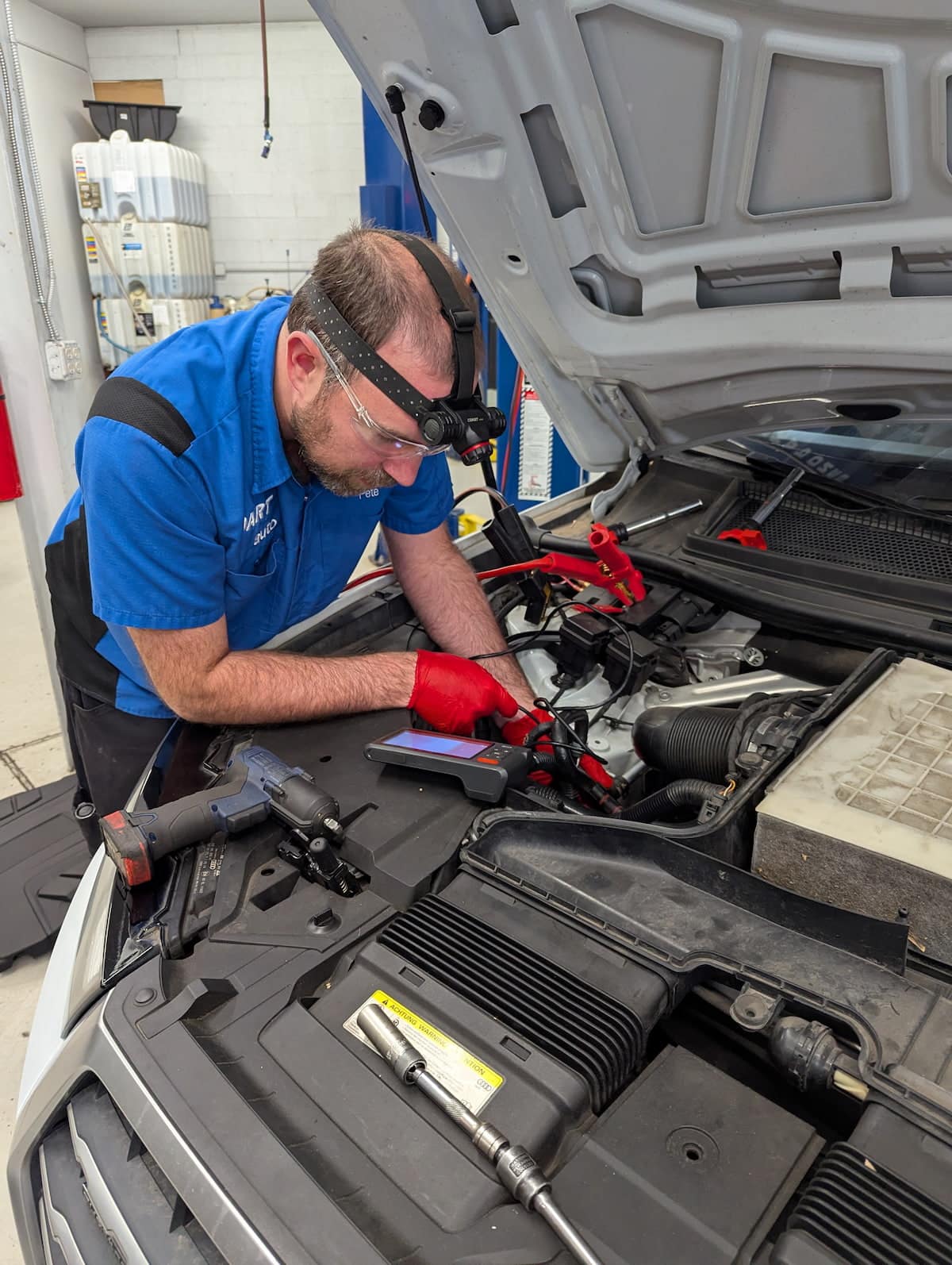
Lamborghini Tune Up at DART Auto
Lamborghini's naturally aspirated V10 and V12 engines – and more recently, the twin-turbo V8 in the Urus – demand precision maintenance that goes far beyond spark plugs and filters. These high-revving powerplants operate at extreme tolerances, with individual throttle bodies, variable valve timing systems, and sophisticated engine management that requires factory-level diagnostics to maintain peak performance. A proper Lamborghini tune up means addressing ignition coil health on engines that routinely see 8,500+ RPM, inspecting carbon buildup on direct-injection systems, and verifying that each cylinder bank's lambda sensors and fuel trims remain within Lamborghini's narrow specifications. The Gallardo's e-gear actuator hydraulics, Huracán's dual-clutch transmission adaptation values, and Aventador's independent shifting rod system all require software interrogation during comprehensive service intervals – work that generic shops simply cannot perform without Lamborghini-specific diagnostic platforms and training.
DART Auto has invested in the factory tooling, repair procedures, and diagnostic capability to service these ultra-performance machines at a level that matches or exceeds dealership standards, without the inflated labor rates. Our master technicians bring dealer training and over a decade of European performance experience to every service bay, using salaried compensation that eliminates the incentive to rush through complex procedures.
When you bring your Lamborghini to DART Auto for a tune up, expect:
- Complete ignition system inspection with coil resistance testing and spark plug gap verification to factory specifications
- Throttle body synchronization across all cylinders using Lamborghini-specific diagnostic software
- Fuel system pressure testing, injector flow balance analysis, and carbon deposit assessment on direct-injection engines
- Comprehensive computer scan covering all control modules, with attention to adaptation values, fuel trims, and stored fault codes that may not trigger dashboard warnings
Common Tune Up Issues on Lamborghini Vehicles
Lamborghini tune-ups demand a level of precision that separates specialist shops from general service centers. These Italian supercars employ unique ignition, fuel, and engine management systems that require brand-specific diagnostic protocols and OEM-calibrated tooling. The V10 and V12 platforms share little with conventional European engines, and even routine maintenance involves procedures that most shops have never encountered.
- Gallardo (2004–2013) and Huracán (2014–present) ignition coil failure: The 5.2L V10 engine uses individual coil-on-plug ignition packs that operate under extreme heat and vibration. Coils on cylinders 5 and 10 fail most frequently due to their position near exhaust manifolds. Misfires under wide-open throttle or hesitation during acceleration are early indicators. OEM coils require specific torque sequences and software verification after replacement.
- Aventador (2011–present) spark plug fouling on the 6.5L V12: The L539 engine's 12 individual throttle bodies and direct injection create lean-burn conditions that accelerate plug electrode wear. Factory service intervals call for plug replacement every 9,000 miles, but aggressive driving or track use shortens this to 5,000–6,000 miles. Incorrect heat-range plugs cause immediate performance loss and potential piston damage.
- Carbon buildup on intake valves (all direct-injection models 2008–present): Lamborghini's switch to direct fuel injection eliminated port injection's natural valve-cleaning effect. Gallardo LP560, Huracán, and Aventador engines accumulate carbon deposits that restrict airflow, causing rough idle, reduced power, and lean fuel trims. Walnut-blasting the intake ports is required every 30,000–40,000 miles.
- Throttle body synchronization drift on V10 and V12 engines: Multi-throttle-body engines require periodic electronic synchronization using Lamborghini's proprietary diagnostic software. Drift between throttle positions creates uneven cylinder fueling, rough idle, and hesitation. This is not detectable without factory-level scan tools and cannot be corrected with generic OBD-II equipment.
- Fuel injector clogging and spray-pattern degradation: High-pressure direct injectors on Huracán and Aventador models operate at 2,900+ PSI and are sensitive to fuel quality. Ethanol-blended pump fuel accelerates varnish formation, reducing atomization efficiency. Symptoms include cold-start stumble, misfires under load, and elevated hydrocarbon emissions. Injector flow-testing and ultrasonic cleaning require specialized benches.
- Air filter restriction and MAF sensor contamination: Lamborghini's high-flow intake systems use large-surface-area filters that trap fine dust particles. Restricted airflow triggers rich fuel trims and reduced throttle response. Mass airflow sensors positioned in the intake tract accumulate oil residue from aftermarket oiled filters, causing false readings and limp-mode activation.
Why Choose DART Auto for Lamborghini Tune Up
Lamborghini V10 and V12 engines demand more than generic maintenance. These naturally aspirated powerplants – from the Gallardo's 5.0L and 5.2L E-gear variants to the Aventador's 6.5L L539 – rely on precise ignition timing, clean throttle bodies, and factory-spec fluid intervals to deliver their legendary performance. DART Auto has invested in the diagnostic hardware and OEM repair information required to service these platforms correctly, matching dealership capability without the markup.
Our master technicians bring dealer-level training to every Lamborghini tune up, using the same scan tools and torque specifications found in factory service manuals. Because we employ salaried technicians rather than flat-rate workers, there's no incentive to rush through spark plug changes or skip throttle body adaptation procedures. We perform complete inspections before recommending any service, explaining what each component does and the consequences of deferring work. When a Gallardo arrives with misfires traced to coil-pack degradation or a Huracán shows carbon fouling on direct-injection valves, we document findings with photos and provide transparent estimates. Our 3-year/36,000-mile warranty on parts and labor backs every repair, and over two decades serving Denver's European car community means we've seen – and solved – the quirks unique to each Lamborghini generation.
Symptoms – How to Know You Need This Service
Lamborghini owners may notice performance degradation gradually, but certain symptoms demand immediate attention while others indicate scheduled service is due soon:
- Rough idle or inconsistent engine note – particularly noticeable at cold start or when the engine is fully warmed; one or more cylinders may be misfiring due to worn spark plugs or failing ignition coils
- Hesitation or flat spots during acceleration – especially between 3,000-5,000 RPM where throttle response should be instantaneous; often points to ignition breakdown under load or fuel delivery issues
- Check engine light with misfire codes – P0300 series codes indicating random or cylinder-specific misfires; continuing to drive risks catalytic converter damage (stop driving and arrange transport)
- Increased fuel consumption – noticeably worse MPG without changes in driving style suggests ignition inefficiency or rich fuel trims compensating for weak spark
- Difficulty starting or extended cranking – particularly in cold weather; worn spark plugs increase the voltage demand beyond what aging coils can deliver
- Rough running that smooths out at higher RPM – classic sign of marginal ignition components that can't sustain combustion at idle but work adequately under load
- Vibration through the cabin at idle – more pronounced than the typical V10 or V12 character; indicates one or more cylinders not firing consistently
Which Lamborghini Models We See for Tune Up
DART Auto services the full range of modern Lamborghini platforms, from the Gallardo that introduced accessible supercar ownership to the current Huracán and Urus models. Our technicians have extensive experience with the brand's naturally aspirated V10 and V12 engines, as well as the turbocharged V8 powertrain introduced in the Urus SUV.
- Gallardo (2003-2013) – all variants including LP550-2, LP560-4, Superleggera, and Spyder; both e-gear and manual transmissions; particular attention to ignition coil failure patterns on higher-mileage examples
- Huracán (2014-present) – LP580-2, LP610-4, Performante, EVO, STO; direct-injection V10 requires carbon assessment and injector flow testing during comprehensive service
- Murciélago (2001-2010) – LP640, LP650, LP670 SV; V12 platforms with individual throttle bodies requiring synchronization and coil pack inspection across all twelve cylinders
- Aventador (2011-present) – LP700-4, LP750 SV, S, SVJ, Ultimae; sophisticated ISR transmission demands software-based diagnostics during service intervals
- Urus (2018-present) – twin-turbo V8 shares architecture with Audi/Porsche platforms but requires Lamborghini-specific calibration files and adaptation procedures
We maintain factory repair information and diagnostic capability for all platforms listed above. Older models such as the Diablo and Countach require specialized consultation – contact us to discuss service options for heritage vehicles.
Causes & Risks – What Happens if Ignored
Lamborghini tune-up issues stem from the extreme operating conditions these engines endure. The V10 and V12 powerplants generate cylinder pressures and combustion temperatures far exceeding typical performance cars. Combined with Denver's altitude (which leans fuel mixtures and stresses ignition systems), short-trip driving that prevents full engine warm-up, and ethanol fuel that degrades over time, even well-maintained Lamborghinis face accelerated wear on ignition and fuel-delivery components. The brand's reliance on individual throttle bodies, high-pressure direct injection, and complex engine-management calibrations means that minor drift in any one component affects the entire system.
Delaying tune-up service transforms manageable maintenance into expensive engine repairs:
- Ignition misfires damage catalytic converters: Unburned fuel from a failing coil or fouled plug enters the exhaust system, where it ignites inside the catalytic converter. Sustained misfires melt the ceramic substrate within 500–1,000 miles, requiring converter replacement at $3,000–$6,000 per unit. Lamborghinis use multiple high-flow cats; replacing all four on a V12 becomes a five-figure repair.
- Carbon buildup leads to valve and piston damage: Excessive intake-valve deposits restrict airflow, causing the ECU to compensate with longer injector pulse widths. This over-fueling washes oil from cylinder walls, accelerating ring wear and allowing fuel dilution of engine oil. Continued operation scores cylinder bores and damages piston ring lands, necessitating complete engine rebuilds.
- Throttle-body desynchronization triggers limp mode: When throttle-position sensors drift beyond factory tolerances, the ECU enters a failsafe state that limits RPM to 3,000 and disables dynamic driving modes. Attempting to drive in limp mode strains the transmission and increases clutch wear on e-gear and LDF dual-clutch systems.
- Clogged injectors cause lean-condition engine knock: Restricted fuel delivery creates lean air-fuel ratios under load. The engine's knock sensors detect detonation and retard ignition timing, reducing power and efficiency. Persistent knock damages piston ring lands, cracks spark-plug insulators, and can hole pistons on forced-induction variants.
- Contaminated MAF sensors cause overboosting on turbocharged models: False airflow readings confuse the ECU's boost-control algorithms. The turbocharger overspeeds, exceeding safe compressor shaft RPM and leading to bearing failure, compressor-wheel damage, and catastrophic turbo destruction.
Safety Impact – Why Tune Up Matters
Lamborghini performance depends on precise engine-management calibration. When tune-up components fail, the cascading effects compromise both driver control and vehicle stability. Misfires under acceleration create sudden power loss during overtaking or merging, leaving the driver without expected thrust. Throttle-response lag from clogged injectors or carbon buildup delays power delivery in emergency maneuvers, extending reaction times when split-second decisions matter.
Specific safety risks include:
- Traction and stability-control interference: Misfires confuse wheel-speed and yaw-rate sensors, causing ABS and ESC systems to intervene inappropriately. On wet or icy roads, unexpected stability-control activation can unsettle the chassis mid-corner.
- Limp-mode activation in traffic: Sudden power limitation to 3,000 RPM while merging onto highways or navigating intersections creates collision risk. The driver loses the ability to accelerate out of dangerous situations.
- Fire risk from catalytic-converter overheating: Sustained misfires superheat exhaust components. Melted catalytic converters ignite underbody insulation and can start vehicle fires, particularly after parking on dry vegetation or in enclosed garages.
- Engine stalling at low speeds: Severe carbon buildup or injector clogging causes rough idle and stalling when coming to a stop. Loss of power steering and brake assist (which rely on engine vacuum or hydraulic pressure) dramatically increases stopping distances and steering effort.
Stop driving immediately if: the check-engine light flashes (indicates active misfire), you smell raw fuel in the cabin, the engine stalls repeatedly, or you hear metallic knocking under acceleration. Schedule service within the week if: you notice reduced power, rough idle, hesitation during throttle application, or the check-engine light remains solid.
How Lamborghini Tune Up Actually Works
Lamborghini's naturally aspirated V10 and V12 engines use individual throttle bodies for each cylinder – a design borrowed from Formula 1 that maximizes airflow and throttle response. Each throttle plate operates independently, controlled by the engine ECU through precise stepper-motor actuation. This configuration eliminates the intake-manifold plenum found in conventional engines, allowing instantaneous cylinder filling and razor-sharp throttle response. The trade-off is complexity: all throttle bodies must open and close in perfect synchronization, or individual cylinders receive unequal air charges, causing rough running and misfires.
Direct fuel injection adds another layer of precision. Unlike port injection (which sprays fuel into the intake manifold), direct injection delivers fuel at ultra-high pressure directly into the combustion chamber during the compression stroke. This enables stratified-charge combustion for efficiency and allows higher compression ratios without knock. However, it eliminates the fuel's natural detergent action on intake valves, acceler
How We Diagnose Tune Up Issues on Lamborghini
Lamborghini V10 and V12 powerplants demand a different diagnostic approach than conventional engines. These high-strung naturally aspirated motors – whether the Gallardo's E-Gear equipped 5.0L or 5.2L, the Murciélago's 6.2L and 6.5L, or the Huracán's and Aventador's latest iterations – rely on precise ignition timing, fuel delivery, and valve train operation at stratospheric RPM. When performance drops or misfires appear, we follow a methodical path that respects the engineering:
- Factory-level scan with Lamborghini-specific diagnostic software. We connect to the Bosch ME7, Siemens VDO, or Continental ECUs used across the lineup to pull ignition misfire counters, lambda sensor trims, and individual cylinder contribution data. This reveals which bank or cylinder is faltering and whether the issue is fuel, spark, or mechanical.
- Coil pack and spark plug resistance testing. Lamborghini coil-on-plug assemblies are stressed by heat and vibration; we measure primary and secondary resistance to catch weak coils before they fail completely. Spark plugs are inspected for fouling, gap erosion, and electrode wear – critical on engines that rev past 8,000 RPM.
- Fuel pressure and injector flow analysis. We verify rail pressure meets spec under load and check injector spray patterns on a flow bench when misfire patterns suggest fuel starvation or imbalance across cylinders.
- Compression and leakdown testing when mechanical wear is suspected. High-mileage Gallardos and first-generation Huracáns can show valve seat recession or carbon buildup affecting sealing; leakdown isolates whether the issue is valves, rings, or head gasket.
- Visual inspection of intake runners, throttle bodies, and PCV system. Carbon deposits on intake valves (common on direct-injection platforms) and oil vapor contamination can choke airflow and misfire at high load.
Once diagnostics are complete, we translate the findings into a prioritized repair plan with transparent pricing, so you understand exactly what your Lamborghini needs and why.
Tune Up on Lamborghini: Repair vs. Replacement
The term "tune up" on a modern Lamborghini rarely means adjusting carburetors or setting points. Instead, it's about restoring ignition and fuel system performance to factory specification. The repair-versus-replacement decision hinges on what the diagnostics reveal:
When Repair Makes Sense
- Carbon cleaning on intake valves and combustion chambers. Walnut-blasting or chemical cleaning restores airflow and compression without replacing hard parts, especially effective on higher-mileage Gallardo and Huracán engines showing rough idle or hesitation.
- Spark plug replacement and coil pack testing. If coil packs test within spec and only the plugs are worn (common every 15,000–20,000 miles on hard-driven cars), replacing plugs alone restores performance at a fraction of the cost.
- Throttle body cleaning and adaptation reset. Electronic throttle bodies accumulate oil vapor deposits; cleaning and relearning idle parameters often cures drivability complaints without new parts.
When Replacement Is the Right Call
- Weak or failed coil packs. Once a coil shows high resistance or intermittent spark, replacement is the only reliable fix. On V10 and V12 engines, we often recommend replacing all coils if one fails at high mileage – prevents repeat labor charges.
- Fuel injectors with flow imbalance or internal leakage. Cleaning rarely fixes a mechanically compromised injector; replacement with OEM or Bosch units restores proper atomization and idle quality.
- Ignition harness damage from heat or rodent chewing. Compromised wiring to coils causes erratic misfires that no component swap will cure; harness replacement is the permanent solution.
We walk you through the trade-offs – repair cost, expected lifespan, and risk of recurrence – so you can make an informed choice rather than defaulting to the most expensive path.
How to Make Your Lamborghini Tune Up Last Longer
Lamborghini engines are built for performance, not neglect. Extending the interval between tune ups requires attention to how you drive and how you maintain the car between service visits.
Driving Habits That Protect Ignition and Fuel Systems
- Warm the engine before high-load operation. Cold oil and tight tolerances mean the first few minutes are critical; let coolant reach 180°F before exploring the upper half of the tach.
- Use premium fuel exclusively and avoid long storage on stale gas. Ethanol-laced pump gas degrades quickly; if the car sits for weeks, add stabilizer or plan to drain and refill before spirited driving.
- Exercise the full RPM range regularly. Lamborghini engines are happiest when used; short trips and constant low-RPM operation promote carbon buildup and fuel system varnish. A monthly Italian tune-up – full-throttle runs through the gears on a safe road – keeps combustion chambers clean.
- Avoid lugging the engine or excessive idling. Low-RPM, high-load operation (climbing hills in too tall a gear) stresses ignition components and fouls plugs. Similarly, extended idling floods cylinders and washes oil from cylinder walls.
Owner-Level Maintenance
- Check for check-engine lights and address them promptly. Misfires damage catalytic converters quickly on high-performance engines; ignoring a flashing CEL can turn a coil pack replacement into a cat replacement.
- Monitor oil consumption and top off with the correct spec. Lamborghini specifies low-SAPS synthetic oils to protect cats and oxygen sensors; using the wrong oil accelerates sensor fouling and ignition issues.
- Listen for changes in idle quality or throttle response. A rougher idle, hesitation on tip-in, or loss of top-end pull are early signs that ignition or fuel delivery needs attention.
What to Leave to the Professionals
Spark plug replacement on a Lamborghini V10 or V12 requires removing engine covers, coil packs, and sometimes intake components – plus torque specs and anti-seize application that matter at high combustion pressures. Coil pack replacement demands careful connector seating and harness inspection. Carbon cleaning involves specialized equipment and intake manifold removal. These are not shade-tree jobs; attempting them without proper tooling risks cross-threaded plugs, damaged coils, or vacuum leaks that cost more to fix than the original service. Trust the work to technicians with Lamborghini-specific training and the factory service information to do it right the first time.
What to Expect When You Bring Your Lamborghini In
From the moment you schedule your appointment, we treat your Lamborghini with the specialist attention it deserves. Here's how the process unfolds:
- Drop-off and initial consultation: Bring your vehicle in at your scheduled time. We'll discuss your service history, any performance concerns, and what you've noticed behind the wheel. Remove personal items from the cabin; we'll secure your key and document mileage.
- Complete pre-service inspection: Before touching ignition components or fluids, our technicians perform a thorough scan-tool check for fault codes, review adaptation values, and inspect related systems – fuel delivery, throttle response, exhaust gas temps – to ensure we're addressing root causes, not just symptoms.
- Written estimate and approval: You'll receive a detailed breakdown of recommended services with part numbers and labor scope. We explain what each service accomplishes and what happens if you delay it. No work begins until you approve the estimate.
- Service execution: We follow OEM procedures for spark plug torque, coil installation, throttle body cleaning, and any software adaptations required after component replacement. Salaried compensation means technicians take the time to do it right.
- Post-repair verification: Every Lamborghini gets a road test and final scan-tool check to confirm smooth idle, throttle response, and no pending codes. We walk you through completed work at pickup and provide documentation for your records.
Loaner vehicles and shuttle service are available for longer jobs. If you notice anything unusual after pickup, call us immediately – we'll re-evaluate at no charge to make sure everything performs as expected.
Our Lamborghini Services
- Air Conditioning AC Repair
- Battery Repair Replacement
- Brake Repair & Brake Fluid Change
- Check Engine Light Diagnostics
- Clutch Repair & Replacement
- Coolant Leak Repair
- Cooling System Repair
- Drive Shaft Repair
- Engine Repair
- Exhaust & Catalytic Converter Repair
- Head Gasket Repair & Replacement
- Oil Change
- Oil Leak Repair
- Scheduled Service Maintenance
- Steering Repair
- Suspension Repair
- Cambelt Timing Belt Replacement
- Transmission Repair
- Wheel Alignment