
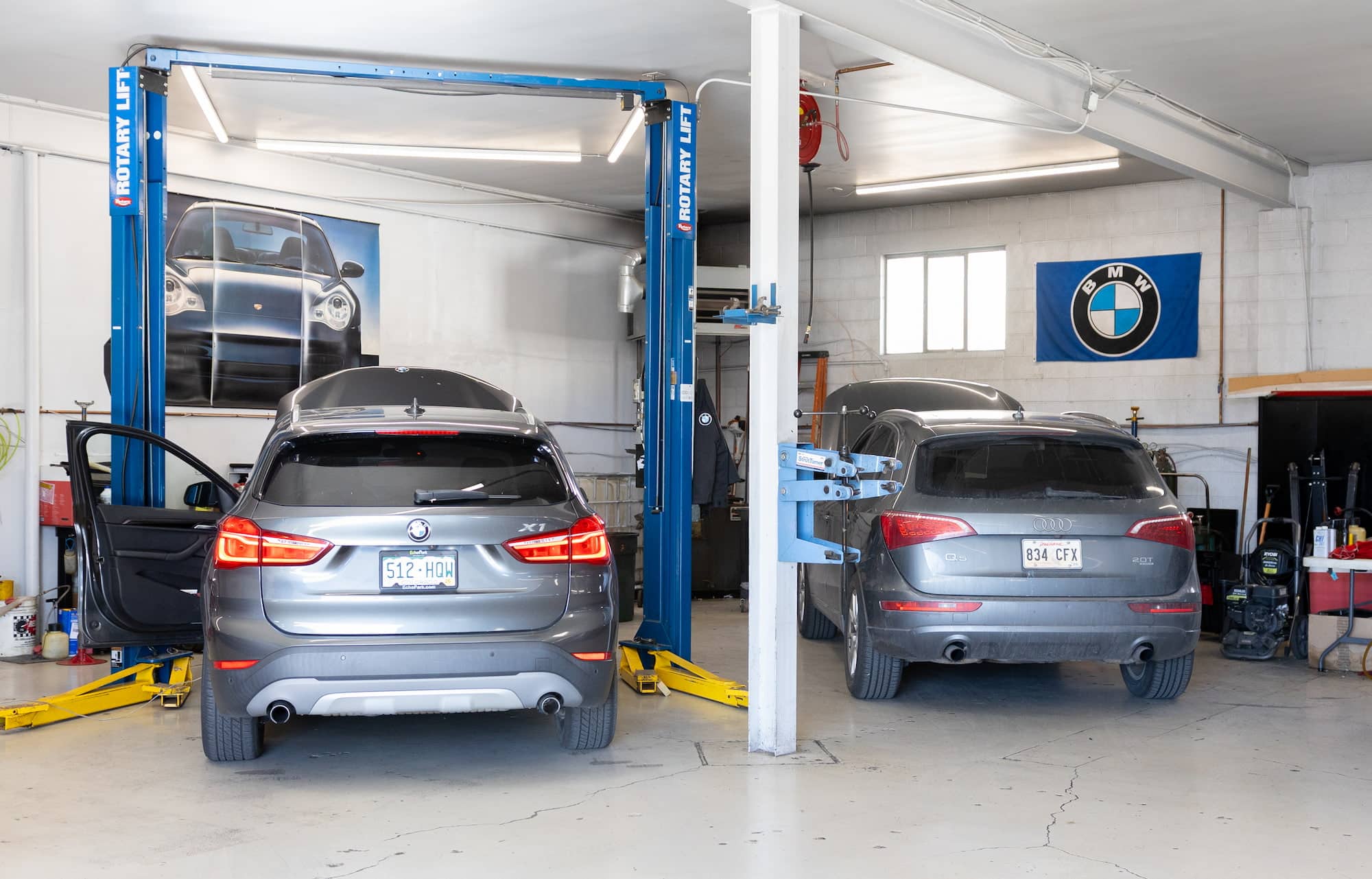
BMW Wheel Alignment at DART Auto
BMW engineers specify wheel alignment tolerances measured in fractions of a degree – settings that directly affect how your xDrive system distributes torque, how your run-flat tires wear, and whether your adaptive dampers can do their job. A generic alignment rack calibrated for pickup trucks won't capture the precision needed for a G20 3-series or F90 M5, and techs unfamiliar with BMW's electronic parking brake release procedures or suspension ride-height calibration can't deliver factory-correct geometry.
At DART Auto, we've aligned thousands of BMWs since 2000 using hunter alignment systems paired with BMW-specific software that accounts for active steering ratios, integral rear steering on newer platforms, and the load-leveling algorithms in air-suspended models. Our master technicians – each with over a decade of experience and dealer training – follow the exact thrust-angle and camber specifications published in BMW's TIS repair procedures, and we verify suspension component condition before touching a single adjustment bolt. We know that F-chassis cars need subframe position verified after any suspension work, that E9X models often require eccentric bolt replacement to achieve spec, and that ignoring steering angle sensor calibration after an alignment triggers false stability control faults.
When you bring your BMW to DART Auto for wheel alignment, you can expect:
- Pre-alignment inspection of control arms, bushings, tie rods, and ball joints to confirm adjustments will hold
- Hunter alignment system with BMW-specific databases covering thrust angle, camber, caster, and toe for your exact chassis code and model year
- Steering angle sensor reset and test drive to verify straight-line tracking and confirm no dashboard warnings
- Printed before-and-after alignment report showing every angle brought to factory specification
Common Wheel Alignment Issues on BMW Vehicles
BMW vehicles place exceptional demands on suspension geometry. The brand's rear-wheel-drive and xDrive platforms require precise toe, camber, and caster settings to deliver the handling character owners expect. When alignment drifts out of specification, the symptoms often appear subtly at first, then accelerate as tire wear compounds the problem.
- Thrust-angle deviation on E90/E92 3-Series (2006–2011): The multi-link rear suspension on these chassis is sensitive to subframe bushing wear. As rubber deteriorates, the rear axle effectively steers slightly off-center, causing the steering wheel to sit crooked even when driving straight. Owners often notice uneven rear tire wear on the inside edges before they feel any handling change.
- Camber bolt slippage on F30/F32 platforms (2012–2018): The strut-type front suspension uses camber bolts that can shift after impacts or aggressive driving. When camber moves negative beyond specification, the outer shoulder of the front tires wears rapidly – sometimes consuming a tire in under 10,000 miles if left unchecked.
- xDrive torque-steer pull on G20/G30 models (2017+): All-wheel-drive BMWs distribute torque front-to-rear dynamically. If front toe is out of spec by even 0.10 degrees, the system can induce a persistent pull under acceleration that feels like a steering fault but is purely alignment-related.
- Control-arm bushing collapse on E46 (1999–2006) and E39 (1997–2003): These older platforms use rubber bushings in the front lower control arms that harden and tear with age. Once the bushing voids, caster and camber shift unpredictably, making alignment adjustments hold only temporarily until the arms are replaced.
- Run-flat tire damage masking alignment issues: Many BMWs leave the factory on run-flat tires with stiff sidewalls. Owners who hit potholes hard enough to bend a wheel or crack a control arm often don't realize the suspension is damaged until unusual tire wear appears thousands of miles later.
- Adaptive M suspension drift on M3/M4 (F80/F82): The electronically adjustable dampers and stiffer spring rates magnify any alignment error. A spec that might be tolerable on a base 3-Series will cause dramatic inside-edge scalloping on the rear tires of an M car within 5,000 miles.
Why Choose DART Auto for BMW Wheel Alignment
BMW vehicles use multi-link suspension architectures with dozens of adjustment points – far more than most domestic platforms. E90 3-Series sedans alone have 14 adjustable parameters across front and rear, and F30/G20 generations add active damping systems that require software recalibration after alignment changes. We maintain Hunter alignment systems loaded with BMW-specific measurement protocols and factory tolerances for every chassis code, from E46 through current G-Series platforms.
Our technicians reference BMW Technical Service Bulletins when addressing alignment-related concerns. We've seen thrust-angle drift on F10 5-Series due to rear subframe bolt elongation, camber creep on E92 M3s with worn front control-arm bushings, and caster shifts on X5/X6 models after replacement of the aluminum front crossmember. Each scenario demands platform-specific knowledge of where wear occurs and which fasteners require replacement versus adjustment.
Because we're salaried rather than flat-rate, our team takes the time to inspect suspension components before touching alignment cams. Key differentiators include:
- Pre-alignment inspection of ball joints, tie-rod ends, control-arm bushings, and subframe mounts
- Documentation of before-and-after specs with printed alignment reports you keep
- Road-test verification on uneven pavement to confirm steering pull is eliminated
- 3-year/36,000-mile warranty covering both parts and labor on suspension work
Symptoms – How to Know You Need This Service
Your BMW will communicate alignment problems through handling changes and wear patterns that become obvious once you know what to watch for:
- Steering wheel off-center when driving straight – the most common sign, often appearing after pothole impacts or suspension component replacement
- Vehicle pulls to one side on flat, level road – requires constant steering correction to maintain lane position, worsens on crowned roads
- Uneven or accelerated tire wear – inside or outside edge wearing faster than the center, feathering across tread blocks, or cupping on run-flats
- Steering feels vague or wanders – car doesn't track straight, requires frequent small corrections, feels nervous at highway speed
- Vibration or shimmy through steering wheel – often combined with alignment issues, especially after curb strikes that bend components
- Squealing from front tires during turns – excessive toe misalignment causes tires to scrub rather than roll cleanly
- Traction control or stability control warning lights – steering angle sensor reading doesn't match wheel speed sensors after alignment drift
- Steering wheel doesn't self-center after turns – caster angle out of specification prevents normal return-to-center geometry
Schedule service soon if you notice any of these symptoms. Delaying alignment allows uneven tire wear to accelerate – once tires develop wear patterns, alignment won't restore even tread depth, and you'll need premature tire replacement.
Which BMW Models We See for Wheel Alignment
We perform precision wheel alignment on the full range of BMW platforms, with particular depth of experience on models from 2000 forward where electronic systems require proper calibration procedures:
- 3-Series – E46 (1999–2006), E90/E91/E92/E93 (2006–2013), F30/F31/F34 (2012–2019), G20/G21 (2019–present), including 328i, 330i, 335i, 340i, M340i variants and xDrive models
- 5-Series – E39 (1997–2003), E60/E61 (2004–2010), F10/F11 (2011–2017), G30/G31 (2017–present), covering 525i through 550i and M550i, plus xDrive configurations
- 7-Series – E38 (1995–2001), E65/E66 (2002–2008), F01/F02 (2009–2015), G11/G12 (2016–present), including long-wheelbase and air suspension variants
- X-Series SUVs – X1 (E84, F48, U11), X3 (E83, F25, G01), X5 (E53, E70, F15, G05), X6 (E71, F16, G06), all with xDrive all-wheel-drive alignment considerations
- M Models – M3 (E46, E90/E92, F80, G80), M5 (E39, E60, F10, F90), M2, M4, X3 M, X5 M – wider track widths, stiffer bushings, and tighter factory tolerances
- Z and i Models – Z3, Z4 (E85/E86, E89, G29), i3 electric, i8 hybrid – unique suspension geometries and lightweight construction requiring specialized procedures
We handle both rear-wheel-drive and xDrive all-wheel-drive platforms, manual and automatic transmissions, standard and adaptive suspension. Models with active steering or integral rear steering receive the additional calibration steps these systems require. If you drive a pre-1995 BMW or a rare variant, call us to confirm – we'll let you know honestly whether we have the specific tooling and data your chassis needs.
Causes & Risks – What Happens if Ignored
Wheel alignment on a BMW rarely drifts on its own. The precision-engineered suspension is designed to hold geometry for tens of thousands of miles under normal use. What changes alignment are impacts – potholes, curbs, parking blocks struck at speed – and the gradual wear of bushings and ball joints that anchor the suspension to the chassis. Colorado's freeze-thaw cycles accelerate rubber deterioration, and the state's variable road surfaces make impacts more frequent than in milder climates.
When alignment goes uncorrected, the escalation follows a predictable path. Tires begin wearing unevenly, typically on one edge. The vehicle may pull gently to one side, requiring constant steering correction on the highway. Fuel economy drops as rolling resistance increases. If the misalignment is severe enough to involve toe error, the tires will scrub laterally with every rotation, generating heat and noise. Within a few thousand miles, what started as a minor pull becomes a safety issue: reduced traction in rain, longer stopping distances, and unpredictable handling during emergency maneuvers.
What gets worse when alignment is ignored:
- Tire replacement cost multiplies: A single damaged tire becomes two or four as uneven wear forces premature replacement of the entire axle or full set to maintain proper diameter matching, especially critical on xDrive models where diameter variance can damage the transfer case.
- Suspension components take secondary damage: Misalignment forces ball joints, tie rods, and wheel bearings to operate at angles they weren't designed for, shortening their lifespan and turning a simple alignment into a multi-component repair.
- Steering rack wear accelerates: Constant correction input and uneven load on the steering mechanism can cause the rack to develop internal wear, leading to a costly replacement on hydraulic-assist or electric-assist systems.
- Braking performance degrades: Uneven tire contact patches reduce the effectiveness of ABS and DSC (Dynamic Stability Control), lengthening stopping distances and increasing the risk of lockup on wet or icy roads.
- Resale value drops: Prospective buyers and pre-purchase inspections will flag uneven tire wear and suspension issues, often negotiating thousands off the asking price or walking away entirely.
Safety Impact – Why Wheel Alignment Matters
Wheel alignment directly affects every dynamic safety system on a modern BMW. The vehicle's electronic stability control, anti-lock braking, and traction management all rely on predictable tire contact with the road. When alignment is out of specification, the sensors feeding data to these systems report conditions that don't match the driver's inputs, causing delayed or incorrect interventions.
Specific safety risks from misalignment:
- DSC and ABS miscalibration: The system expects all four wheels to rotate at predictable speeds relative to steering angle and throttle input. Misalignment causes one or more wheels to scrub, altering rotational speed and triggering false stability interventions or failing to intervene when needed.
- Reduced emergency-maneuver capability: A vehicle pulling to one side requires the driver to hold constant corrective input. In a sudden swerve to avoid an obstacle, that pre-loaded input can cause overcorrection and loss of control.
- Hydroplaning risk in rain: Unevenly worn tires with reduced tread depth on one edge lose their ability to channel water. The vehicle becomes prone to hydroplaning at lower speeds than the owner expects, especially on I-25 during summer monsoons.
- Blowout probability increases: Tires worn to the cords on one edge are structurally compromised. A blowout at highway speed on a rear-wheel-drive BMW can induce snap oversteer, particularly dangerous in older models without modern stability systems.
When to stop driving immediately: If the steering wheel is off-center by more than 45 degrees when traveling straight, if the vehicle pulls hard enough to require constant firm pressure to stay in lane, or if you hear squealing from the tires during straight-line driving, the alignment is severe enough to warrant a tow rather than driving to the shop.
How BMW Wheel Alignment Actually Works
Modern wheel alignment on a BMW involves measuring and adjusting three primary angles: camber (the inward or outward tilt of the tire when viewed from the front), caster (the forward or rearward tilt of the steering axis when viewed from the side), and toe (whether the tires point inward or outward when viewed from above). BMW specifies these angles to fractions of a degree, far tighter than mass-market vehicles, because the brand's handling characteristics depend on precise suspension geometry. The alignment process uses a computerized system with cameras or sensors mounted to each wheel, measuring the angles in three dimensions while the vehicle sits on a level surface.
What distinguishes BMW alignment from generic service is the integration with electronic systems. Many BMWs since 2010 require a steering-angle sensor reset after alignment, performed through the factory ISTA diagnostic software. Without this reset, the DSC system will throw fault codes and may limit power or intervene inappropriately during cornering. xDrive models add another layer: the transfer case and rear differential expect consistent wheel speeds, so alignment must ensure all four tires have matching diameters and roll at identical rates. Adaptive or electronic dampers (EDC) on sport-package and M vehicles also need recalibration if ride height changes during suspension work.
BMW-specific alignment considerations:
- Non-adjustable rear camber on many platforms: Unlike adjustable front struts, the rear multi-link suspension on most 3-Series and 5-Series models has fixed camber. If rear camber is out of spec, it indicates bent components – a trailing arm, upper link, or subframe – that must be replaced before alignment is possible.
- Eccentric bolts and shims: BMWs use eccentric camber bolts on the front struts and shim plates at various suspension mounting points. These require specific torque sequences and must be t
How We Diagnose Wheel Alignment Issues on BMW
BMW suspension geometry is engineered to tight tolerances, and even minor deviations show up as tire wear, steering pull, or compromised handling. We begin every alignment diagnosis by understanding what the car is actually doing on the road and what the owner is experiencing.
- Road test and symptom verification. We drive the vehicle to confirm pull direction, steering-wheel off-center position, and any drift or wander. On F-chassis and G-chassis models with electric power steering, we note whether the vehicle self-centers properly or exhibits the drift common to worn control-arm bushings.
- Visual inspection of suspension and steering components. We inspect control arms, ball joints, tie rods, subframe bushings, and strut mounts for play or damage. E90/E92 models are notorious for torn lower control-arm bushings; F30/F80 platforms frequently show outer tie-rod wear. Any failed component must be replaced before alignment.
- Tire inspection. We measure tread depth across each tire and look for inside or outside edge wear, feathering, or cupping. Uneven wear patterns tell us whether camber, toe, or caster has been out of spec and for how long.
- Hunter or John Bean alignment rack measurement. We mount the vehicle on our alignment system, compensate the sensors for wheel runout, and measure camber, caster, toe, and thrust angle at all four corners. BMW publishes narrow acceptable ranges; we compare measured values to factory specifications for the specific chassis and suspension package.
- Suspension component assessment. If alignment angles are beyond the adjustment range, we identify which parts – camber arms, eccentric bolts, shims, or subframe position – need correction or replacement to bring the vehicle back into spec.
Once the diagnosis is complete, we provide a detailed quote that separates alignment service from any necessary component replacement, so you understand exactly what's required and why.
Wheel Alignment on BMW: Repair vs. Replacement
Wheel alignment itself is an adjustment service, not a repair or replacement. The question is whether the suspension components allow adjustment back into specification, or whether worn or damaged parts must be replaced first.
When Alignment Adjustment Alone Is Sufficient
- Alignment angles are within the adjustable range and no suspension components show wear or damage.
- The vehicle has hit a curb or pothole but suspension hardware remains intact – angles simply need resetting.
- New tires have been installed and a fresh alignment ensures even wear from the start.
When Component Replacement Is Required
- Control-arm bushings are torn or collapsed (extremely common on E90, E92, F30, and F32 models after 60,000 miles).
- Tie rod ends or ball joints have excessive play, making precise alignment impossible and unsafe.
- Camber or toe is outside the adjustable range due to bent suspension arms, subframe shift, or accident damage.
- Strut mounts are worn, allowing the strut to shift position under load and negating any alignment work.
We walk you through what's worn, why it matters, and what happens if you delay replacement. If parts must be replaced to achieve proper alignment, we explain the scope and cost upfront. Our goal is to fix the car correctly, not to sell you parts you don't need.
How to Make Your BMW Wheel Alignment Last Longer
Proper alignment depends on the health of suspension bushings, joints, and mounting hardware. Protecting those components extends the time between alignments and keeps your BMW handling as intended.
Driving Habits That Preserve Suspension Geometry
- Avoid potholes, curbs, and road debris whenever possible. Hard impacts shift alignment angles and accelerate bushing wear.
- Drive smoothly over speed bumps and dips rather than hitting them at speed.
- Reduce spirited cornering on worn suspension components – lateral load accelerates bushing tear and ball-joint wear.
Maintenance You Can Monitor
- Check tire wear monthly. Inside or outside edge wear signals camber or toe drift; address it before the tire is ruined.
- Listen for clunking over bumps or during direction changes, which often indicates worn control-arm bushings or tie rods.
- Watch for steering pull or an off-center steering wheel, both early signs that alignment has shifted.
Professional Service That Protects Alignment
- Replace suspension bushings and ball joints at the first sign of play or tearing. Delaying replacement allows geometry to shift and accelerates tire wear.
- Have alignment checked after any suspension work, tire replacement, or significant impact.
- Follow BMW's recommended service intervals for suspension inspection, especially on higher-mileage E- and F-chassis models.
Alignment adjustment itself is straightforward, but only if the suspension components are in good condition. Leave bushing and ball-joint replacement to the shop – these are safety-critical parts that require proper torque specs and, in many cases, final torquing at ride height.
What to Expect When You Bring Your BMW In
We schedule alignment appointments to give your vehicle the attention it deserves. Here's how the process unfolds:
- Drop-off and intake: During check-in, we ask about symptoms – steering pull, uneven tire wear, recent curb impacts, or suspension work. We note any aftermarket wheels or lowering springs that affect baseline specs. Loaner vehicles and local shuttle service are available; just ask when booking.
- Pre-alignment inspection: Before mounting your BMW on the rack, a technician performs a thorough suspension inspection. We check for play in ball joints, torn control-arm bushings, bent tie rods, and subframe movement. If we find worn components that prevent accurate alignment, we call with a detailed estimate and photos.
- Alignment procedure: Once cleared, we mount the vehicle on our Hunter system, measure all angles against BMW factory specs, and adjust camber, caster, toe, and thrust angle. On models with active steering or adaptive dampers, we connect factory-level scan tools to recalibrate steering-angle sensors and ensure systems recognize the new geometry.
- Post-alignment verification: We road-test every vehicle to confirm straight-line tracking and centered steering. You receive a printed before-and-after alignment report at pickup, and we walk you through what was adjusted and why.
If anything feels off after you drive home, call us. We'll re-check the alignment at no charge and address any concerns immediately. Our goal is a BMW that tracks straight, wears tires evenly, and feels confident through corners – the way it left Munich.
Our BMW Services
- Air Conditioning AC Repair
- Battery Repair Replacement
- Brake Repair & Brake Fluid Change
- Check Engine Light Diagnostics
- Clutch Repair & Replacement
- Coolant Leak Repair
- Cooling System Repair
- Drive Shaft Repair
- Engine Repair
- Exhaust & Catalytic Converter Repair
- Head Gasket Repair & Replacement
- Oil Change
- Oil Leak Repair
- Scheduled Service Maintenance
- Steering Repair
- Suspension Repair
- Cambelt Timing Belt Replacement
- Transmission Repair
- Tune Up