
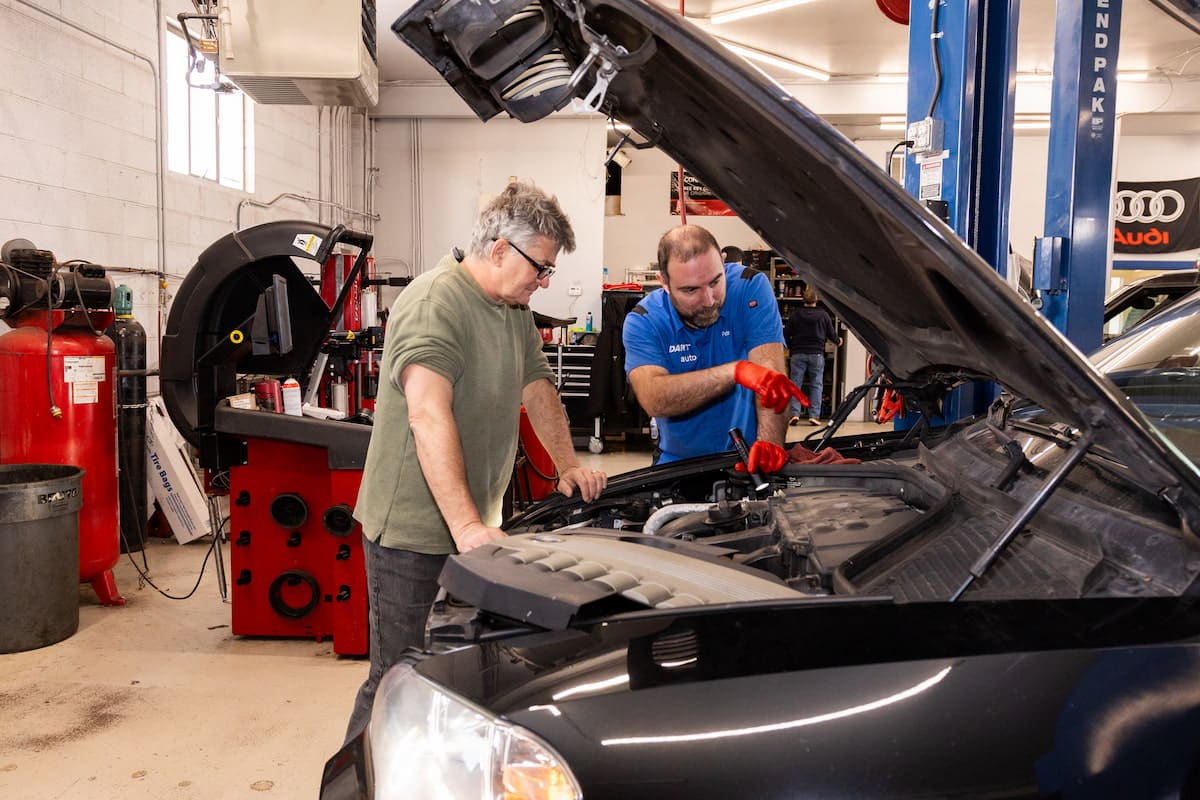
MINI Scheduled Service Maintenance at DART Auto
A customer once brought in their 2015 MINI Cooper S after ignoring the service interval light for months. What should have been routine maintenance turned into diagnosing why the engine was running rough and the turbo felt sluggish. The culprit? Overdue spark plugs and carbon-clogged valves on the B46 engine – issues that proper scheduled service would have caught early. That story plays out more often than it should, and it's why treating MINI scheduled maintenance as optional is a mistake.
MINI scheduled service maintenance isn't just oil and filters. These cars use precise service interval algorithms tied to driving style, fuel quality, and engine load. The first-generation R56 Cooper S with the N14 engine, for example, is notorious for timing chain stretch and carbon buildup on intake valves – both accelerated by missed service intervals. Later B-series engines improved reliability but still demand attention to valve cleaning schedules and software-driven service resets using factory-level ISTA diagnostic tools. Generic shops often skip the software reset or use incorrect oil specs, leaving your service indicator flashing and your warranty documentation incomplete.
At DART Auto, we follow MINI's exact service protocols while adding our own multi-point inspection. Our master technicians have dealer-level training and the diagnostic equipment to properly reset service intervals, check for software updates, and catch early signs of platform-specific issues before they escalate. Here's what you can expect:
- Complete fluid service using MINI-spec oils and coolants matched to your engine generation
- Inspection of timing chain tensioners, valve cover gaskets, and turbo oil feed lines on high-risk platforms
- Factory-correct service interval reset using ISTA or equivalent OEM diagnostic software
- Detailed report of upcoming maintenance needs based on your specific model year and mileage
Common Scheduled Service Maintenance Issues on MINI Vehicles
A customer recently brought in a 2015 MINI Cooper S Hardtop with 62,000 miles, complaining of sluggish acceleration and a rough idle. The owner had skipped the last two scheduled services, thinking the car "felt fine." During inspection, we found carbon buildup on the intake valves – a textbook consequence of deferred maintenance on the direct-injection N18 engine. The spark plugs were worn beyond spec, the air filter was clogged with debris, and the brake fluid had absorbed enough moisture to lower its boiling point dangerously. What started as routine upkeep turned into a multi-hour deep service because small tasks had compounded into bigger problems.
MINI vehicles follow strict factory service intervals tied to their high-performance engineering and tightly packaged designs. Missing these intervals doesn't just void warranty coverage – it accelerates wear on components that depend on fresh fluids, clean filters, and properly calibrated systems. Here are the most common scheduled service maintenance issues we see on MINI platforms:
- Carbon buildup on intake valves (2007–2016 N14, N18, and early B38/B46 engines): Direct-injection engines lack port fuel injection to wash valve surfaces. Skipping oil changes or using low-quality oil accelerates deposits, leading to misfires, rough idle, and power loss. The N14 is especially prone due to PCV system weaknesses.
- Timing chain stretch (2007–2010 R56 Cooper S with N14 engine): Factory oil-change intervals were too long for early N14 engines. Delayed oil changes accelerate chain wear, causing rattling at cold start and eventual timing failure. MINI issued multiple service campaigns to address this.
- Brake fluid moisture absorption (all models, 2-year factory interval): MINI specifies DOT 4 low-viscosity fluid that absorbs water quickly in Denver's temperature swings. Skipping the biennial flush leads to internal corrosion, reduced pedal feel, and brake fade under hard use.
- Spark plug fouling and coil failure (N14, N18, B38, B46 engines): Factory intervals call for plug replacement every 50,000–60,000 miles depending on model year. Worn plugs stress ignition coils, leading to misfires and expensive coil replacements on top of overdue plugs.
- Transmission fluid degradation (Aisin 6-speed automatic and 8-speed ZF in F-series): Despite "lifetime fill" claims, transmission fluid breaks down. By 60,000 miles, oxidized fluid causes harsh shifts and clutch slip. Early fluid service prevents expensive internal damage.
- Cabin and engine air filter neglect (all models): MINI's compact engine bays trap dirt and leaves. Clogged engine filters reduce power and fuel economy; dirty cabin filters overwork the HVAC blower motor, leading to premature failure.
Why Choose DART Auto for MINI Scheduled Service Maintenance
A customer recently brought in a 2015 MINI Cooper S (F56) for what she thought was a routine oil change. Our technician noticed the inspection II interval was overdue and flagged a common issue on that generation: the timing chain tensioner showing early signs of wear. Because we follow MINI's CBS (Condition Based Service) reset procedures and maintain a database of TSBs, we caught a problem that would have cost her thousands down the road. That's the difference between checkbox service and real preventive maintenance.
DART Auto has been the go-to European shop in Denver since 2000, and our team knows MINI platforms inside and out. We use the same factory diagnostic software dealers rely on – including the ability to read CBS counters, perform adaptation resets, and apply manufacturer software updates during service intervals. Our master technicians average over a decade of experience and receive ongoing dealer-level training on MINI-specific procedures, from the R50/R53 first-generation cars through the latest F-series models.
- Platform expertise: We're familiar with generation-specific quirks like N14 carbon buildup on 2007–2010 Cooper S models, electric power steering pump failures on second-gen cars, and the updated service schedules for turbocharged B-series engines.
- Complete service ownership: Our salaried technicians perform the full inspection, execute the service, road-test the car, and verify all systems before you pick up – no hand-offs, no shortcuts.
- Dealer capability, independent pricing: We back our work with a 3-year/36,000-mile warranty and invest in the specialty tools and training that let us match or exceed dealership standards without the markup.
Symptoms – How to Know You Need This Service
Your MINI will tell you when scheduled service is due, but sometimes the signs appear before the dashboard does. You may notice:
- Service interval light or message on the instrument cluster – the most obvious sign, often appearing 500 miles before the actual due date
- Rough idle or hesitation on acceleration – particularly on N14 and N18 engines where overdue spark plugs cause misfires
- Increased oil consumption – a sign that valve cover gaskets or PCV systems need attention during service
- Turbo lag or reduced boost pressure – carbon buildup on intake valves restricts airflow, especially on direct-injection B-series engines
- Rattling noise on cold start – timing chain tensioner wear on R56/R57 models, accelerated by oil that's lost its viscosity
- Engine running hotter than normal – degraded coolant loses its ability to regulate temperature, particularly critical on turbocharged models
- Sluggish transmission shifts – automatic transmission fluid breaks down and needs replacement at specific intervals
- Check engine light with misfire codes – often P0300-series codes pointing to ignition components overdue for replacement
If you see the check engine light combined with rough running or loss of power, schedule service immediately. If it's just the service interval reminder, plan to bring the car in within the next few weeks to stay on top of preventive maintenance.
Which MINI Models We See for Scheduled Service Maintenance
We service the full range of MINI vehicles, with particular expertise in the platforms that demand careful attention to service intervals. Our technicians know the specific failure modes and maintenance quirks across generations.
- R50/R52/R53 (2002–2008 Cooper, Cooper S, Convertible) – first-generation models with naturally aspirated W10 and supercharged W11 engines requiring specific coolant and transmission service intervals
- R55/R56/R57/R58/R59 (2007–2015 Clubman, Cooper, Convertible, Coupe, Roadster) – second-generation cars with N14, N16, and N18 engines; timing chain and carbon buildup monitoring critical during service
- R60/R61 (2011–2016 Countryman, Paceman) – larger platform with N14/N18 engines and optional ALL4 all-wheel-drive requiring transfer case and rear differential service
- F54/F55/F56/F57 (2014–present Clubman, Cooper, Convertible) – third-generation models with B36, B38, and B46 engines; improved reliability but still need valve cleaning schedules and software-managed service resets
- F60 (2017–present Countryman) – current SUV platform with B-series engines and available ALL4 system
- Manual and automatic variants – Getrag manual transmissions, Aisin automatics, and dual-clutch transmissions all have different fluid change intervals
- John Cooper Works models – higher-performance variants with more aggressive service schedules due to increased engine stress
We occasionally see older classic Minis and special editions, though our primary focus remains 2002-and-newer BMW-era MINI vehicles where factory diagnostic integration and platform-specific knowledge make the biggest difference.
Causes & Risks – What Happens if Ignored
Scheduled service maintenance issues arise from a combination of factors: Denver's altitude and temperature extremes, short-trip driving that never fully warms fluids, and MINI's performance-oriented engineering that demands precision. The brand's turbocharged engines, direct-injection fuel systems, and electronically controlled transmissions rely on clean oil, fresh filters, and properly maintained cooling systems. When intervals slip, wear accelerates in ways that aren't immediately obvious – until a warning light appears or performance drops noticeably.
Ignoring scheduled maintenance doesn't just void your warranty. It sets off a cascade of failures that turn inexpensive preventive work into major repairs:
- Skipping oil changes beyond 10,000 miles on N14/N18 engines: Sludge forms in the timing chain tensioner and variable valve timing (Valvetronic) system. Within 15,000–20,000 miles of overdue service, you'll hear timing chain rattle at cold start. By 25,000 miles overdue, the chain can jump time, bending valves and requiring engine teardown or replacement.
- Delaying spark plug replacement past 70,000 miles: Worn electrodes cause misfires that dump unburned fuel into the catalytic converter. The catalyst overheats and breaks down internally, leading to a $1,200–$2,500 converter replacement on top of the $400 plug-and-coil service you deferred.
- Running old brake fluid for 4+ years: Moisture lowers the boiling point from 500°F to under 350°F. During hard braking on mountain descents, the fluid boils, creating vapor pockets that make the pedal go soft or sink to the floor. ABS function degrades, and internal caliper corrosion requires full brake system overhaul.
- Ignoring transmission service past 80,000 miles: Degraded fluid loses its friction properties. Clutch packs slip, generating metal particles that clog valve bodies. What starts as occasional harsh shifts becomes limp mode, then total transmission failure requiring $4,000–$6,000 rebuild or replacement.
- Neglecting cooling system service (thermostat, coolant flush): MINI's electric water pumps and plastic expansion tanks fail when coolant becomes acidic. A $180 coolant flush avoided at 100,000 miles turns into a $1,200 repair when the pump seizes and the engine overheats, warping the cylinder head.
Safety Impact – Why Scheduled Service Maintenance Matters
Deferred scheduled maintenance on a MINI doesn't just affect reliability – it directly compromises the safety systems you depend on every day. Brake fluid that's absorbed moisture can boil during emergency stops, leaving you with a spongy pedal and dramatically reduced stopping power. Worn spark plugs cause misfires that trigger the check engine light, disabling traction control and stability systems when you need them most on wet or icy Denver roads. A timing chain that jumps because of neglected oil changes can cause sudden engine failure in traffic, leaving you stranded in a dangerous situation.
Here's when maintenance neglect crosses into the safety zone:
- Stop driving now: Brake pedal feels soft or sinks to the floor; engine rattles loudly at startup (timing chain); coolant warning light with steam from under the hood; transmission stuck in gear or won't shift out of park.
- Schedule service this week: Check engine light flashing (active misfire damaging catalyst); brake pedal travel has increased noticeably; transmission shifts harshly or hesitates; unusual smells from brakes after normal driving.
- Schedule within the month: Solid check engine light; minor oil leaks visible under the car; HVAC blower making noise; slight vibration or roughness at idle.
Beyond immediate safety, there's a liability angle: if a known maintenance issue contributes to an accident and you've ignored service reminders or warning lights, insurance adjusters and legal teams will scrutinize your maintenance records. Keeping up with factory intervals protects not just your safety, but your legal and financial position if the worst happens.
How MINI Scheduled Service Maintenance Actually Works
MINI's scheduled maintenance program is built around Condition Based Servicing (CBS), an onboard system that monitors driving conditions, fluid age, and component wear to calculate service intervals dynamically. Unlike older fixed-interval systems, CBS tracks engine starts, operating temperature, fuel consumption, and mileage to determine when oil, filters, brake fluid, and other items actually need attention. The system displays remaining service life as a percentage on the instrument cluster and sends alerts when thresholds are reached.
What makes MINI maintenance different from generic service is the integration of electronic systems that require specific procedures and factory tooling. Oil changes aren't just drain-and-fill – they require resetting the CBS computer using MINI-specific diagnostic software (ISTA or equivalent). Brake service involves electronically retracting electric parking brake actuators. Transmission services on the ZF 8-speed demand precise fill procedures with the fluid at exact temperature, measured via scan tool. Spark plug replacement on turbocharged engines requires torque specs and anti-seize application to prevent thread damage in the aluminum head.
Key technical points that affect how we perform MINI scheduled maintenance:
- CBS reset requires OEM or equivalent scan tool: Simply changing oil without resetting the system leaves incorrect service reminders and can trigger limp mode on some models.
- Brake fluid specification is critical: MINI requires DOT 4 low-viscosity fluid (LV). Using standard DOT 4 or DOT 3
How We Diagnose Scheduled Service Maintenance Issues on MINI
A customer rolled into our shop last month with a 2015 MINI Cooper S Hardtop, complaining of a rough idle and a check-engine light that had been on for weeks. She'd been putting off her scheduled service, assuming it was "just a sensor." Our diagnostic process revealed carbon buildup on the intake valves – a well-known issue on the N18 turbocharged engine – along with overdue spark plugs and a clogged cabin filter that was restricting airflow. What seemed like a minor annoyance turned into a clear roadmap for getting her MINI back to peak performance.
Here's how we approach scheduled service diagnostics on every MINI that comes through our doors:
- Complete scan with factory-level tooling. We use BMW/MINI-specific diagnostic software that reads every module in the car – engine, transmission, ABS, airbag, body control, and more. This reveals stored fault codes, freeze-frame data, and adaptation values that generic scanners miss. On models with Condition Based Service (CBS), we pull the exact service intervals and reset flags so you know what's actually due.
- Visual inspection of wear items and fluids. Our technicians check brake pad thickness, tire tread depth, fluid levels and condition (engine oil, coolant, brake fluid, power steering if equipped), belt condition, and any visible leaks or damage. On first-generation Cooper S models (R53 supercharged), we pay special attention to the supercharger oil level – a common oversight that leads to expensive failures.
- Road test to confirm drivability concerns. We don't just rely on codes. A test drive lets us feel transmission shift quality, listen for suspension noise, check brake response, and verify that any customer-reported symptoms are present. This is especially important on dual-clutch Getrag transmissions (found in 2007-2013 models), where shift quality can degrade long before a fault code appears.
- Measure and record key parameters. We document battery voltage and health, coolant system pressure, compression or leak-down on high-mileage engines, and alignment specs if tire wear is uneven. These baseline measurements help us track trends over time and catch problems before they become failures.
- Cross-reference service history and MINI technical bulletins. We review what's been done previously and check for any factory service campaigns or known issues for your specific model year and engine code. For example, the N14 engine (2007-2010 Cooper S) had a timing chain tensioner update that we verify has been completed.
Once the diagnostic process is complete, we compile a prioritized list of what's due now, what's approaching, and what can wait. You'll receive a clear quote with explanations for each item, so you can make informed decisions about your MINI's care.
Scheduled Service Maintenance on MINI: Repair vs. Replacement
Scheduled maintenance on a MINI often sits in a gray area between simple service and component replacement. Understanding when to repair, when to replace a single part, and when to swap an entire assembly saves you money and keeps your car reliable for the long haul.
When Repair or Adjustment Is the Right Call
- Brake service without rotor replacement. If your rotors are still within minimum thickness spec and the surface is smooth, we can resurface them (if thickness allows) and install new pads. This is common on lower-mileage cars or those with gentle driving habits.
- Cleaning carbon buildup on direct-injection engines. The N18 and B38/B46/B48 engines are prone to intake valve carbon deposits. Walnut-blasting the intake ports restores airflow and idle quality without replacing valves or the cylinder head.
- Transmission fluid and filter service. Many MINI owners are told the Getrag dual-clutch or Aisin automatic is "lifetime fill," but a fluid and filter change at 40,000–60,000 miles dramatically extends transmission life. This is a service, not a replacement, and one of the best investments you can make.
- Throttle body cleaning and adaptation reset. A dirty throttle body on the N14 or N18 engine can cause rough idle and hesitation. Cleaning the bore and resetting adaptations with factory software often solves the problem without replacing the throttle assembly.
When Partial Replacement Makes Sense
- Replacing individual ignition coils. If one coil fails (common on the N14 and N18 engines), we replace the failed unit and inspect the others. If your car is high-mileage or the coils are original, we may recommend replacing all four to avoid repeat failures, but it's not always necessary.
- Single control arm or bushing replacement. If one front lower control arm bushing is torn but the rest of the suspension is tight, we can replace just that arm. However, if multiple bushings are deteriorating (common after 80,000 miles), replacing both sides at once saves labor on the second visit.
- Water pump on the N14/N18/B-series engines. These engines use electric water pumps that fail predictably. We replace the pump and thermostat together (they're in the same housing), but the rest of the cooling system can stay if hoses and the radiator are in good shape.
When Full Replacement Is the Best Path
- Timing chain and guides on high-mileage N14 engines. If the chain has stretched and the guides are cracked, replacing just the chain leaves you vulnerable to guide failure. We replace the chain, guides, tensioner, and sprockets as a complete kit to ensure reliability.
- Brake rotors and pads together. If rotors are below minimum thickness, warped, or heavily scored, we replace them with the pads. Trying to save a worn rotor compromises braking performance and shortens the life of new pads.
- Turbocharger on the N18 or B-series engines. Turbo failures are rare if oil changes are kept up, but if the turbo is leaking oil or the wastegate is sticking, replacement is the only reliable fix. Rebuilds are available, but a new or remanufactured unit with a warranty is the safer choice.
We walk you through the trade-offs for every decision. Our technicians are salaried, not flat-rate, so there's no incentive to upsell you into unnecessary replacements. We'll tell you what's genuinely needed now, what can wait, and what the consequences are of delaying – then you decide.
How to Make Your MINI Scheduled Service Maintenance Last Longer
Scheduled maintenance intervals are designed around average driving conditions, but how you drive and care for your MINI between visits has a huge impact on how long components last and how well the car performs.
Driving Habits That Extend Component Life
- Warm up the engine before hard acceleration. Turbocharged MINIs (Cooper S, JCW) build boost quickly, but oil takes time to reach full operating temperature. Give the engine two to three minutes of gentle driving before pushing into boost, especially in cold weather. This reduces wear on the turbo bearings and piston rings.
- Avoid short trips whenever possible. Frequent cold starts without reaching full operating temperature accelerate oil contamination, increase carbon buildup on direct-injection engines, and prevent the battery from fully recharging. Combine errands or take a longer route occasionally to let everything heat-soak.
- Use engine braking and anticipate stops. Coasting to a stop in gear (rather than braking hard at the last second) reduces brake wear and keeps the dual-clutch transmission engaged and lubricated. It also improves fuel economy and reduces stress on the brake fluid.
- Keep the fuel tank above a quarter full. The fuel pump on MINIs is cooled and lubricated by the fuel in the tank. Running low regularly shortens pump life and can stir up sediment that clogs the filter.
Owner Maintenance Between Service Visits
- Check tire pressure monthly. MINI recommends specific pressures (usually 32–35 psi front and rear, but check your door jamb sticker). Underinflated tires increase rolling resistance, reduce fuel economy, and cause uneven wear. Overinflation makes the ride harsh and wears the center of the tread.
- Monitor fluid levels and look for leaks
What to Expect When You Bring Your MINI In
We know your time matters, so here's exactly how the process works from the moment you schedule your appointment:
- Drop-off and intake: Bring your MINI in at your scheduled time. We'll ask about any concerns you've noticed and confirm the service interval you're due for – whether it's an oil change, Inspection I, or Inspection II. If you need a loaner or shuttle service, let us know when you book; we'll make arrangements so you're not stuck waiting.
- Multi-point inspection: Before we perform the scheduled service, our technician conducts a complete inspection using factory scan tools. We check fluid conditions, brake wear, suspension components, and pull any stored fault codes. On turbocharged models, we pay special attention to intake carbon buildup and PCV system health.
- Written estimate and approval: You'll receive a detailed estimate that separates the scheduled service items from any additional findings. We explain what each repair addresses and the consequences of delaying it, so you can make an informed decision. No pressure, no upselling – just the facts.
- Service execution: We use OEM or premium aftermarket parts from trusted suppliers, follow MINI torque specs and fluid requirements, and reset the CBS system properly so your dashboard reflects accurate service intervals.
- Post-service verification: Every car gets a road test and a final scan-tool check to confirm all systems are operating correctly. At pickup, we walk you through what we did and answer any questions. If something doesn't feel right in the days after service, call us – we'll get you back in and make it right.
Leave your personal items in the car if you'd like; we'll keep everything secure. After-hours pickup can be arranged if your schedule demands it – just ask when you drop off.
Our MINI Services
- Air Conditioning AC Repair
- Battery Repair Replacement
- Brake Repair & Brake Fluid Change
- Check Engine Light Diagnostics
- Clutch Repair & Replacement
- Coolant Leak Repair
- Cooling System Repair
- Drive Shaft Repair
- Engine Repair
- Exhaust & Catalytic Converter Repair
- Head Gasket Repair & Replacement
- Oil Change
- Oil Leak Repair
- Steering Repair
- Suspension Repair
- Cambelt Timing Belt Replacement
- Transmission Repair
- Tune Up
- Wheel Alignment