
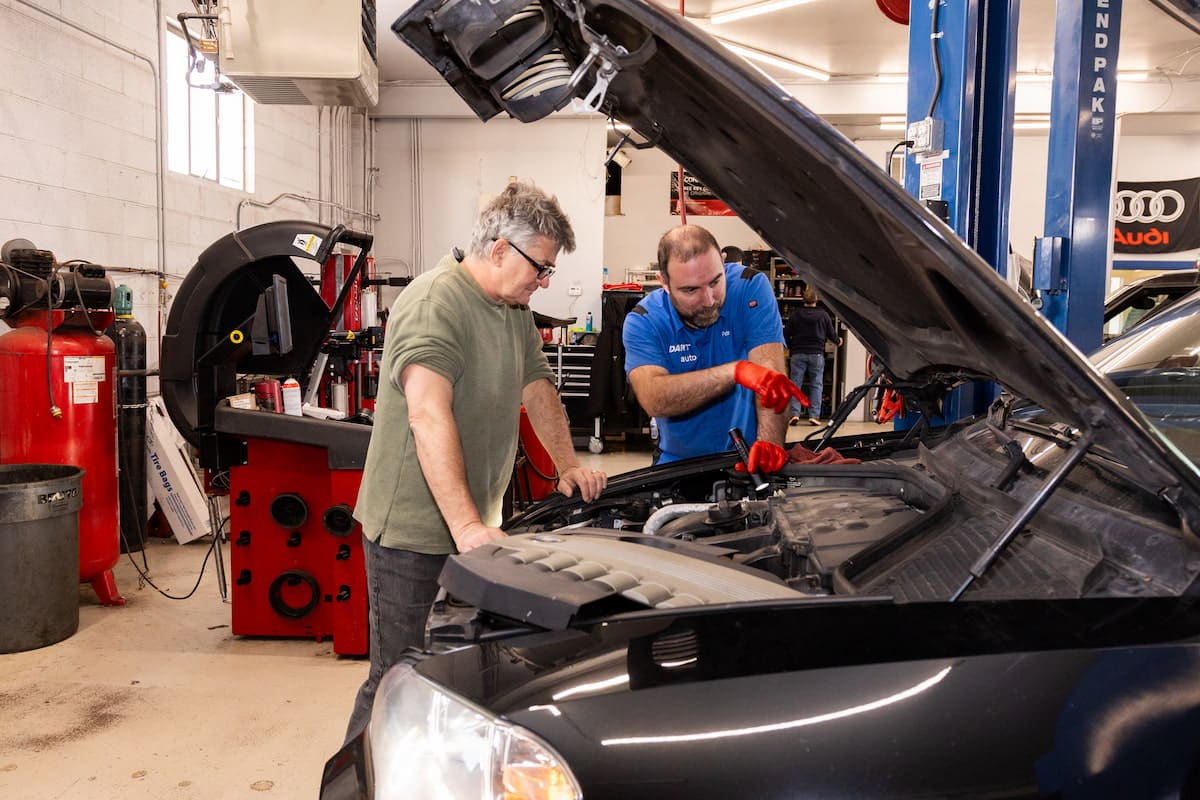
Bentley Scheduled Service Maintenance at DART Auto
Bentley owners know their vehicles demand more than the average oil change and tire rotation. Every Continental GT, Flying Spur, and Bentayga relies on precision-tuned systems that require factory-level attention at specific intervals. Most independent shops lack the diagnostic hardware to read Bentley's proprietary fault codes or the training to interpret what those codes actually mean. DART Auto bridges that gap with factory-spec tooling and technicians who've spent years inside these platforms.
Scheduled service on a Bentley isn't just about changing fluids. The W12 and V8 engines share architecture with Audi and Volkswagen AG platforms, but Bentley calibrates everything differently – oil viscosity, coolant specs, transmission adaptation values, and brake fluid moisture thresholds. Miss a software update during service and you'll trigger phantom faults. Skip the correct filter spec and you risk starving the twin-turbo system of clean oil under boost. Our master techs follow VAS 6154 diagnostic protocols and OEM service schedules down to the torque spec, so your Bentley gets the same attention it would at the dealer without the markup.
When you bring your Bentley to DART Auto for scheduled service maintenance, you can expect:
- Complete multi-point inspection using factory diagnostic software to capture fault codes and adaptation values
- OEM-spec fluids and filters sourced directly from trusted suppliers, not generic substitutes
- Software updates and module coding where service intervals require ECU recalibration
- Transparent documentation of what was done, what's due next, and what to watch as mileage climbs
Common Scheduled Service Maintenance Issues on Bentley Vehicles
Bentley service intervals are engineered around both mileage and time, because these hand-assembled machines use materials and fluids that degrade even when parked. Miss a service window and you're not just skipping an oil change – you're risking expensive failures that generic shops won't catch until metal has already met metal. Here's what Denver Bentley owners typically face:
- W12 engine oil sludge and cam follower wear (2004–2012 Continental GT/Flying Spur): The 6.0L twin-turbo W12 demands Bentley-spec 0W-40 and 10,000-mile intervals maximum. Stretching changes to 12,000+ miles causes cam follower wear on the bucket-over-shim valvetrain, and sludge accumulates in the valley between cylinder banks. Once follower surfaces pit, you're looking at camshaft replacement – not a fluid flush.
- ZF 6HP26 and 8HP transmission fluid degradation (2006–present across most models): Bentley calls these "lifetime fill" units, but that lifetime ends around 60,000 miles in real-world use. Delayed fluid service leads to valve body sticking, harsh shifts, and eventually mechatronic failure. The ZF-spec fluid and pan-drop procedure are non-negotiable – a simple drain-and-fill misses half the old fluid and doesn't reset adaptation values.
- Brake fluid moisture absorption (all models, 24-month service interval): DOT 4 fluid is hygroscopic. In two years, moisture content climbs high enough to lower boiling points and corrode ABS/ESP hydraulic units internally. On a 5,000-pound Bentley with ceramic or iron rotors, compromised fluid means fade under hard braking and expensive ABS pump replacement if corrosion sets in.
- Air suspension compressor and dryer service (Continuous Damping Control models, 2004–present): The CDC system's compressor has a desiccant dryer cartridge that saturates over time. Skipping the 60,000-mile dryer replacement allows moisture into the air lines, corroding height sensors and valve blocks. Compressor rebuilds run into four figures; proactive dryer swaps cost a fraction.
- Coolant system corrosion and thermostat housing leaks (V8 and W12 platforms): Bentley specifies G12++ or G13 coolant with a five-year/150,000-mile interval, but aluminum housings and plastic thermostat bodies degrade faster in dry Colorado air. Old coolant loses its anti-corrosion additives, leading to weeping thermostat housings and corroded water pump impellers – especially on 4.0L V8 twin-turbo engines (2013–present).
- Cabin and engine air filter neglect (all models, 20,000–30,000 mile intervals): Bentley cabins are sealed tight. A clogged cabin filter starves HVAC blowers, burning out resistors and control modules. Engine filters, when neglected past 30,000 miles, allow fine dust into MAF sensors and turbo inlets, causing lean codes and compressor blade erosion on turbocharged engines.
Why Choose DART Auto for Bentley Scheduled Service Maintenance
Bentley scheduled maintenance isn't just oil changes and tire rotations – it's a choreographed series of platform-specific inspections, fluid flushes, and software updates that generic shops simply skip. DART Auto owns factory diagnostic tooling and subscriptions to Bentley TSB databases, so when your Continental GT (2011–2018 W12 platforms especially) needs its dual-clutch transmission adaptation reset or your Flying Spur requires ZF 8HP transmission fluid at the precise 60,000-mile interval, we follow OEM procedures to the letter. Our master technicians average over a decade of European marque experience and receive ongoing dealer-level training, which means they recognize early signs of air-suspension valve-block leaks on the VW Group D1 platform or catch failing engine mounts on the 4.0L twin-turbo V8 before they cascade into expensive driveline damage.
Because our technicians are salaried – not flat-rate – they have zero incentive to rush your service or upsell unnecessary work. We perform complete multi-point inspections at every interval, document findings with photos, and explain what needs attention now versus what can wait. You'll receive a written estimate before any wrench turns, and we back every repair with a 3-year/36,000-mile warranty on parts and labor. Over 24 years in business and hundreds of five-star reviews prove that doing it right the first time costs less than doing it twice at the dealer.
Symptoms – How to Know You Need This Service
Bentley's onboard systems will alert you when scheduled service is due, but waiting for a dashboard message can mean you're already past the ideal interval. Watch for these signs that your car needs attention:
- Service reminder light or message center alert – Bentley's MMI will display a spanner icon or text message when the next service interval approaches, typically based on mileage and time since last reset
- Oil level warnings or low oil pressure messages – W12 and V8 engines consume oil by design under spirited driving; if the system flags low oil between services, schedule immediately
- Reduced power or limp mode activation – often triggered by overdue transmission fluid or clogged air filters starving the turbos
- Rough idle or hesitation on cold start – can indicate spark plug wear or carbon buildup on direct-injection engines, both addressed during major service intervals
- Brake pedal feel changes or ABS fault lights – Bentley brake fluid absorbs moisture quickly; overdue fluid changes compromise ABS module function and pedal response
- Transmission shift quality degradation – delayed engagement or harsh shifts often mean the ZF eight-speed needs fresh fluid and adaptation resets
- Coolant or oil leaks visible under the car – aging hoses and gaskets fail predictably at certain mileage thresholds; catching them during scheduled service prevents roadside breakdowns
If you see oil pressure warnings or significant fluid leaks, stop driving and arrange transport. Other symptoms mean schedule service within the next few hundred miles.
Which Bentley Models We See for Scheduled Service Maintenance
DART Auto services the full range of modern Bentley platforms, from the early Continental GT through current Bentayga SUVs. Our technicians have deep experience with the VW Group architecture that underpins these vehicles, plus the Bentley-specific calibrations and luxury systems that set them apart.
- Continental GT and GTC (2003–present) – both generations, including W12 and V8 variants; first-gen cars (through 2011) share the D1 platform with VW Phaeton and require careful attention to air suspension service intervals
- Flying Spur (2005–present) – sedan variant of the Continental platform, same powertrain and service requirements
- Bentayga (2016–present) – shares MLB Evo platform with Audi Q7/Q8 and Porsche Cayenne but uses unique W12, V8, and hybrid powertrains; diesel variants (sold outside North America) require SCR system service
- Mulsanne (2010–2020) – bespoke 6.75L V8 platform with unique service procedures; we handle scheduled maintenance but recommend specialist consultation for major powertrain work
- Azure, Arnage, Brooklands (pre-2010 models) – we service these older platforms on a case-by-case basis; parts availability and diagnostic coverage vary by year
All-wheel-drive Bentleys require transfer case and rear differential service at specific intervals. Hybrid Bentayga models add high-voltage battery cooling system checks. If you own a rare coachbuilt or limited-edition variant, call ahead so we can confirm parts availability and service documentation.
```htmlCauses & Risks – What Happens if Ignored
Scheduled maintenance intervals exist because Bentley engineers know exactly when fluids, filters, and wear components hit their functional limits. The root causes are physics and chemistry: oil oxidizes, rubber hardens, metal fatigues, and moisture infiltrates. Colorado's temperature swings and low humidity accelerate seal degradation and fluid breakdown. Short trips never bring engines to full operating temperature, leaving condensation in crankcase vapors and preventing complete combustion – both of which contaminate oil faster than highway miles.
When you delay or skip a scheduled service, the damage compounds in predictable stages. What starts as a $400 fluid exchange becomes a $6,000 transmission replacement; what begins as a $150 brake fluid flush escalates into a $3,500 ABS module and master cylinder job. Here's the progression:
- Months 0–6 past due: Fluids lose additive packages. Oil no longer suspends contaminants; transmission fluid can't maintain clutch friction; coolant stops inhibiting corrosion. Performance feels normal, but internal wear accelerates invisibly.
- Months 6–12 past due: Symptoms emerge – sluggish shifts, slight oil consumption, reduced boost pressure, occasional warning lights. Components operate outside design tolerances. Seals harden and begin weeping. Turbo bearings start scoring if oil viscosity has dropped.
- 12–24 months past due: Hard failures occur. Transmissions slip or bang into gear. Turbos smoke on startup. Cooling systems overheat because corroded water pumps can't move fluid. ABS activates randomly because moisture-laden brake fluid has corroded wheel speed sensors. At this stage, you're replacing assemblies, not servicing them.
- Beyond 24 months: Catastrophic damage – spun bearings, blown head gaskets, seized compressors, failed valve bodies. The repair bill often exceeds the depreciated value of older Bentleys, turning a maintainable luxury car into a parts donor.
The safety risk is real: brake fade from old fluid, loss of power steering assist from contaminated hydraulic fluid, engine fires from oil leaks onto hot exhaust components. Insurance won't cover an accident caused by deferred maintenance you knew about.
Safety Impact – Why Scheduled Service Maintenance Matters
Bentley builds cars that weigh 5,000–6,000 pounds and reach 60 mph in under four seconds. When maintenance lapses, the systems that manage that mass and speed begin failing in ways that put everyone on the road at risk. Brake fluid past its service life boils under hard stops, turning your pedal to mush and extending stopping distances by 30 percent or more. Worn suspension bushings and expired damper fluid allow body roll that overwhelms stability control, especially in emergency lane changes. Old transmission fluid causes delayed downshifts exactly when you need power to merge or overtake safely.
Specific safety systems compromised by skipped services:
- ABS and ESP: Corroded hydraulic units from old brake fluid cause intermittent activation or complete failure. You lose threshold braking and stability intervention – the two things that prevent skids on wet pavement.
- Power steering: Low or contaminated fluid leads to pump failure and sudden loss of assist, especially at low speeds in parking situations where you need maximum hydraulic pressure.
- Cooling system: Overheating engines lose power unpredictably. A failed thermostat stuck closed can cause a head gasket blow mid-drive, filling the cabin with steam and leaving you stranded in traffic.
- Turbocharger integrity: Oil-starved turbos can seize, sending metal fragments through the intake and causing sudden power loss or engine fires if oil sprays onto exhaust manifolds.
Stop driving immediately if: brake pedal feels spongy or sinks to the floor; steering becomes heavy or unresponsive; temperature gauge climbs into the red; you see smoke from under the hood; transmission won't engage any gear. Schedule service within the week if: you're past any scheduled interval by more than 3,000 miles or six months; warning lights appear intermittently; you notice new leaks or smells.
How Bentley Scheduled Service Maintenance Actually Works
Bentley scheduled maintenance isn't a generic checklist – it's a series of platform-specific procedures that require factory tooling and software access. The W12 engine, for example, uses a dry-sump oiling system with a separate scavenge pump and remote reservoir; draining it properly means running the engine through a purge cycle with the diagnostic tool to clear all galleries. The ZF 8HP transmission requires a closed-loop fluid temperature check during fill, monitored via the OBD-II port, to ensure the mechatronic clutch packs receive exactly the right volume. Overfill by 200ml and you'll get harsh shifts; underfill and you'll burn clutches within 10,000 miles.
Bentley-specific design choices that affect service procedures:
- Electronic parking brake calibration: After any brake service, the EPB module must be recalibrated using the factory diagnostic tool. Skip this step and the system either won't release fully or won't hold on hills – both dangerous.
How We Diagnose Scheduled Service Maintenance Issues on Bentley
Bentley scheduled service isn't a guessing game, and it's far more involved than a quick oil change and tire rotation. At DART Auto, we start every service with a methodical, platform-specific diagnostic process that mirrors – and often exceeds – what the dealer does, minus the three-week wait and the markup.
- Pre-service scan with factory-level tooling. We connect Bentley-specific diagnostic equipment that reads every control module – engine, transmission, air suspension, active roll control, infotainment, and driver-assist systems. This catches stored fault codes, pending codes, and adaptation values that reveal developing issues before they strand you. On Continental GT and Flying Spur models (especially 2004–2012 W12 platforms), this scan often flags early turbocharger wastegate faults, air suspension compressor wear, or transmission mechatronic issues that wouldn't trigger a dashboard warning yet.
- Visual and physical inspection. Our technicians perform a comprehensive under-hood and undercarriage inspection: checking for oil seepage around valve covers and cam carriers (a known weak point on the 6.0L W12), inspecting brake pad thickness and rotor condition, examining suspension bushings and air strut integrity, and verifying coolant hoses for brittleness. We measure brake fluid moisture content and test battery health – both critical on vehicles with extensive electronics.
- Fluid analysis and service-interval verification. We pull the service history from the vehicle's onboard memory and cross-reference it against Bentley's published intervals. We inspect transmission fluid color and smell (the ZF 6HP26 and 8HP units are sensitive to degraded fluid), check differential and transfer-case oil, and verify that the correct VW/Audi Group spec fluids were used in prior services.
- Road test and dynamic checks. Before and after service, we road-test the vehicle to assess throttle response, transmission shift quality, brake feel, and suspension behavior. On air-suspended models, we cycle through ride-height modes to confirm compressor performance and strut seal integrity.
Once diagnostics are complete, we compile a prioritized report: what must be done now per the service schedule, what we found that needs attention soon, and what can wait. You get a transparent quote with part numbers, labor estimates, and a clear explanation of why each item matters – so you can make an informed decision without the dealer pressure.
Scheduled Service Maintenance on Bentley: Repair vs. Replacement
Scheduled service on a Bentley often sits at the intersection of maintenance and repair, and knowing when to repair versus replace comes down to the component, its condition, and the cost-benefit trade-off. Here's how we approach that decision:
When Repair Makes Sense
- Brake system service: If rotors are within minimum thickness spec and show no cracking or excessive runout, we resurface them and install new pads. On Bentley models with carbon-ceramic brakes (optional on Continental GT Speed and Supersports), pad replacement is straightforward; rotor replacement is a $15,000+ proposition, so we preserve rotors whenever safely possible.
- Fluid exchanges and filter service: Transmission service on the ZF 8-speed involves a fluid and filter change, not a full mechatronic replacement – unless scan data shows internal clutch slip or pressure faults.
- Air suspension compressor rebuild: Early Continental GT air compressors can often be rebuilt with new seals and bushings rather than replaced outright, saving significant cost if the piston and cylinder aren't scored.
When Replacement Is the Right Call
- Turbocharger wastegate actuators: On 2004–2012 W12 engines, wastegate rattle and boost control faults are common. Repair attempts rarely last; replacement with updated actuators is the durable fix.
- Engine mounts: Bentley's hydraulic engine mounts degrade and leak. Once they're collapsed, replacement is the only option – and it's worth doing all of them at once to avoid repeat labor.
- Timing components: When the timing chain or tensioners show wear on the 4.0L V8 (used in 2013+ Continental GT V8 and Flying Spur V8), partial replacement isn't an option. The entire timing set, guides, and tensioners get replaced as an assembly to prevent catastrophic failure.
We walk you through the trade-offs honestly. If a repair buys you another 20,000 miles at one-third the cost of replacement, we'll recommend it. If replacement is the only safe, long-term solution, we explain why – and we never upsell a replacement when a repair will do the job.
How to Make Your Bentley Scheduled Service Maintenance Last Longer
Bentley engineering is exceptional, but longevity depends on how you drive and maintain the car. Here's what actually extends the life of service-critical components:
Driving Habits That Matter
- Warm up properly: The W12 and V8 engines run tight tolerances and rely on full oil pressure before heavy throttle. Let the engine reach operating temperature (at least 180°F coolant temp) before aggressive acceleration or high RPM. Cold-start full-throttle runs accelerate turbo bearing wear and valve carbon buildup.
- Brake progressively: Bentley brakes are phenomenal, but hard stops from speed generate extreme heat. Smooth, progressive braking reduces pad glazing, rotor warping, and brake fluid boil – especially if you have the standard cast-iron rotors.
- Avoid short trips: Frequent short trips prevent the engine from reaching full temp, leading to moisture accumulation in the oil, incomplete combustion, and carbon deposits on intake valves (a particular issue on direct-injection engines). If you must make short trips, plan a longer highway drive weekly to burn off deposits and evaporate moisture.
Owner-Level Maintenance You Can Do
- Check fluid levels monthly: Pop the hood and verify engine oil, coolant, brake fluid, and power steering fluid (on older models). Low coolant can indicate a small leak; low brake fluid often means worn pads.
- Listen for changes: New noises – turbo whistle, suspension clunks, brake squeals – are early warnings. Addressing them early prevents expensive secondary damage.
- Wash the undercarriage in winter: Road salt accelerates corrosion on brake lines, suspension components, and exhaust hangers. A periodic undercarriage rinse in winter extends the life of these parts.
What to Leave to the Professionals
Bentley service intervals are specific and non-negotiable. Oil changes every 10,000 miles (or annually) with VW 502.00 / 505.00 spec oil, transmission service every 40,000 miles, brake fluid flush every two years, coolant replacement every four years, and spark plugs every 60,000 miles (W12) or 40,000 miles (V8 turbo). Skipping or stretching these intervals to save money backfires – carbon buildup, transmission slip, and cooling system failures cost exponentially more to fix than the service would have cost. Software updates from the dealer or a specialist shop like DART Auto also matter: Bentley releases drivetrain and suspension calibration updates that improve shift quality, throttle response, and ride comfort. Keeping your car's software current is as important as changing the oil.
What to Expect When You Bring Your Bentley In
Scheduled service at DART Auto follows a structured process designed to keep you informed and your Bentley running exactly as Crewe intended:
- Drop-off and intake: Schedule your appointment online or by phone. When you arrive, a service advisor walks your car with you, notes any concerns, and confirms the factory-recommended service interval (10K, 20K, or annual – whichever comes first). Remove personal items; we offer loaner vehicles and local shuttle service so you're never stranded.
- Complete inspection: Our technician performs the full Bentley service checklist – engine and transmission fluids, brake system health, air-suspension calibration, battery health (critical on cars with stop/start systems), and a scan-tool sweep for stored fault codes or pending software updates. We photograph anything that needs attention.
- Written estimate and approval: You receive a detailed estimate with photos before we proceed. We explain what's required now, what's preventive, and what can be deferred – no pressure, just facts.
- Service execution: We use OEM or premium aftermarket fluids (Pentosin, Liqui Moly, Castrol Edge as specified), genuine filters, and torque specs pulled straight from Bentley ELSA repair data. Software updates and adaptations are performed with factory-grade diagnostic platforms.
- Post-service verification: Every car gets a road test and a final scan to confirm no new codes. At pickup, your advisor walks you through what was done, shows you old parts if requested, and answers any questions. If something feels off in the days after, call us – we'll get you back in and make it right.
Our Bentley Services
- Air Conditioning AC Repair
- Battery Repair Replacement
- Brake Repair & Brake Fluid Change
- Check Engine Light Diagnostics
- Clutch Repair & Replacement
- Coolant Leak Repair
- Cooling System Repair
- Drive Shaft Repair
- Engine Repair
- Exhaust & Catalytic Converter Repair
- Head Gasket Repair & Replacement
- Oil Change
- Oil Leak Repair
- Steering Repair
- Suspension Repair
- Cambelt Timing Belt Replacement
- Transmission Repair
- Tune Up
- Wheel Alignment